In This Article
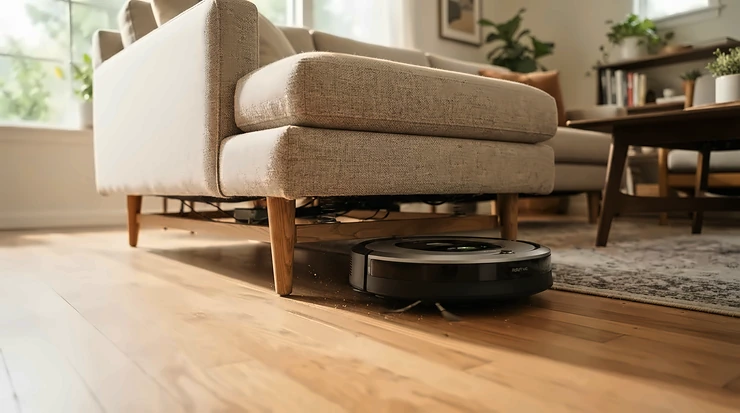
There’s a particular kind of dread that comes with unclipping a robot vacuum’s mop pad on a Tuesday evening and discovering it smells like a swimming pool changing room. A self-washing mop robot vacuum exists specifically to spare you that moment. Instead of you rinsing a grey, greasy pad in the sink, the machine trundles back to its dock, gets scrubbed with hot water, and comes out ready to go again — no gloves, no grimacing.
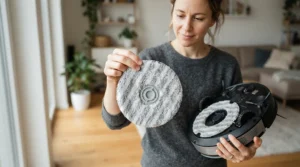
That said, “self-washing” is doing a lot of heavy lifting as a marketing term, and not every dock washes with the same rigour. Some use lukewarm water and a quick rinse; others hit 70°C, add detergent, and finish with a proper hot-air dry. The difference matters more than most listings let on, because a mop pad that’s rinsed but not dried is arguably worse than one you wash by hand — at least you’d hang that one out to dry properly.
This guide walks through seven genuine models on sale in the UK right now, spanning honest budget picks through to eye-wateringly capable flagships, with real specs, real aggregated review sentiment, and the sort of practical detail that Amazon listings tend to skip entirely: how often you actually need to run the wash cycle, what detergents are safe to pour in, and why your floors might still smell faintly of “wet dog” even with a top-tier machine.
Quick Comparison Table
| Model | Suction | Mop Wash Temp | Best For |
|---|---|---|---|
| Roborock Qrevo Series (QV 35A) | 8,000 Pa | Not heated (cold rinse) | Tightest budgets |
| Eufy X10 Pro Omni | 8,000 Pa | Hot air dry only | Mixed hard floor/carpet homes |
| Ecovacs DEEBOT N30 PRO OMNI | 10,000 Pa | 60°C | Compact UK kitchens |
| eufy C28 Omni | 15,000 Pa | Hot water (roller) | Pet hair + lesser-known value |
| roborock Qrevo Curv | 18,500 Pa | 75°C | Uneven, multi-surface floors |
| Roborock Saros 10 | High-suction flagship | Heated wash + dry | Best navigation, low-clearance homes |
| eufy Omni S2 | 30,000 Pa | 70°C + detergent | Ultimate hygiene, families with pets |
Looking across the table, suction and wash temperature don’t always move together, and that’s the trap most buyers fall into. The Roborock Qrevo Series and Eufy X10 Pro Omni match each other on raw suction but differ sharply on how thoroughly they actually clean the mop itself, which matters more for odour control than the Pa figure ever will. If hygiene is your priority rather than headline suction, the eufy Omni S2 and roborock Qrevo Curv justify their higher price tags through wash temperature and detergent dosing rather than through vacuuming power alone.
💬 Already spotted one that suits your home? A quick click through to check today’s price could save you a wasted trip later.
Top 7 Self-Washing Mop Robot Vacuums: Expert Analysis
1. Roborock Qrevo Series (QV 35A) — cheapest genuine auto mop pad auto-wash system
The QV 35A is the entry point into this category rather than its showcase, and it earns that spot by including auto mop washing, an all-in-one dock, and 200RPM spinning mops at a price that undercuts almost everything else here. At 8,000 Pa suction, it handles crumbs and short pile carpet competently, though it won’t compete with 18,000+ Pa flagships on deep-pile rugs or dense pet hair. The anti-tangle brushes are a sensible inclusion at this price, since hair-wrap is the single most common complaint on cheaper robot vacuums.
Because the mop wash cycle here isn’t heated, don’t expect the sanitising benefit of hotter systems — this is more “rinse and reuse” than “scrub and disinfect,” and reviewers of similarly specified Roborock Q-series machines consistently flag that the pad can still hold a faint smell in humid weather if left in the dock too long between full cleans. It’s a solid pick for renters, first-time buyers, or anyone wanting to try the self-washing mop robot vacuum category without committing four figures.
Pros:
- ✅ Genuine auto mop washing at a genuinely low price point
- ✅ All-in-one dock handles emptying and refilling too
- ✅ Anti-tangle brush design suits homes with long hair or fur
Cons:
- ❌ No heated wash cycle, so hygiene benefit is limited
- ❌ 8,000 Pa struggles on thick carpet and heavy pet hair
Prices for the QV 35A sit in the under-£500 range at the time of research, making it one of the most accessible ways into hands-free mopping — check current price and stock before buying, as availability shifts with Roborock’s UK line-up.
2. Eufy X10 Pro Omni — best dual-mop auto-lift for mixed floors
The X10 Pro Omni pairs 8,000 Pa suction with dual mops that auto-lift by 12mm the moment carpet detection kicks in, which matters enormously in typical UK homes where a hallway runner sits between two rooms of laminate. That lift stops the pads dragging a wet streak across your rug, a problem that plagues cheaper single-mop machines. Camera-based navigation, rather than LiDAR, keeps costs down but does mean object recognition can be less consistent in low light than laser-guided rivals.
On the washing side, the dock handles auto mop washing and hot-air drying, though independent price-comparison sites list its average customer rating as middling — around 3 out of 5 — with recurring themes in aggregated feedback pointing to inconsistent app performance and a shorter-than-advertised three-hour runtime on the base configuration. What most buyers overlook is that the Dreame X40 Ultra, a direct competitor, edges it on suction and runtime for similar money, so the X10 Pro Omni suits people prioritising carpet detection and mop-lift specifically over outright power.
Pros:
- ✅ 12mm auto-lift genuinely protects carpets from wet mop streaks
- ✅ Auto mop washing and hot-air drying included as standard
- ✅ AI obstacle avoidance handles cables and shoes reasonably well
Cons:
- ❌ Camera navigation less reliable than LiDAR in dim rooms
- ❌ Aggregated customer ratings sit only around the middle of the pack
Pricing has fluctuated wildly across retailers, from roughly £450 up toward £800 depending on bundle and sale timing, so treat any listed figure as a snapshot rather than gospel — always check current price before ordering.
3. Ecovacs DEEBOT N30 PRO OMNI — best compact hygiene-focused mid-ranger
Ecovacs built its name on spinning microfibre mop pads, and the N30 Pro Omni shows that heritage clearly: 10,000 Pa suction, ZeroTangle Anti-Tangle Technology 2.0, and a genuinely compact OMNI station that squeezes a professional mop-washing system into a footprint that won’t dominate a small UK utility cupboard. The 60°C hot water wash and 40°C hot-air dry sit in a sensible middle ground — hot enough to shift grease, without the near-boiling temperatures of pricier flagships.
Aggregated reviewer sentiment is genuinely mixed rather than glowing. TechHive rated it well for the price, praising the self-emptying bin and suction, while The Ambient specifically flagged that mopping performance “fell short compared to similarly priced competitors” — an honest trade-off worth weighing if streak-free hard floors matter more to you than raw suction figures. The TruEdge adaptive edge mopping is a genuine strength for skirting boards, an area cheaper mops routinely miss entirely.
Pros:
- ✅ 60°C hot water wash meaningfully outperforms unheated rivals on hygiene
- ✅ Compact station suits smaller UK kitchens and utility rooms
- ✅ TruEdge edge mopping reaches skirting boards other mops miss
Cons:
- ❌ Independent reviewers report mopping trails behind pricier competitors
- ❌ 320-minute runtime claims reportedly drop under real mixed-surface use
Expect a price somewhere in the £450–£600 range depending on bundle, positioning it as a genuine mid-range self-cleaning mop robot review favourite rather than a budget or premium pick.
4. eufy C28 Omni — best lesser-known roller-mop alternative
Often overshadowed by its flagship sibling, the C28 Omni deserves more attention than it gets. It uses a HydroJet roller mop rather than spinning pads, rated at a genuinely strong 15,000 Pa suction, with zero-tangle design aimed squarely at pet owners tired of extracting fur from brush rolls by hand. Professional reviewers testing Eufy’s mid-price range have specifically called out the C28 as impressing on value, performance, and everyday usability — a notably more positive verdict than some pricier stablemates receive.
Roller mops wash continuously as they rotate rather than only between runs, which on paper gives more consistent hygiene than a spinning pad that sits dirty until the robot docks. In practice, that depends heavily on how well the roller’s own washing chamber gets flushed, and Eufy hasn’t published independent hygiene testing data to confirm long-term performance here — worth noting honestly rather than assuming it. As an “upgrade from the X10 Pro” positioning, it also inherits some of that model’s carpet detection smarts.
Pros:
- ✅ 15,000 Pa suction is genuinely strong for its market position
- ✅ Roller mop design suits continuous self-cleaning better than static pads
- ✅ Zero-tangle build specifically aimed at pet-hair households
Cons:
- ❌ Long-term roller hygiene performance isn’t independently verified yet
- ❌ Less brand recognition means a smaller pool of verified UK reviews
As a newer entrant, expect pricing in the £500–£650 range, sitting just above budget spinning-pad rivals but below Roborock’s mid-tier Qrevo line.
5. roborock Qrevo Curv — best chassis engineering for uneven UK floors
The Qrevo Curv topped Vacuum Wars’ top 20 list outright, and the reason is largely mechanical rather than about suction alone: its AdaptiLift Chassis can raise the whole robot by 10mm or lift individual corners independently, which sounds like overkill until you’ve watched a cheaper robot get stuck on a raised threshold strip in a Victorian terrace. Suction sits at 18,500 Pa, and the FlexiArm side brush extends to sweep corners that fixed-brush competitors simply skip.
On the washing side, the Multifunctional Dock 3.0 runs a 75°C hot water wash, self-cleans, and dries with warm air, refilling automatically for roughly seven weeks between manual top-ups. Vacuum Wars’ own testing noted “average airflow” and crevice performance as relative weak points despite the overall win, which is a useful reality check — this is a brilliant all-rounder rather than a class-leader on every single metric. For households with a mix of old floorboards, tile, and the odd loose rug edge, the chassis flexibility alone can be worth the premium over flatter rivals.
Pros:
- ✅ AdaptiLift Chassis handles uneven UK floors better than fixed designs
- ✅ 75°C hot water wash is genuinely hot enough to dissolve grease
- ✅ FlexiArm side brush covers corners many rivals leave dusty
Cons:
- ❌ Independent testing flagged average airflow versus suction-focused rivals
- ❌ Crevice cleaning underperforms compared with its overall score
Pricing typically lands in the £1,100–£1,300 range at the time of research, positioning it as an upper-mid-range investment rather than a casual upgrade — check current price given how often Roborock refreshes this line.
6. Roborock Saros 10 — best navigation and slimline design
At just 7.98cm tall, the Saros 10 uses a retractable LiDAR turret that lowers to slide under furniture other robots simply bounce off, then rises again in open rooms for full 360° mapping. T3’s reviewers called it “the best hybrid robot vacuum on planet Earth, at least for now” — high praise, though worth remembering that’s one outlet’s opinion rather than a universal verdict, and PC Mag’s testing found it doesn’t scrub quite as thoroughly as dual-spinning-pad rivals like the Qrevo Curv despite the higher price.
The VibraRise 4.0 mopping system and RockDock Ultra combine for a genuinely quiet 52dB(A) quiet-mopping mode and 2.5-hour fast charging — both small details that matter enormously if the dock lives near an open-plan kitchen-diner. One honestly reported limitation from real-world UK testing is worth flagging: upstairs, away from the dock, the Saros 10 can’t reattach, wash, or refill its mop automatically, so multi-floor homes lose some of the hands-free magic that makes this machine so appealing downstairs.
Pros:
- ✅ Retractable LiDAR fits under furniture most robots can’t reach
- ✅ Exceptionally quiet mopping mode suits open-plan UK homes
- ✅ Mapping accuracy specifically praised in divided, traditional room layouts
Cons:
- ❌ Mopping scrub performance trails dual-pad rivals despite premium pricing
- ❌ Full auto-wash convenience is lost entirely on upper floors
At around £1,300–£1,500, it sits firmly in flagship territory — a strong self-cleaning mop robot review candidate for single-storey or bungalow-style UK properties specifically.
7. eufy Omni S2 — best ultra-premium hygiene system
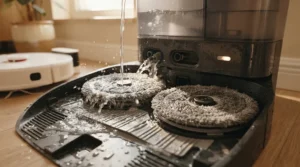
If your priority is genuinely obsessive mop hygiene rather than simply “good enough,” the Omni S2 is the model built for that brief. Its UniClean 12-in-1 station washes the HydroJet roller mop at 70°C, uses ozonated water for disinfection, dries with 55°C hot air, and automatically doses detergent from a refillable 600ml cartridge — a level of automation Amazon listings barely scratch the surface of explaining. Suction is rated at a genuinely enormous 30,000 Pa, more relevant for deep carpet pile than most UK homes strictly need, but welcome nonetheless.
Reviewer sentiment is consistently the same shape across outlets: impressive, but expensive. Expert Reviews called it “one of the most expensive robot vacuums on the market”; TechRadar praised the self-cleaning mop and detergent system while noting the price is “equally shocking.” A turbidity sensor checks whether the mop is actually clean after washing and reruns the cycle automatically if not — a small but genuinely useful hygiene safeguard most rivals skip entirely.
Pros:
- ✅ 70°C ozonated water wash plus automatic detergent dosing is class-leading
- ✅ Turbidity sensor re-washes automatically if the mop isn’t clean
- ✅ Fragrance diffuser and 2-year warranty add genuine everyday value
Cons:
- ❌ RRP around £1,599 puts it out of reach for most buyers
- ❌ Replacement parts kit reportedly costs a further £79.99 annually
Given the RRP sits close to £1,600, this is a considered purchase rather than an impulse buy — but for households prioritising hygiene above all else, the case is a strong one.
Practical Usage Guide: Getting Your Dock Set Up Right
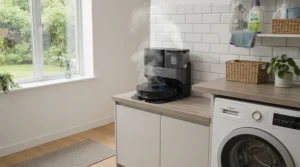
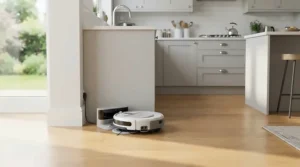
Unboxing day matters more than most guides let on. Position the dock on a hard, level floor — not carpet, and not a thick doormat — because uneven ground throws off the robot’s docking alignment and can trigger repeated failed wash cycles. Leave at least 50cm clear on either side and roughly 1.5 metres in front, since several models fully extend side brushes or a robotic arm during docking manoeuvres.
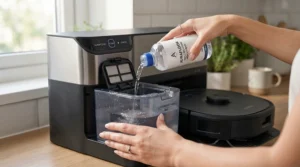
During the first 30 days, the most common mistake is ignoring the clean-water tank until it’s bone dry, which forces the dock to attempt a wash cycle with no water and simply skip it silently — you won’t get an error, just a dirty mop next run. Set a weekly reminder to top up both clean water and detergent, if your model uses it, until the routine beds in. Equally common: forgetting the dirty-water tank exists at all. Every self-washing mop robot vacuum sends the grey wash water somewhere, and that tank needs emptying every few days in busy households, more often than the dust bag itself.
Finally, resist the urge to overload the detergent dispenser “to be thorough.” More isn’t better here — excess detergent residue is one of the more common causes of a sticky floor finish that then attracts more dust, undoing the entire point of the exercise.
Real-World Scenarios: Which Model Actually Suits Your Home
The renter in a one-bed flat with laminate throughout: budget matters most, and a full hot-water hygiene system is arguably overkill for a smaller floor area cleaned frequently. The Roborock Qrevo Series (QV 35A) covers the basics without the four-figure commitment, and its smaller footprint suits limited storage.
The family with two dogs and a downstairs-only layout: this is precisely the household the eufy Omni S2 is built for — ozonated water washing genuinely matters when muddy paw prints are a daily occurrence, and the fragrance system, while not transformative, softens the “wet dog” smell that heavier mopping duty tends to create.
The Victorian terrace with mixed flooring and raised thresholds: uneven transitions between rooms are exactly where cheaper chassis designs fail, making the roborock Qrevo Curv‘s AdaptiLift system the more sensible investment over a flatter, cheaper alternative that might simply get stuck.
Problem → Solution: Fixing Common Self-Washing Mop Complaints
A recurring theme across aggregated reviews is a lingering musty smell despite regular washing. The most frequent cause is drying, not washing — a dock that rinses but doesn’t heat-dry leaves the pad damp enough for bacteria to multiply within hours, echoing long-established hospital hygiene research showing that mops stored wet support bacterial growth to very high levels that chemical disinfection alone can’t fully control. Models like the Eufy X10 Pro Omni, which include hot-air drying as standard, address this directly; unheated-wash budget models don’t, so manually removing the pad to air-dry occasionally is a sensible workaround.
A second common issue is streaky floors after washing, usually traced to detergent residue rather than dirt — reduce dosing rather than increasing it. Third, docks that repeatedly fail to complete a wash cycle are very often simply out of clean water; check the tank before assuming a fault. Fourth, a mouldy smell specifically from the dock itself, rather than the mop, points toward ventilation — the same principle behind UK government guidance on preventing damp and mould in the home applies at appliance scale: standing moisture in an unventilated cupboard breeds smells regardless of how good the robot itself is.
✨ Ready to Ditch the Bucket and Sponge Mop for Good?
🧽 Whichever self-washing mop robot vacuum fits your floors and budget, checking today’s price only takes a moment — click through on any model above and see what’s currently in stock before you commit.
What Is a Self-Washing Mop Robot Vacuum?
A self-washing mop robot vacuum is a robotic floor cleaner whose docking station automatically rinses, and in better models heats and dries, the mop pad after every cleaning run, removing the need to manually wash it by hand. The dock typically also refills the clean-water tank and, on premium models, doses detergent automatically.
That definition sounds simple, but the execution varies enormously between the seven models above, from a basic cold rinse right through to ozonated hot-water disinfection with automatic detergent dosing. The category sits above standard self-emptying robot vacuums — which only handle dry dust — and below fully plumbed-in systems that connect directly to household water lines, a configuration still rare in typical UK homes.
How to Choose a Self-Washing Mop Robot Vacuum
- Check the wash temperature first, not suction. Anything under roughly 55–60°C is closer to a rinse than a genuine hygiene cycle.
- Confirm hot-air drying is included. A washed-but-damp pad breeds odour faster than a dirty dry one.
- Match suction to your flooring, not the marketing headline. Hard floors rarely need more than 8,000–10,000 Pa; thick carpet and heavy pet hair justify going higher.
- Consider your home’s layout. Multi-floor properties lose most auto-wash benefits upstairs, away from the dock — factor that in before paying flagship prices.
- Check detergent compatibility before assuming any bottle will do. Manufacturer-specific formulas exist for a reason, covered in detail below.
- Look at dock footprint versus your utility space. Compact stations like the N30 Pro Omni’s suit smaller UK kitchens; larger 12-in-1 stations need genuine floor space.
- Weigh replacement part costs, not just the sticker price. Premium docks can add £60–£80 a year in mop pads, filters, and detergent refills.
Self-Washing Mop Robot Vacuum vs Manual Mopping and Basic Robot Mops
Comparing this category against both a traditional bucket-and-mop routine and a basic non-washing robot mop reveals where the real value sits.
| Factor | Manual Mopping | Basic Robot Mop | Self-Washing Mop Robot Vacuum |
|---|---|---|---|
| Weekly time cost | 30–60 minutes | 10–15 minutes | Under 5 minutes |
| Mop hygiene | Depends on user habit | Pad reused dirty between runs | Washed, often heated, after each run |
| Upfront cost | Lowest | Low–mid | Mid–high |
| Best For | Small flats, occasional spills | Light daily maintenance | Busy households wanting hands-off hygiene |
The table understates one point worth stating plainly: a basic robot mop that drags the same unwashed pad around your kitchen for a week can, per the hospital hygiene research cited earlier, actually spread bacteria across the floor rather than removing it. A self-washing system doesn’t eliminate that risk entirely, but heated washing meaningfully reduces it compared with either manual mopping done inconsistently or a basic robot mop with no washing stage at all.
Mop Pad Hygiene: What the Self-Cleaning Cycle Actually Prevents
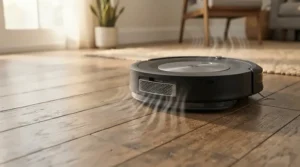
Mop pad hygiene is arguably the entire justification for this product category, yet it’s the part Amazon listings explain least clearly. A damp microfibre or roller pad left sitting between cleaning runs is a genuinely favourable environment for bacterial growth — food-safety research on kitchen cloths found that bacteria multiplied readily in cloths left crumpled and undried, while hanging cloths to dry properly produced a substantial reduction in bacterial counts within 24 hours. The same logic scales down to a robot’s mop pad, just on a faster cycle.
This is why the wash-then-dry combination matters more than wash alone. A cold rinse removes visible debris but does little to the bacteria load; heat, ideally above 60°C, does the actual hygienic work, and hot-air drying afterwards prevents regrowth in the hours before the next run. Models like the eufy Omni S2, which adds ozonated water disinfection on top of 70°C washing, are aiming squarely at this concern rather than at suction figures — worth remembering when comparing spec sheets that lead with Pa ratings rather than wash temperature.
Detergent Compatibility: What You Can (and Can’t) Use
Detergent compatibility catches out more buyers than any other maintenance question in this category. Manufacturer-specific floor cleaner cartridges, like the one bundled with the eufy Omni S2, are formulated to avoid excess foaming, which can damage pump mechanisms and sensors inside the dock — a genuinely different requirement from a normal household floor cleaner designed for hand mopping.
Using ordinary supermarket floor cleaner in docks not designed for it is a common cause of blocked detergent lines and residue build-up on the mop pad itself, which ironically leaves floors stickier rather than cleaner. Budget models without a dedicated detergent system, such as the Roborock Qrevo Series (QV 35A), sidestep this issue entirely by washing with plain water only — a trade-off worth knowing before assuming every self-washing dock accepts any cleaning fluid you already own.
Wash Cycle Frequency: How Often Is Often Enough?
Wash cycle frequency is largely handled automatically on every model here — the dock washes after each cleaning run by default — but the more useful question is how often the deeper maintenance tasks need doing. Clean-water tanks typically need topping up every few days in an average three-bedroom home; dirty-water tanks usually need emptying slightly more often than that, since wash water plus collected grime fills faster than clean water empties.
Detergent-equipped docks, like the roborock Qrevo Curv and eufy Omni S2, generally last several weeks per cartridge under normal use, though households running daily cleans in high-traffic kitchens will burn through both water and detergent noticeably faster than an every-other-day schedule. If odour returns despite frequent automatic washing, it’s worth manually removing the pad every fortnight or so for a proper air-dry outside the dock — a five-minute task that resets any residual dampness the automated cycle alone hasn’t fully addressed.
Common Mistakes When Buying a Self-Washing Mop Robot Vacuum
The single biggest mistake is choosing purely on suction Pa figures, which tell you almost nothing about mop hygiene performance — a 30,000 Pa machine with a cold-water rinse still leaves you with a damp, average-hygiene pad. A close second is ignoring dock footprint entirely; several premium stations are genuinely large, and cramming one into a tight understairs cupboard defeats the ventilation that keeps mould at bay, echoing the same principles UK electrical safety guidance expects manufacturers to design around for domestic appliances generally.
Buyers also frequently overlook multi-floor limitations, assuming full auto-wash convenience travels with the robot everywhere, when in reality most systems only wash, refill, and dry while docked. Finally, underestimating running costs is common — replacement mop pads, filters, and detergent cartridges on premium models can add meaningfully to the true annual cost, a figure worth calculating before comparing sticker prices alone.
Long-Term Cost & Maintenance
Total cost of ownership varies more than the upfront price suggests. Budget models like the Roborock Qrevo Series (QV 35A) keep running costs low simply by having less to replace — no detergent cartridges, simpler mop pads, and dust bags that cost a few pounds each. Premium systems trade a higher purchase price for genuinely better hygiene outcomes, but that comes with recurring costs: the eufy Omni S2‘s full replacement parts kit runs to roughly £80 a year, plus detergent refills at around £20 each and fragrance capsules on top.
Over a three-year ownership period, a budget model might cost an extra £30–£50 annually in basic consumables, while a flagship hygiene-focused dock could realistically add £100–£150 a year once detergent, fragrance, and premium mop pads are all accounted for. That’s not a reason to avoid premium models outright — for households genuinely bothered by odour and hygiene, the ongoing cost is arguably the price of the feature actually working as intended, not an unexpected sting.
FAQ
❓ Is a self-washing mop robot vacuum worth it?
❓ How often should I run the self-cleaning wash cycle?
❓ Can I put any detergent in a self-washing mop robot vacuum?
❓ Do self-washing mop robot vacuums actually stop bad smells?
❓ What's the difference between self-washing and self-emptying robot vacuums?
Conclusion
Choosing a self-washing mop robot vacuum ultimately comes down to how honestly you can answer one question: do you care more about never touching a dirty mop pad again, or about the deepest possible hygiene outcome? The Roborock Qrevo Series (QV 35A) answers the first question cheaply and reasonably well. The eufy Omni S2 answers the second at a price that reflects just how thoroughly it does so, right down to a sensor that double-checks its own work.
In between sit genuinely strong all-rounders — the Ecovacs DEEBOT N30 PRO OMNI for compact UK kitchens, the eufy C28 Omni as an underrated roller-mop alternative, the roborock Qrevo Curv for homes with awkward, uneven floors, and the Roborock Saros 10 for anyone who values navigation and a genuinely slim profile over the last word in scrub pressure. None of the seven is objectively “best” in isolation; each earns its place for a specific kind of UK home, floor type, and tolerance for ongoing running costs. Whichever you land on, the honest advice holds regardless of price point: check the wash temperature before the suction figure, and budget for detergent and replacement pads as part of the real cost, not an afterthought.
✨ Don’t Miss These Exclusive Deals!
🔍 Take your floor-cleaning routine to the next level with any of the self-washing mop robot vacuums covered here. Click through on a model above to check current pricing and availability, and give yourself back the hours you’d otherwise spend hunched over a mop bucket!
Recommended for You
- Self-Emptying Robot Vacuum Mop: 7 Best UK Picks (2026)
- Robot Vacuum Mop Under £500: 7 Brilliant Picks for UK Homes (2026)
- Robot Vacuum Mop Combo: 7 Best UK Picks That Actually Work (2026)
Disclaimer: This article contains affiliate links. As an Amazon Associate, I earn from qualifying purchases. If you purchase products through these links, we may earn a small commission at no additional cost to you.
✨ Found this helpful? Share it with your friends! 💬🤗
