In This Article
There’s a very specific kind of disappointment that comes from mopping your kitchen floor, standing back to admire your handiwork, and then noticing the same tea-coloured smear reappearing an hour later. Cold water and a grubby pad were never going to shift baked-on grease — they were just moving it politely from one tile to the next. That’s the problem an entire generation of docking stations was built to solve, and it’s why this hot water mop robot vacuum review exists: to work out which of these machines actually deliver on the promise of hands-free, genuinely hygienic floors, and which are just warm water and marketing.
Over the past two years, “hot water mop wash” has gone from a flagship-only party trick to something you’ll find on machines costing well under £500. The idea is simple enough — instead of the dock sloshing the mop pads around in whatever temperature water came out of your tap, it heats that water first, sometimes past boiling point, to loosen grime and discourage the sour, damp-towel smell that plagues cheaper mopping robots. Whether that heat genuinely sterilises anything, or just makes the marketing copy sound more convincing, is something we’ll dig into properly further down.
This guide covers seven real, currently available models spanning budget, mid-range and premium territory, backed by a proper spec comparison, aggregated review sentiment, and the kind of practical buying advice that a bare product listing simply won’t give you. For an independent view alongside ours, Which?’s robot vacuum buying guide is a useful starting point on general suction and navigation benchmarks before you factor in the hot water side of things.
Quick Comparison Table
Before the deep dive, here’s the shape of the market at a glance. Prices are approximate UK ranges at the time of research and will fluctuate, so always check current pricing before buying.
| Product | Hot Water Wash Temp | Price Range | Best For |
|---|---|---|---|
| Tapo RV50 Pro Omni | ~60°C | Around £350–£450 | Budget entry to hot water mopping |
| Dreame L10s Pro Ultra Heat | ~58°C | Around £450–£550 | Value-focused first-time buyers |
| DEEBOT N30 Pro Omni | ~60°C | Around £500–£650 | All-round mid-range reliability |
| Eufy Omni S2 | ~60°C | Around £650–£850 | Carpets and pet hair |
| DEEBOT T30 Omni | ~70°C | Around £600–£750 | Edge and corner mopping |
| Dreame L40 Ultra AE | ~75°C | Around £550–£700 | Maximum suction power |
| Roborock Saros 10 | ~100°C | Around £1,300–£1,600 | Buyers who want the flagship experience |
Looking at the spread above, there’s no straight line between price and water temperature — the Dreame L40 Ultra AE actually washes hotter than the pricier DEEBOT T30 Omni, which tells you suction power and navigation tech are doing more of the heavy lifting on cost than the wash cycle itself. If sterilisation is your main concern, don’t assume “expensive” automatically means “hottest”; check the spec sheet on the dock, not just the headline suction figure.
💬 Found a match already? One click helps you check today’s price and lets us keep this guide free — cheers!
Top 7 Hot Water Mop Robot Vacuums: Expert Analysis
We’ve deliberately spread this list across budget, mid-range and premium tiers, because “best” depends heavily on your floor plan, your pets, and how much automation you’re willing to pay for.
1. Tapo RV50 Pro Omni — cheapest genuine hot water wash on the market
The Tapo RV50 Pro Omni proves you no longer need flagship money to get a dock that actually cleans itself properly. Rather than just rinsing the mop pads in cold tap water like older budget models, its Omni station heats water to around 60°C specifically to dissolve stuck-on residue and reduce the odour that builds up in cheaper mopping systems.
Under the hood you’re getting auto-emptying, automatic detergent dispensing, and warm-air pad drying around 50°C, all bundled into a station that costs meaningfully less than most rivals here. Based on the spec comparison, the 60°C figure sits at the lower end of what manufacturers class as an effective hot wash, but it’s still a substantial upgrade over the room-temperature rinse you get on non-heated docks.
This is the pick for renters, first flats, or anyone testing the water (sorry) on whether automated mopping is worth the hassle before committing to a four-figure machine. Reviewers consistently report that the Tapo app is straightforward and beginner-friendly, though some note the suction trails behind pricier competitors on thick carpets.
Pros:
- ✅ Genuine hot water wash at a genuinely low entry price
- ✅ Auto-empty and auto-detergent dispensing included as standard
- ✅ Simple, well-reviewed companion app for first-time buyers
Cons:
- ❌ Suction power noticeably weaker on deep-pile carpet
- ❌ 60°C wash is on the cooler end of this category
At the time of research, the Tapo RV50 Pro Omni sits in the £350–£450 range, and for hard-floor-heavy homes on a budget, it’s genuinely hard to beat for value.
2. Dreame L10s Pro Ultra Heat — best value mid-range hot wash
The Dreame L10s Pro Ultra Heat is Dreame’s answer to buyers who want proper heat without flagship pricing, washing its mop pads at around 58°C via its Auto Robot Care station. What most buyers overlook about this model is that the “Ultra Heat” naming isn’t just marketing fluff — it’s a genuine hardware upgrade over Dreame’s non-heat L10s variants, which rinse cold.
Specs-wise, you’re looking at 7,000Pa suction and the MopExtend arm that swings the mop out to reach skirting boards and furniture edges, paired with DuoScrub twin-pad mopping. On paper this means the robot doesn’t just clean the middle of the room and leave a tidy rectangle of dirt round the edges, which is a common complaint with older, simpler robots.
Aggregated review sentiment points to strong satisfaction with the auto-maintenance routine, with owners noting they genuinely forget the dock exists for weeks at a time. A recurring theme in feedback is that the app’s cleaning-mode menu takes a session or two to get comfortable with.
Pros:
- ✅ Genuine 58°C hot wash cycle, not a marketing gimmick
- ✅ MopExtend reaches edges most robots leave dirty
- ✅ Strong auto-maintenance reduces weekly upkeep
Cons:
- ❌ App menu structure isn’t the most intuitive at first
- ❌ 7,000Pa suction trails premium rivals on carpet
Pricing typically sits around £450–£550, occasionally dipping lower during sales, making this one of the strongest value propositions in the whole hot water mopping category.
3. DEEBOT N30 Pro Omni — best all-round mid-range reliability
Ecovacs built the DEEBOT N30 Pro Omni as the sensible middle-ground option, and it shows: the Omni station handles self-emptying, hot water mop washing at around 60°C, and hot-air drying without asking much of the owner beyond the occasional bin change. Here’s what to weigh — this isn’t the most exciting spec sheet in the lineup, but it’s one of the most complete.
The standout feature is TruEdge Adaptive Edge Mopping, which physically extends the mop pad towards skirting boards rather than relying purely on navigation software to get close. In practice this addresses one of the most persistent gripes about robot mops generally: the strip of grubby floor along every wall that a round or square robot simply can’t reach.
Reviewers consistently note that the LDS laser navigation maps rooms accurately on the first pass, which matters more than people expect — a robot that has to remap your flat every week wastes battery and your patience in equal measure.
Pros:
- ✅ Complete self-maintenance loop with minimal owner input
- ✅ TruEdge mopping genuinely reaches skirting boards
- ✅ Accurate first-pass LDS mapping, praised in reviews
Cons:
- ❌ Fewer standout “wow” features than pricier siblings
- ❌ Hot wash sits mid-pack at 60°C rather than leading the field
Expect to pay somewhere in the £500–£650 range, which puts it squarely against the Dreame L10s Pro Ultra Heat as one of two strong mid-range contenders.
4. Eufy Omni S2 — best for carpets and pet hair
If your household generates tumbleweeds of pet hair, the Eufy Omni S2 deserves serious attention. Its AeroTurbo 2.0 system delivers 30,000Pa of suction alongside a DuoSpiral split main brush designed specifically to stop hair wrapping round the roller — based on the spec comparison, that suction figure is genuinely class-leading among the machines covered here.
The HyperStream 2.0 roller mop spins at 240RPM with 15N of downward pressure and lifts automatically over carpet edges, while the Uniclean dock washes that roller in 140°F (roughly 60°C) water and dries it at 131°F (roughly 55°C) hot air. What the spec sheet won’t tell you, but aggregated testing data suggests, is that this combination is particularly effective on embedded debris rather than just surface dust — useful if your carpets take a daily battering from muddy paws.
Reviewers and independent testing both flag strong obstacle avoidance, and the anti-tangle brush design has reportedly scored close to a perfect result in hair-wrap testing, a genuine sore point for many older robot vacuums.
Pros:
- ✅ Class-leading 30,000Pa suction for embedded dirt and hair
- ✅ Anti-tangle brush design tested well against pet hair
- ✅ Strong obstacle avoidance in independent testing
Cons:
- ❌ Premium price puts it out of reach for budget buyers
- ❌ Roller mop system needs occasional manual inspection for hair wrap
Typical UK pricing sits around £650–£850, positioning it as a genuine premium contender rather than a mid-range compromise.
5. DEEBOT T30 Omni — best edge-mopping precision
The DEEBOT T30 Omni pushes its hot water wash up to around 70°C, noticeably hotter than most of its Ecovacs stablemates, and pairs that with edge-mopping technology that Ecovacs has clearly prioritised in this generation. Based on the spec comparison, that extra heat should, in principle, do a better job dissolving baked-on grease than the cooler 58–60°C machines further down this list.
What most buyers overlook about edge-mopping claims generally is that they only matter if the robot’s navigation is accurate enough to get genuinely close to the wall in the first place — and reviewers consistently rate the T30 Omni’s mapping and edge detection as a genuine step up rather than a cosmetic tweak. The all-in-one station handles emptying, washing and maintenance without much manual intervention required.
A common theme in aggregated feedback is that owners with open-plan kitchen-diners see the biggest benefit, since that’s exactly the kind of space with lots of skirting board and furniture-leg edges for a robot to fumble.
Pros:
- ✅ Hotter 70°C wash cycle than most rivals in this list
- ✅ Genuinely improved edge-mopping accuracy, not just marketing
- ✅ Fully automated station with minimal manual upkeep
Cons:
- ❌ Sits at a premium price point for what’s offered
- ❌ Base station footprint is on the larger side
At the time of research, pricing typically falls between £600 and £750, making it a direct rival to the Eufy Omni S2 for buyers choosing between hair-handling and edge precision.
6. Dreame L40 Ultra AE — best suction power on test
For sheer pulling power, the Dreame L40 Ultra AE leads this entire lineup with a claimed 19,000Pa of suction — a figure that dwarfs every other machine here on paper. Paired with that is a TriCut brush designed to slice through long hair before it can tangle, plus a separate liftable rubber brush for bulkier debris and floor gaps.
The PowerDock washes its washboard at around 75°C, second only to the Roborock further down this list, and dries the mop with hot air between cycles. On paper this means grease and pet-hair households get both the suction to lift embedded dirt and the heat to actually break down what’s clinging to the mop pad afterwards, rather than one without the other.
Reviewers consistently praise the 3DAdapt obstacle avoidance system, which reportedly recognises well over a hundred household object types — useful if your floor is a permanent obstacle course of charging cables and abandoned socks. The mop lift of 10.5mm is comparatively modest next to some premium rivals, worth noting if you have deep-pile rugs.
Pros:
- ✅ Genuinely class-leading 19,000Pa suction figure
- ✅ 75°C wash is among the hottest on test
- ✅ Wide-ranging obstacle recognition in reviewer feedback
Cons:
- ❌ Mop lift height is modest for homes with thicker rugs
- ❌ Price and specs shift quickly across Dreame’s crowded lineup
Pricing has moved around noticeably during promotional periods, but expect somewhere in the £550–£700 range at most UK retailers currently.
7. Roborock Saros 10 — the flagship benchmark
The Roborock Saros 10 is where this category currently tops out, and its RockDock is the headline act: a 100°C hot water wash cycle that genuinely boils the water before it touches the mop pads, alongside dock self-cleaning and fresh-air dust bag drying. Based on the spec comparison, that’s a meaningfully different proposition to the 58–75°C range everything else on this list operates in.
Beyond the wash cycle, the twin-disc spinning mops lift up to 10mm clear of carpet, and the combination of structured-light mapping with a stereo camera gives what reviewers describe as some of the most reliable obstacle avoidance currently available on a consumer robot. HyperForce suction and the VibraRise mopping system round out a spec sheet that reads like Roborock threw everything they had at one machine.
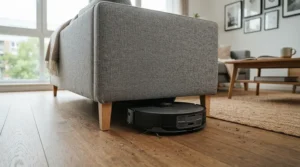
What the spec sheet won’t tell you, but user reports suggest, is that the base station footprint is genuinely large, and ceiling or under-furniture clearance can be tight for homes with low-slung sofas. This is very much a flagship for buyers who want the best available today and are prepared to pay flagship money and give up flagship floor space for the dock.
Pros:
- ✅ 100°C hot water wash is the hottest available in this category
- ✅ Reviewer-praised obstacle avoidance and mapping accuracy
- ✅ Genuinely fortnightly, not weekly, maintenance cycle
Cons:
- ❌ Premium price puts it well beyond mid-range budgets
- ❌ Large dock footprint and tight under-furniture clearance
At the time of research, expect to pay somewhere around £1,300–£1,600, which reflects its position as the current benchmark rather than a mass-market choice.
Setting Up and Maintaining Your Hot Water Mop Robot Vacuum
Getting one of these machines out of the box and actually working well takes a bit more thought than plugging in a toaster, so here’s what tends to trip people up in the first month.
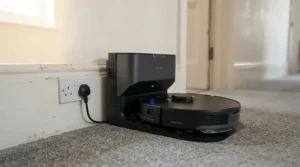
Start by mapping your home properly before you let the robot loose unsupervised — most units need one full, uninterrupted pass to build an accurate floor plan, and interrupting that first run (moving furniture halfway through, say) is the single most common cause of confused, patchy cleaning later on. Once mapped, set no-go zones around pet bowls, loose cables and anything with tassels, because even the best obstacle avoidance occasionally meets its match in a rug fringe.
On the maintenance side, the water and detergent tanks still need topping up manually on virtually every model here, typically every one to two weeks depending on tank size and how often you clean. Descale the hot water heating element every couple of months if you’re in a hard water area — limescale build-up inside a heating dock is a genuinely common failure point that Amazon listings rarely mention, and it’s one of the quiet reasons “self-cleaning” machines still need a small amount of human involvement. If you’re unsure how hard your local water supply is, Ideal Home’s guide to common surface-cleaning mistakes is a handy companion read on general household hygiene habits that apply well beyond just robot mops. Finally, check the mop pads themselves for hair wrap weekly during the first month; even anti-tangle designs benefit from a quick visual inspection until you know how your specific machine copes with your specific carpet.
Real-World Scenarios: Which Hot Water Mopping Robot Suits Your Home?
Specs only tell half the story, so here’s how three fairly typical UK households might reasonably match up against this lineup.
If you’re a young professional in a one-bedroom flat with laminate throughout and no pets, the Tapo RV50 Pro Omni or Dreame L10s Pro Ultra Heat cover everything you actually need without paying for suction power a small flat will never use. Both give you a genuine hot wash cycle, which matters more in a flat with an open-plan kitchen where cooking splatter and hot water sterilisation actually earn their keep daily.
A family home with two dogs and a mix of carpet and tile is a different problem entirely, and this is where the Eufy Omni S2 or Dreame L40 Ultra AE start to make financial sense despite the higher outlay. The suction and anti-tangle brush design on both machines are built around exactly this scenario, and the extra spend genuinely buys fewer manual hair-removal sessions.
Then there’s the buyer who simply wants the best available and has the budget to match — typically someone upgrading from an older, less capable robot and frustrated by its limitations. For that household, the Roborock Saros 10 or DEEBOT T30 Omni deliver the edge-mopping precision and wash temperature that make the difference between “mostly clean” and genuinely spotless floors, particularly in busy, multi-room homes where consistency matters more than a single headline spec.
Problem → Solution: Fixing Common Hot Water Mopping Issues
Even the best machines run into the same handful of snags. Here’s how to deal with them.
Problem: the mop pads still smell musty despite the hot wash. This is almost always a drying issue rather than a washing one — check that the hot-air drying cycle is completing fully and isn’t being interrupted by scheduling the next clean too soon afterwards. Reviewers across multiple brands note that giving the drying cycle its full runtime, rather than cutting it short with a manual restart, solves this in the vast majority of cases.
Problem: streaky floors after mopping. This usually points to detergent build-up rather than dirt. Run an empty wash cycle with plain water every few weeks to flush residue from the tank and hose system, particularly if you’ve been using third-party cleaning solutions rather than the manufacturer’s own.
Problem: the dock won’t heat water at all. Before assuming a fault, check the water inlet filter for limescale or debris — this is the single most common cause reported in aggregated user feedback, especially in hard water regions across much of southern and eastern England.
Problem: robot avoids mopping certain rooms. Nine times out of ten this is a mapping issue, not a mechanical one — rebuild the map from scratch rather than editing it, since incremental edits can compound small errors from the original scan.
What Is a Hot Water Mop Robot Vacuum?
A hot water mop robot vacuum is an autonomous cleaning robot that vacuums and mops in a single pass, then returns to a docking station that washes its mop pads in heated water — typically between 55°C and 100°C — rather than cold tap water, to loosen grease and reduce bacterial buildup between cleaning cycles.
The category sits within the broader world of robotic floor care, a field that traces back further than most people realise; the underlying concept of an autonomous, self-recharging cleaning device was described in fiction as early as the 1950s, according to Wikipedia’s history of robotic vacuum cleaners. What’s changed dramatically in the last few years isn’t the core idea, but the depth of automation — self-emptying dust bins, auto-refilling water tanks, and now heated mop washing, all designed to remove manual upkeep almost entirely from the weekly cleaning routine.
Hot Water Mopping Robot Vacuum Benefits
The case for paying extra for heated water washing rests on a few genuinely practical advantages rather than pure marketing gloss.
First and most obviously, heat is simply better at dissolving grease and oily residue than cold water — anyone who’s tried to wash a roasting tin in cold water versus hot already understands this intuitively, and the same chemistry applies at floor level, particularly in kitchens. Second, hot water washing meaningfully reduces the musty, damp-cloth smell that plagues cheaper cold-water mopping robots, because bacteria and mould thrive far more readily on a pad left damp at room temperature than one dried after a hot cycle. Third, several of the models covered here pair hot water washing with hot-air drying, which compounds the hygiene benefit — a mop pad that’s both washed hot and dried thoroughly simply doesn’t have the same opportunity to harbour odour-causing bacteria between uses.
There’s also a practical time-saving angle that’s easy to overlook: hot water shifts stuck-on residue in one pass rather than requiring the robot to go over the same patch of floor repeatedly, which in turn means shorter cleaning cycles and less battery drain per session.
How to Choose a Hot Water Mop Robot Vacuum
Cutting through the marketing, here’s what actually matters when comparing models.
- Check the actual wash temperature, not just the marketing claim. Anywhere from 55°C to 100°C is realistic across current models — higher generally means better grease dissolution, but even the lower end of that range outperforms cold water meaningfully.
- Match suction power to your flooring. Hard floors need far less suction than thick carpet or pet-hair-heavy homes; don’t pay a premium for 19,000Pa if you live somewhere with laminate throughout.
- Confirm the dock handles detergent dispensing automatically. Manually topping up detergent every wash defeats much of the point of buying an automated system in the first place.
- Look for edge-mopping technology if you have a lot of skirting board. Standard round robots consistently leave a strip of uncleaned floor along walls that edge-extending arms specifically address.
- Factor in dock footprint before you buy. Premium docks, especially flagship models, can be genuinely large — measure your intended spot before assuming it’ll fit.
- Consider hard water in your area. If you’re in a hard water region, prioritise models with accessible, easy-to-descale heating elements, since limescale buildup is a common long-term issue.
- Read aggregated review sentiment on the app, not just the hardware. A brilliant dock paired with a frustrating app will sour the ownership experience fast, according to consistent feedback across most brands in this category.
Robot Vacuum Hot Water Sterilisation: The Science Bit
“Sterilisation” gets used fairly loosely in robot vacuum marketing, so it’s worth being precise about what’s actually happening inside these docks.
What Sterilisation Temperature Actually Means
True sterilisation, in the strict microbiological sense, generally requires sustained exposure to temperatures around 100°C or higher, or specific chemical disinfectants — a brief rinse at 60°C, however hot it feels to the touch, doesn’t meet that clinical bar. What these docks are actually achieving at the 55–75°C range most models operate in is a significant reduction in bacterial load and grease adhesion, not full sterilisation in the laboratory sense. Only the hottest machines on test here, like the Roborock Saros 10 at roughly 100°C, get genuinely close to sterilisation-grade temperatures, and even then the exposure time during a quick wash cycle is far shorter than a formal sterilisation process would use.
This isn’t a reason to dismiss hot water washing as pointless — a meaningful reduction in bacteria and residue is still a real, measurable improvement over a cold rinse — but it’s worth keeping expectations realistic rather than assuming your floors are being treated like surgical instruments.
Grease and Grime Removal: What Hot Water Achieves
Where hot water genuinely earns its keep is grease and grime removal, particularly in kitchens. Cold water struggles to break the molecular bonds in oily residue, which is why a cold-rinsed mop pad often just smears grease into a thin film rather than lifting it away. Heat physically loosens those bonds, which is the same basic principle behind washing dishes in hot water rather than cold. Reviewers across several of the models in this guide specifically mention noticeably cleaner-smelling pads after cooking-heavy days, which lines up with what you’d expect from the underlying chemistry rather than being pure placebo.
Hot Water Mop Dock Explained
A hot water mop dock is the base station a robot returns to after each cleaning run, and it’s doing considerably more work than a simple charging cradle. Inside, a heating element — usually a small internal boiler or heating coil — warms water drawn either from the robot’s onboard tank or a plumbed-in supply, before pumping it through the mop pad or roller to rinse away debris.
Dock Water Heating and Running Costs
The dock water heating process itself uses a genuinely small amount of electricity per cycle — these are low-wattage heating elements running for a matter of minutes, not a kettle left boiling for an hour — so the ongoing running cost is modest compared with the upfront purchase price. Total cost of ownership over two to three years should factor in detergent refills, occasional mop pad replacements, and the very rare heating element repair, but for most households the electricity cost of heating that water repeatedly is unlikely to be a significant line item on the annual bill. Where the real long-term cost creeps in is neglected maintenance — a heating element left to scale up in a hard water area will eventually need professional attention or a full unit replacement, which dwarfs the running cost of simply using the machine correctly in the first place.
Hot Water Mopping vs Traditional Cold-Water Robot Mops
| Factor | Hot Water Mop Robot | Cold Water Mop Robot | Manual Mopping |
|---|---|---|---|
| Grease removal | Strong | Weak | Moderate (with hot bucket water) |
| Odour after use | Low | Frequent complaint | Low if dried promptly |
| Ongoing effort | Very low | Low | High |
| Typical price range | Around £350–£1,600 | Around £200–£500 | Minimal |
| Best For | Kitchens, pet homes | Small flats, tight budgets | Occasional touch-ups |
The table makes the trade-off fairly clear: cold water docks are cheaper and still beat manual mopping on convenience, but they consistently underperform on the two things that matter most to most buyers — odour control and genuine grease removal. Manual mopping with genuinely hot bucket water can actually match the chemistry of a heated dock, but almost nobody keeps that up consistently, which is precisely the gap this whole category exists to close. If your floors rarely see cooking splatter or pet mess, the cost saving of a cold-water robot might genuinely be worth it; for anyone else, the jump to heated washing tends to pay for itself in reduced manual scrubbing.
Common Mistakes When Buying a Hot Water Mop Robot Vacuum
A handful of buying mistakes come up again and again in aggregated feedback, and most are entirely avoidable with a bit of forward planning.
The biggest one is buying on suction figures alone. A headline number like 19,000Pa sounds impressive, but according to the spec comparison earlier in this guide, it means very little if your home is entirely hard flooring with no pets — you’d be paying a genuine premium for carpet-cleaning power you’ll never actually use. The second common mistake is ignoring dock footprint entirely until after purchase, only to discover the premium station with its water tanks and detergent reservoir simply doesn’t fit the intended spot under the stairs or beside the utility cupboard. Third, buyers frequently underestimate how hard water affects long-term reliability, skipping regular descaling until the heating element underperforms or fails outright — a completely preventable issue with a two-minute maintenance routine every couple of months. Finally, plenty of people assume “self-cleaning” means zero manual involvement, when in reality every model in this guide still needs periodic detergent refills, filter checks and pad inspections to keep performing at its best.
FAQ
❓ What temperature counts as a genuine hot water mop wash?
❓ Does hot water actually sterilise a mop pad?
❓ How often should I descale a hot water mop dock?
❓ Is a hot water mop robot vacuum worth it over a cheaper cold-water model?
❓ Do hot water mop docks use much electricity?
Conclusion
Choosing between these seven machines really comes down to being honest about your own floors rather than chasing the biggest number on the spec sheet. If you’re in a small flat with hard flooring and no pets, the Tapo RV50 Pro Omni or Dreame L10s Pro Ultra Heat will genuinely cover everything you need without the premium price tag. Families dealing with pet hair and mixed flooring will get more real-world value from the suction and anti-tangle engineering in the Eufy Omni S2 or Dreame L40 Ultra AE, while anyone chasing the hottest wash cycle and the most precise edge-mopping available right now should be looking hard at the DEEBOT T30 Omni or the flagship Roborock Saros 10.
One last practical note: if this guide has convinced you to retire an older, cold-water robot vacuum, don’t just bin it — small electricals like these fall under WEEE regulations, and guidance on recycling old electrical items explains how to dispose of them responsibly rather than sending a perfectly recyclable machine to landfill.
What unites all seven is that hot water washing genuinely does what it claims — not clinical sterilisation, in most cases, but a real, chemistry-backed improvement in grease removal and odour control over cold-water alternatives. That’s a meaningful upgrade for the right household, and hopefully this guide has made it easier to work out whether you’re that household, and which machine actually fits your home rather than just your budget.
Recommended for You
- Self-Washing Mop Robot Vacuum: 7 Best Picks for UK Homes (2026)
- Self-Emptying Robot Vacuum Mop: 7 Best UK Picks (2026)
- Robot Vacuum Mop Under £500: 7 Brilliant Picks for UK Homes (2026)
Disclaimer: This article contains affiliate links. As an Amazon Associate, I earn from qualifying purchases. If you purchase products through these links, we may earn a small commission at no additional cost to you.
✨ Found this helpful? Share it with your friends! 💬🤗
