
In This Article
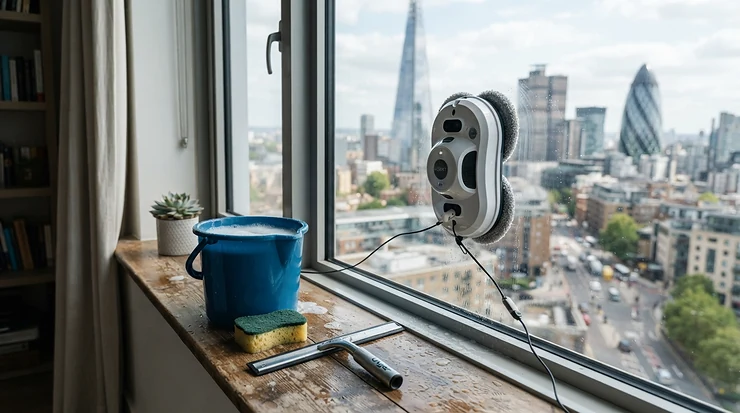
It’s a bright Saturday. The low sun has just exposed every smear, fingerprint and rain streak on your glass, and the stepladder is glaring at you from the side of the shed. This is the moment the robot window cleaner vs manual cleaning debate stops being theoretical.

Plenty of UK households are asking the same question. Which? reported in August 2026 that UK online interest in robot window cleaners had risen by around 850% in a year. Robots promise to stick to the glass, trundle along tidy Z-shaped or N-shaped routes and leave you with a hot cuppa. Manual cleaning promises control, a lower upfront bill and the quiet satisfaction of a job done by hand. Both promises are partly true, and partly marketing.
This guide untangles it. I’ve pulled together real specifications, published UK cost guides and the genuine themes in retailer and editorial coverage, then run the numbers on cost, time and finish. You’ll find seven real robots from budget to premium, plus practical routines and honest verdicts on when a professional still wins. One caveat up front: nobody here has tested these machines in a lab. Where the evidence is thin, I’ll tell you rather than bluff.
What Is Robot Window Cleaner vs Manual Cleaning?
Robot window cleaner vs manual cleaning is a comparison between two ways of keeping glass clear. One is a suction-mounted robot that wipes a pane by itself. The other is traditional hand cleaning with a cloth, squeegee, window vac or water-fed pole. The comparison covers upfront and running cost, hands-on time, safety, and the quality of the finish.
Quick Comparison: Robot Window Cleaner vs Manual Cleaning at a Glance
| Method | Upfront cost | Ongoing cost | Your hands-on time | Finish | Best For |
|---|---|---|---|---|---|
| Robot window cleaner | Around £60 to £600 depending on tier | Pads, electricity | Low (place, start, collect) | Good on large flat panes; edges vary | Large or awkward panes, e.g. Karcher RCW 2 |
| DIY bucket and squeegee | Under £20 | Cleaning solution | High | Excellent with practice | Small homes, tight budgets |
| Window vac | Modest | Little | Medium | Streak-free on easy panes | Reachable glass, condensation |
| Professional round | None | Roughly £12 to £55 per visit | Zero | Consistent exterior finish | Upstairs glass, busy households |
Look closely and no single row wins across the board. The robot’s real advantage is hands-on time, not the finish, while a skilled human still sets the quality benchmark on edges and frames. If your glass is mostly large, flat and awkwardly placed, a premium option like the Ecovacs Winbot W2 Pro Omni starts to make sense. Otherwise the cheap, humble squeegee punches well above its weight.
💬 Just one click — help others make better buying decisions too!😊
Top 7 Robot Window Cleaners: Expert Analysis (Budget to Premium)
A quick note on pricing before we start. I haven’t displayed live prices, because they change constantly. The bands below are indicative guides, so always check the current price on the product page.
1. Lubluelu CHYW200 — headline suction at a bargain price
The big talking point is the 6,500Pa suction rating in the listing. That’s a manufacturer claim, and suction figures aren’t directly comparable between brands. In practice, more suction gives you a better safety margin on slightly textured or dusty glass, though it says nothing about how well the pads actually clean. The listing also advertises “smart routing”, which, if it works as described, should mean fewer missed strips than a random-bounce robot.
Who is it for? Curious first-timers who want to find out whether robot cleaning suits their home without spending much. It makes a low-risk experiment.
On reviews, I couldn’t verify a large pool of independent UK reviews for this model, and Which? doesn’t list it. So treat the headline specs sceptically, and read the Amazon reviews yourself, looking specifically for comments on the safety rope and backup battery.
Pros:
- ✅ Generous headline suction rating
- ✅ Very low entry price
- ✅ Smart-routing claim promises fewer missed strips
Cons:
- ❌ Independent review evidence is thin
- ❌ After-sales support less established than big brands
A June 2026 promotion put it at roughly £60 to £70, so expect a budget band; check current price. A fair value verdict: an inexpensive gamble that’s only worth it if the safety features check out.

2. Memows Window Cleaner Robot — cheap bestseller basics
Which? flags this as one of the cheaper options among Amazon’s bestsellers. It uses two rotating round microfibre pads with a misting system. Pressure and optical sensors detect the window’s boundaries so it doesn’t wander off the glass, and a 4-metre safety tether acts as a backstop.
The 35ml water tank is on the small side. Practically, that means you’ll top it up more often on bigger panes, and a patio door may need a pause mid-job. Round pads also tend to leave the very corners untouched, a trade-off you accept at this price.
Reviewer sentiment, as summarised by Which? from retailer and search data, is that it’s a sensible low-cost entry. I haven’t verified individual star ratings, so I won’t quote any.
Pros:
- ✅ Among the cheaper robots on the market
- ✅ Mains power with emergency battery backup
- ✅ Includes a 4-metre safety tether
Cons:
- ❌ Small 35ml tank means more refills
- ❌ Round pads can miss corners
Expect a budget band, indicatively under £100; check current price. As a value verdict, it’s a decent starter for plain, well-spaced panes.
3. AlfaBot X7Pro — sprays in both directions of travel
What stands out is the dual spray system, which mists the glass on both sides of the robot, so it’s always wiping a freshly dampened surface rather than a dry patch. Which? lists a 60ml tank and a body of about 27.5 x 13 x 6.5cm. That’s roughly twice Memows‘s tank capacity, which is genuinely useful on bigger glass.
There’s a catch, and it’s an important one. Which? notes there are no sensors to stop it going too close to the edge of frameless glass. Mirrors in frames are fine, but balustrades and frameless doors need extra caution. As with other round-pad designs, corners can get missed.
Sentiment from Which?’s roundup is cautiously positive, and I haven’t verified individual ratings beyond that.
Pros:
- ✅ Two-way water spray keeps glass wet
- ✅ Larger 60ml tank than cheaper rivals
- ✅ Edge-detection sensors for framed glass
Cons:
- ❌ No edge protection on frameless glass
- ❌ Round pads may skip spots
Think of it as the budget-to-mid band, roughly £100 to £150 (indicative). The value verdict is good for framed, flat windows, but poor for frameless ones.
4. Karcher RCW 2 — remote control and a 4-metre rope
The Karcher RCW 2 pairs two spray nozzles with two rotating microfibre covers. It has optical and pressure sensors to find edges, and four cleaning modes (quick, intensive, spot and finishing). A supplied remote handles manual mode, which is more useful than it sounds. When you spot one stubborn bird-dropping patch, you can steer the robot to it instead of re-running a full cycle.
Which? likes the 4-metre safety rope and the voice prompts with LED indicators. It cautions that the round pads might miss corners. Based on the spec comparison, the remote is the differentiator in this tier.
Which? lists the Karcher RCW 2 at around £180 via Very, at the time of its research. Review sentiment isn’t independently verified here.
Pros:
- ✅ Remote control for targeted spot cleaning
- ✅ Four automatic cleaning modes
- ✅ 4-metre safety rope included
Cons:
- ❌ Round pads can leave corners behind
- ❌ Dual-tank capacity isn’t a headline feature
It lands in the mid-£100s, and the value verdict is strong if you like having manual control.
5. Ecovacs Winbot Mini Gen 2 — claims to clean within 1mm of the edge
The standout here is the edge-hugging claim. Which? reports it’s said to clean within 1mm of the pane’s edge, and the compact 21.5 x 21.5 x 5.5cm body lets it fit smaller panes. It measures the window, plans a Z-shaped or N-shaped route and returns to its starting point. The brand’s app offers five modes: fast, deep, thorough, edge and spot.
Worth knowing: it needs to stay plugged in, so cable length matters in your layout. An emergency battery guards against drops during a power cut.
On reviews, I couldn’t verify extensive UK data for this second-generation model. A Digitec Galaxus tester of the earlier Winbot Mini concluded these robots don’t clean better than you do, but they do it for you. That’s a sensible expectation to carry through any purchase.
Pros:
- ✅ Edge-focused cleaning claim, within 1mm
- ✅ Five cleaning modes via app
- ✅ Compact body suits smaller panes
Cons:
- ❌ Must remain plugged into the mains
- ❌ Evidence for Gen 2 specifically is thin
Think mid-range, roughly £150 to £250 (indicative). The value verdict is good if edge quality is your priority.
6. Hobot S7 Pro — dual mop pads and a heavy-duty safety rope
A squarer 26 x 26 x 8.9cm body is better at reaching into corners than a round one, and that’s where this model earns its keep. Two microfibre pads work with dual ultrasonic water sprays. It maps the window, plans a Z-shaped or N-shaped route, offers three auto modes and returns to its start point.
Which? praises the heavy-duty safety rope, with the same plug-in caveat as others in this tier. The voice prompts tell you progress without checking an app.
On reviews, I can’t point to a verified body of UK ratings, and Which? hasn’t lab-tested it. What I can say from the spec sheet is that this is the model to shortlist if corners annoy you.
Pros:
- ✅ Square body reaches corners better
- ✅ Dual ultrasonic spray for even dampness
- ✅ Heavy-duty safety rope included
Cons:
- ❌ Needs to stay plugged in
- ❌ Bulkier at 8.9cm deep
Indicatively around £200 to £300; check current price. The value verdict is good for corner-sensitive homes.
7. Ecovacs Winbot W2 Pro Omni — portable station for near-cordless convenience
This is the premium pick. Its 4,500 mAh battery and portable station mean it can charge while it works, avoiding the cable tangles that plague cheaper models. Ecovacs says it works on interior and exterior glass, shower screens and non-porous surfaces, and the robot measures roughly 271 x 271 x 77mm.
A German retailer roundup places the Pro between the older W2 Omni and the newer W2S Omni. A Haus & Garten Test review of the related W2 Omni scored it 77/100 (“Good”), praising its out-of-the-box convenience and app control but marking it down for high price. Note that was the W2 Omni, not this Pro.
Pros:
- ✅ Portable station reduces cable fuss
- ✅ Wide surface compatibility, including shower screens
- ✅ Strong app control reported for the family
Cons:
- ❌ Premium price tag
- ❌ Station adds bulk to store
Expect list prices roughly in the £450 to £600 range (indicative), with periodic discounts. A fair verdict: worth it only if you have lots of tricky glass.
| Product | Standout | Price band (indicative) | Evidence base | Best For |
|---|---|---|---|---|
| Lubluelu CHYW200 | 6,500Pa claim | Budget | Thin | Cautious experimenters |
| Memows Window Cleaner Robot | Cheap basics | Under £100 | Which? roundup | First-timers |
| AlfaBot X7Pro | Two-way spray | £100 to £150 | Which? roundup | Framed glass |
| Karcher RCW 2 | Remote control | Around £180 | Which? roundup | Spot-cleaning fans |
| Ecovacs Winbot Mini Gen 2 | 1mm edge claim | £150 to £250 | Which? roundup | Edge perfectionists |
| Hobot S7 Pro | Square pads | £200 to £300 | Which? roundup | Corner-sensitive homes |
| Ecovacs Winbot W2 Pro Omni | Portable station | £450 to £600 | Retail and editorial coverage | Large, awkward glass |
The table shows a steep price jump at the top and the cheapest tiers share the same pad geometry. If you only buy one rung up from entry level, the Karcher RCW 2 or Hobot S7 Pro deliver the most meaningful upgrades (remote control and corner reach, respectively). Premium buyers should note that the Ecovacs Winbot W2 Pro Omni earns its price through convenience rather than any proven cleaning gap.
✨ Don’t Miss These Exclusive Deals!
🔍 Take your window cleaning to the next level with these carefully selected robots. Click any highlighted product name to check current pricing and availability. A few minutes of research now can give you back hours of weekends.
Practical Usage Guide: Your First 30 Days with a Robot
Buying is the easy bit. Getting reliable results takes a routine, and the first month is where most mistakes happen. Always follow your manufacturer’s manual, but these habits apply broadly.
Day one. Wipe visible grit off the glass and frame first. Dragging a pad over sand-like dust is the fastest way to scratch a pane. Check the pads are clean and dry, fill the tank as directed, and anchor the safety rope to something solid indoors. Test it on a small, low pane before trusting it on a tall one.
Week one. Start with the pane you can reach easily so you can watch how it handles edges. Stay nearby. Note whether it leaves a dry strip, and adjust mode (or add a manual pass) accordingly.
Weeks two to four. Wash pads after every use, as Which? stresses that dirty pads just spread grime. Inspect the pad velcro and cable for wear. Use your own spot-cleaning cloth for corners and frame edges.
Common first-month mistakes: leaving the tether unattached, running on very dirty glass, forgetting to top up the tank mid-job, and expecting it to hop between panes. It can’t. As Which? points out, you place it manually on each pane, and multi-pane or gridded windows aren’t suitable at all.
Real-World Scenarios: Matching Your Home to the Right Method
Here are three realistic household profiles, with the reasoning for each.
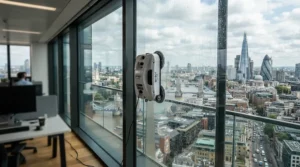
The flat-dweller with floor-to-ceiling glass. Large, uninterrupted panes are a robot’s natural habitat. For interior glass and balcony doors, the Hobot S7 Pro‘s corner reach suits this layout. If you want fewer cables, the Ecovacs Winbot W2 Pro Omni is the splurge. Budget: £200 to £600. Frequency: monthly.
The 3-bed semi with Georgian-style gridded sashes. Honestly, robots struggle here. Small multi-pane windows defeat them, as Which? warns. A bucket, squeegee and a professional exterior round at £15 to £25 per visit is probably smarter. A Karcher RCW 2 would still handle the patio doors.
The cautious homeowner who dislikes ladders. Use a robot for the big accessible panes and book a professional for upper exteriors. This hybrid approach respects the safety guidance covered later, and pairs well with an entry model like the Memows Window Cleaner Robot for low-risk trials.
Is a Window Cleaning Robot Worth It? The Honest Maths
So, is a window cleaning robot worth it? It depends on three variables: how much suitable glass you have, how often you clean, and how much you value your Saturday.
Run the numbers on a simple basis. A 3-bed semi cleaned by a professional at £15 to £25 every six weeks costs roughly £135 to £225 a year. A mid-range robot at around £180 pays for itself in about a year, if it genuinely replaces that service. But it doesn’t automatically do upstairs exteriors, and it can’t navigate small gridded panes.
My honest take: if you’ve got large, flat, reachable panes and you’d otherwise postpone cleaning for months, a robot is worth it. If you’ve got lots of small panes, a squeegee wins. In between, the AlfaBot X7Pro or the Karcher RCW 2 offers the best price-to-capability balance on paper.
Robot Window Cleaner vs Professional Cleaner Cost Over Three Years
Here’s the three-year view, using published UK ranges. Assume £15 to £25 per exterior visit, 6-weekly (about 9 visits a year) or 4-weekly (about 13 visits).
| Option | Year 1 | Three years | Notes | Best For |
|---|---|---|---|---|
| Pro, 6-weekly | £135 to £225 | £405 to £675 | Exterior only, typically | Busy households |
| Pro, 4-weekly | £195 to £325 | £585 to £975 | Pristine year-round | Roadside or coastal homes |
| Budget robot (e.g. Memows Window Cleaner Robot) | Under about £150 | Under about £200 | Add spare pads | Trial runs |
| Karcher RCW 2 | About £180 to £220 | About £200 to £260 | Reachable panes only | Mid-range sweet spot |
| Ecovacs Winbot W2 Pro Omni | £450 to £650 | £450 to £700 | Convenience premium | Large awkward glass |
The maths tilts toward robots quickly, with a mid-range model recouping its cost within roughly a year against a 6-weekly service. But the comparison isn’t like for like. A professional with a water-fed pole reaches upper exteriors that a robot can’t without you leaning out. Think of the robot as replacing your own labour, rather than replacing the window cleaner.
Professional Cleaning Service Cost in the UK: What You’ll Really Pay
What does professional cleaning service cost look like in practice? Published 2026 guides vary. Fantastic Services puts professional window cleaning at roughly £12 to £55 per visit, mostly by property size. Whito’s September 2026 roundup lists a 3-bed semi at £12 to £18 on one platform and £20 to £40 on another, while Checkatrade shows starting prices from around £35 and hourly rates of £25 to £40.
Extras climb quickly. Add-on guides suggest inside cleaning at around 50% of the exterior price, and conservatory roofs or gutters cost more. First cleans are often pricier too, since the grime has accumulated.
Practically, that means a regular round on a standard semi lands around £15 to £30 a visit. Get two or three quotes, ask what’s included and check whether they use water-fed poles, which are typically a little cheaper and avoid ladders altogether.
DIY Window Cleaning vs Robot: Where Each One Wins
DIY window cleaning vs robot isn’t a fight with a villain. It’s two different tools for two different jobs.
| Factor | Robot | Bucket and squeegee | Window vac |
|---|---|---|---|
| Effort | Very low | High | Medium |
| Edges | Varies by model | Best | Good |
| Upfront cost | £60 to £600 | Under £20 | Modest |
| Best For | Big flat panes, e.g. Hobot S7 Pro | Small panes, tight budgets | Reachable glass, condensation |
Which? says that if your glass is easily accessible and you don’t mind some effort, a window vacuum is cheaper and faster. But for hard-to-reach first- or second-floor spots, a robot is the better option, though pricier.
Read the table this way: the squeegee wins on edge quality and price, while the robot wins on effort and awkward placement. Hobbyists with small windows should stay manual, and people with big glass doors and bad knees should seriously consider the Hobot S7 Pro or similar.

Cleaning Quality Comparison: Streaks, Edges and Corners
A fair cleaning quality comparison needs three lenses.
Streaks. A trained human with a squeegee is still the benchmark. Robots use microfibre pads and fine mists, which usually leave a clean but not always perfectly polished finish. Dual-spray designs like the AlfaBot X7Pro help by keeping the surface evenly damp.
Edges. This is where robots trail. Which? notes that pads often don’t reach right to the device’s edge, so strips can be missed. The Ecovacs Winbot Mini Gen 2 claims 1mm edge work, but that’s a claim, not a lab result.
Corners. Round pads are the culprit again. Square bodies like the Hobot S7 Pro fare better on paper.
The takeaway: for large panes a robot gets you roughly 90% there with little work, and a quick cloth finish handles the rest. If you want showroom-perfect edges, you’ll still end up picking up a microfibre.
Time Savings: How Many Hours Does a Robot Really Give Back?
The time savings argument is often overstated, so let me be precise. These are planning assumptions rather than measured results.
Assume 12 panes. By hand, allow roughly 5 to 8 minutes per pane including prep and wipe-down. That’s 60 to 95 minutes per side, and 2 to 3 hours for both sides with ladder shuffling. A robot’s cycle may take just as long on the clock, but your hands-on time drops sharply. You place it, start it and move on, then spend perhaps 10 minutes washing pads afterwards.
So the real benefit is reclaimed attention, rather than a shorter elapsed time. You can load the dishwasher or answer emails while the glass cleans itself. If your windows are small and numerous, repositioning the robot each time erodes that benefit fast.
How to Choose a Robot Window Cleaner (5 Steps)
- Audit your glass. Count your large, flat, single panes. Gridded or multi-pane windows are a poor fit, as Which? warns.
- Pick your power approach. Mains with an emergency battery is the common safe choice. Cordless station models like the Ecovacs Winbot W2 Pro Omni cost more but cut cable hassle.
- Choose body shape. A square or rectangular body reaches corners better than round pads, according to Which?.
- Check the tank and spray. A bigger tank (like AlfaBot X7Pro‘s 60ml) means fewer interruptions.
- Confirm safety kit. A tether, backup battery and edge sensors matter more than app features.
Features That Actually Matter (And Those That Don’t)
Matter: a safety rope, an emergency battery, edge sensors and a body shape that suits your corners. Cable length matters too, since a short lead can ruin your plan for the big patio door.
Matter somewhat: water tank size, remote control (a real bonus on the Karcher RCW 2), and voice prompts.
Mostly marketing: headline suction figures. Pa ratings aren’t standardised across brands, so a 6,500Pa claim on the Lubluelu CHYW200 doesn’t guarantee better cleaning than a lower rating elsewhere. Likewise, treat long lists of “protection levels” or app modes as bonuses, not decision-makers.
Safety Guide: Ladders, Tethers and UK Rules
Here’s the uncomfortable bit. Ladders are a major cause of falls from height. Workplace figures cited in HSE-derived guidance suggest roughly a third of such falls involve ladders and stepladders, with about 14 deaths and 1,400 injuries a year. Those are workplace stats, but the HSE believes misuse at work partly reflects how ladders get used at home.
The HSE’s work-at-height guidance sets out a simple hierarchy: avoid work at height where possible, prevent falls where you can’t, and reduce the consequences otherwise. A robot fits the first step neatly for accessible panes, since you’re not climbing anything.
Robots bring their own safety points:
- Always anchor the tether to a secure indoor point.
- Choose a model with an emergency battery.
- Never leave it running unattended on upper-floor glass.
- Take extra care on frameless glass, where edge detection may be absent.
For upper exteriors, hiring a pro with a water-fed pole is often the safest route.

FAQ
❓ Can a robot window cleaner replace a window cleaner for outside windows?
❓ Do robot window cleaners work on frameless glass?
❓ How much does a window cleaner cost per month in the UK?
❓ Do window cleaning robots leave streaks?
❓ Is it cheaper to buy a robot or keep paying a window cleaner?
Conclusion
So, where does robot window cleaner vs manual cleaning land? The robot wins on effort, safety and awkward placement. The squeegee wins on edges, price and small panes, and a professional wins on height and consistency. Nobody gets everything for free.
Here’s the short version. If you’ve got large, reachable, flat glass and hate the chore, a robot is a smart buy, with the Karcher RCW 2 and Hobot S7 Pro as the sensible mid-range picks. Tight on budget? The Memows Window Cleaner Robot or AlfaBot X7Pro are the low-risk way in. If you’ve got lots of tricky glass and the money, the Ecovacs Winbot W2 Pro Omni buys convenience. And if your house is all Georgian grids and upstairs exteriors, stick with a squeegee and a professional.
Whichever way you go, count your panes, check the safety kit and keep a microfibre cloth handy for the corners.
✨ Ready to reclaim your weekends?
🔍 Compare the picks above, check current prices and availability on each product name, and choose the method that fits your glass, your budget and your Saturdays. Your future self (and your ladder) will thank you!
Recommended for You
- Robot Window Cleaner With Remote Control: 7 Best UK Picks (2026)
- Robot Window Cleaner For Large Windows: 7 Best Picks UK (2026)
- Robot Window Cleaner For High-Rise Flats: 7 Safest Picks (2026)
Disclaimer: This article contains affiliate links. As an Amazon Associate, I earn from qualifying purchases. If you purchase products through these links, we may earn a small commission at no additional cost to you.
✨ Found this helpful? Share it with your friends! 💬🤗
