
In This Article
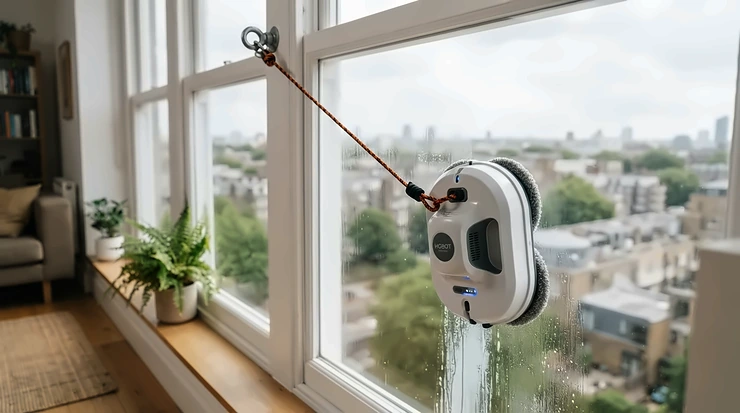
There’s a particular British dread reserved for the first dry Saturday after a month of grey. Bucket, squeegee, wobbly stepladder, and a conservatory roof glaring down at you. A vertical glass cleaning robot offers a way out. Stick it to the pane, press start, and it crawls across the glass on suction, spraying and wiping while you get on with something, anything, else. In 2026 a vertical glass cleaning robot is no longer a gadget for facilities teams in glass towers. ECOVACS puts household prices at roughly £200 for a decent basic model, rising to around £400 for premium ones.
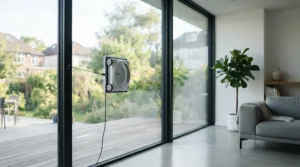
Here’s the plot twist most listicles skip. Most British homes have insulated glazing: two sealed panes in uPVC, aluminium or timber frames. Those frames, not the glass, usually decide whether a robot succeeds. Raised beads, slim sashes and tiny panes trip up machines that glide happily across a frameless shower screen. So this guide goes beyond “top picks” and weighs frame thickness compatibility, double-glazing suitability and cleaning path patterns, plus glass doors and the evidence behind the reviews.
One honesty note first. Nothing here comes from hands-on testing. It’s built from manufacturer specifications, retailer listings and published roundups, and I flag the thin spots rather than papering over them.
What is a vertical glass cleaning robot?
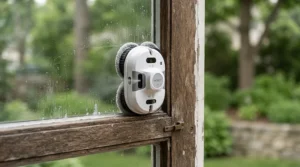
A vertical glass cleaning robot is a small, self-propelled appliance that clings to windows, glass doors, mirrors or shower screens using suction, then moves in a programmed path while spraying and wiping the surface. It carries a safety rope and backup power, so a cable or mains failure doesn’t send it tumbling.
Who is it for? Anyone with large, flat, hard-to-reach glass: patio doors, conservatory ends, first-floor picture windows. It’s a poorer match for small-paned sash windows or heavily decorated glass, where the manual squeegee still wins.
Quick Comparison: Which Vertical Glass Cleaning Robot Fits Which Home?
| Pick | Standout Trait | Best For |
|---|---|---|
| ECOVACS WINBOT W2 OMNI | Docking station, runtime quoted up to 110 minutes | Large glazing, many windows |
| HOBOT S7 Pro | Dual cloths plus ultrasonic mist | Streak-averse owners, frameless edges |
| HOBOT SP-10 iScraper | Any glass thickness, scraper system | Mixed or older glazing, shop fronts |
| ECOVACS WINBOT MINI | Compact body | Small and awkward panes |
| SYTEH Electric Window Cleaner | Low cost, 4m cord | Budget buyers with plain glass |
Looking at the comparison above, the WINBOT W2 OMNI is the one to beat if you have acres of glass, while the HOBOT S7 Pro is the finish-first choice. The SYTEH Electric Window Cleaner trades suction and speed for a lower price, so it suits simple, flat, clean panes. Notice that none of these labels says “best for narrow frames”. That’s the gap the rest of this guide fills.
💬 Just one click — help others make better buying decisions too!😊
Top 7 Vertical Glass Cleaning Robots: Expert Analysis
Every entry below is analysis rather than a rewritten listing. Specs come from manufacturers and retailers, framed by what they mean on an actual window. Price bands are indicative at the time of research, so check current price before buying.
1. ECOVACS WINBOT W2 OMNI — docking station that tidies its own cord
The party piece is the multi-function station. Hand the robot back and the cord retracts by itself, and the station can supply power when no socket sits near the window. ECOVACS states over 800N of suction and a 5,500 Pa fan, steered by WIN-SLAM 4.0 route planning at around 11cm a second. The brand also claims it clears low obstacles above 4mm, such as window handles, and runs as quietly as 63 dB.
The runtime is quoted at up to 110 minutes, against 30–60 minutes typical elsewhere. That means a big patio door and a row of upstairs windows in a single outing. Based on the spec comparison, this is the model for floor-to-ceiling glass and houses with a dozen windows. Mind the limits, though. ECOVACS lists windows as small as 30 x 40cm as workable, and warns that frames narrower than 5mm can cause trouble.
Review signal: several 2026 roundups rank the WINBOT W2 family at or near the top, but most are affiliate-driven. I couldn’t verify a large pool of genuine owner reviews, so treat the praise as directional.
Pros:
- ✅ Station retracts the cord automatically
- ✅ Very long quoted runtime
- ✅ Seven cleaning modes, including edge and spot
Cons:
- ❌ Premium bracket overkill for small flats
- ❌ Frames under 5mm flagged as problematic
Price and verdict: expect roughly £350–£450. It’s worth it for large glazing and poor value for three small windows.

2. HOBOT S7 Pro — dual-cloth polish for streak-haters
HOBOT’s figures show twin cloths shuttling around 600 times a minute over a 4mm stroke, while an ultrasonic nozzle lays down a 15µm mist. The lower cloth lifts dirt and the upper one chases water marks on the next row. Retailer listings add the practical numbers: 4,800 Pa suction, a 4m cable, a small 26ml tank, 64 dB noise and a 1.67kg body. Minimum glass thickness is quoted at 4–5mm, so thin or old panes deserve a manual check.
The real-world meaning is a finish-first machine. Listings quote about 20 minutes of operating time, which reads as the safety-battery window rather than a cordless promise. Mains power means it won’t quit halfway across a bifold door. Edge-Leakage Bumper sensors detect air escaping at frameless edges, and silicone bumpers protect frames. That’s a thoughtful combination wherever glass meets painted timber or uPVC.
Review signal: one Central European retailer shows 4.5/5 from just seven ratings, which is encouraging but statistically thin. eufy, a brand that sells robot vacuums rather than window robots, names it top in its 2026 roundup.
Pros:
- ✅ Dual cloths target streaks and water marks
- ✅ Edge sensors suit frameless glass
- ✅ Silicone bumpers protect frames
Cons:
- ❌ Tiny tank needs refills on big panes
- ❌ Short 4m cable limits reach
Price and verdict: roughly £350–£450. It’s strong value if streak-free glass tops your wish list.
3. HOBOT SP-10 iScraper — scraper system for glass of any thickness
Where most robots rely on wiping alone, this one adds a Dual Glide Scraper inside HOBOT’s three-stage SSS cleaning system. That’s handy for dried-on splashes a damp cloth merely smears. HOBOT quotes 6,000 Pa suction, a UPS backup that holds the robot for up to 20 minutes in a power cut, and operation on glass of any thickness and finish. It measures the pane itself, copes with areas up to 5 x 6 metres, and needs a minimum surface of about 50 x 50cm.
On paper that makes it the most forgiving model here for mixed glazing: thinner older panes, thick toughened doors, mirrored wardrobes, even shop windows. The sensors also detect air escaping between frameless panels, which matters on glass balustrades and shower enclosures. Four cleaning modes, including fine, fast and long-duration, let you trade speed for thoroughness. Over-the-air firmware updates mean navigation can improve after purchase.
Review signal: I couldn’t find a sizeable verified UK owner pool. A 2026 roundup lists it fourth of four, as “best alternative”. Treat it as promising but under-evidenced.
Pros:
- ✅ Works on glass of any thickness
- ✅ Scraper loosens dried-on marks
- ✅ 6,000 Pa quoted suction
Cons:
- ❌ 50 x 50cm minimum excludes small panes
- ❌ Limited verifiable owner feedback
Price and verdict: roughly £350–£500. It’s worth it for varied or frameless glass and a skip for small-paned windows.
4. ECOVACS WINBOT MINI — compact body for smaller panes
ECOVACS pitches it as space-saving, with flexible movement, ultrasonic spray, edge cleaning, nine safety features and WIN-SLAM 3.0 navigation. A smaller footprint gets into places bigger machines can’t turn: bathroom windows, narrow side-lights, the pane above the kitchen sink. I couldn’t confirm a suction figure in the sources I reviewed, so check the product page before you commit.
Here’s the honest trade-off. WIN-SLAM 3.0 is a generation behind the WINBOT W2 OMNI‘s 4.0, which ECOVACS says plans routes around 30% more efficiently. So the WINBOT MINI gives up some route-planning polish for manoeuvrability. For a flat with several modest windows, that’s often the right swap. For a glass-walled extension, it’ll feel slow.
Review signal: one 2026 ranking places it third as “best compact”. I couldn’t verify a large owner-review base, so the evidence is modest.
Pros:
- ✅ Compact enough for small panes
- ✅ Nine separate safety features
- ✅ Edge cleaning and ultrasonic spray
Cons:
- ❌ Older WIN-SLAM 3.0 navigation
- ❌ Suction and runtime unconfirmed in sources
Price and verdict: likely the mid bracket, roughly £200–£300. It’s good value for small windows and a weak fit for huge glazing.
5. HUTT W8 — N+Z dual-path planning and a big tank
The HUTT W8 offers three modes (fixed-point, daily and deep) and “N+Z” dual-path planning that claims 99% window coverage. Its 80ml tank is generous: roughly three times the HOBOT S7 Pro‘s. Brushless fans deliver a stated 3,200 Pa. A backup battery holds about 20 minutes and sounds an alarm, and the safety rope is rated for a 148kg pull. It even gives spoken status updates, which you’ll either enjoy or merely tolerate.
In practice the larger tank means fewer interruptions on a patio door. The N+Z logic means two passes in different directions, which should catch spots a single sweep leaves behind (more in the cleaning path patterns section below). At 3,200 Pa it’s mid-pack suction, fine on flat, clean uPVC but less reassuring where seals or beads leak air.
Review signal: it appears as a “popular option” in eufy’s 2026 roundup, but I couldn’t verify independent owner ratings.
Pros:
- ✅ 80ml tank means fewer refills
- ✅ Dual-path planning with deep mode
- ✅ Strong 148kg safety-rope rating
Cons:
- ❌ Mid-pack 3,200 Pa suction
- ❌ Little verifiable owner feedback
Price and verdict: roughly £150–£250. It’s a sensible middle ground for plain flat glass.
6. SYTEH Electric Window Cleaner — budget pick with a 4m cord
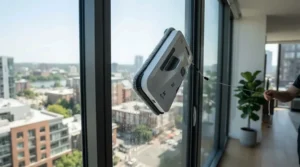
The SYTEH Electric Window Cleaner is notably cheaper than the premium names. It brings a double-spiral cleaning head, AI obstacle detection, 2,800 Pa of suction, a 4m high-strength wire and anti-drop algorithms. It switches itself off when finished, which is a nice touch.
Here’s what that means on a real pane. Its quoted pace is about one square metre in four minutes, so ten square metres of glazing is roughly forty minutes of crawling. That’s fine if you’re making tea and slower than you’d like on a conservatory. With the lowest suction in this round-up, it’s best on dry, smooth, flat glass with a generous frame, not on bumpy or leaky edges.
Review signal: it appears in one retailer-brand roundup, and I couldn’t find a large verifiable pool of owner reviews. Buy it with modest expectations.
Pros:
- ✅ Lowest cost of the seven
- ✅ AI obstacle detection included
- ✅ Auto shut-off after finishing
Cons:
- ❌ Lowest suction in this group
- ❌ 4m cord limits big panes
Price and verdict: probably the budget bracket, below roughly £200. It’s decent value for simple, flat glazing.
7. Yoolax Window Cleaning Robot — square body that reaches corners
The Yoolax Window Cleaning Robot (also listed as Yooalx) is square, with three automatic cleaning paths and control by remote or app. It has a 50ml tank with a spray nozzle on two sides and a voice alarm when water runs low. Suction is quoted at 3,000 Pa, with UPS protection and a spoken alert if power drops.
Why does the shape matter? In principle a square footprint puts the cleaning surface closer to corners than a round body can reach, which helps on rectangular uPVC casements. Three selectable paths let you match effort to dirt, quick on a dusty pane and slower on a grimy one. The low-water alarm is a small feature that saves a wasted run.
Review signal: I only found it in a single roundup, with no verifiable owner-review data. Treat any glowing claim cautiously.
Pros:
- ✅ Square body for tighter corners
- ✅ Remote and app control
- ✅ Low-water voice alarm
Cons:
- ❌ Modest 3,000 Pa suction
- ❌ Thin evidence base
Price and verdict: budget bracket, probably under £200. It’s worth a look for rectangular glass, with clear caveats.
Top 7 at a Glance
| Model | Stated Suction | Standout Spec | Indicative Price | Review Signal | Best For |
|---|---|---|---|---|---|
| ECOVACS WINBOT W2 OMNI | 5,500 Pa | Station, up to 110 min | £350–£450 | Roundups favourable, owner pool unverified | Big glazing |
| HOBOT S7 Pro | 4,800 Pa | Dual cloths, 15µm mist | £350–£450 | 4.5/5 from 7 retailer ratings | Streak-free finish |
| HOBOT SP-10 iScraper | 6,000 Pa | Any glass thickness | £350–£500 | Limited | Mixed glazing |
| ECOVACS WINBOT MINI | Not confirmed | Compact, 9 safety features | £200–£300 | Limited | Small windows |
| HUTT W8 | 3,200 Pa | 80ml tank, N+Z paths | £150–£250 | Limited | Mid-range value |
| SYTEH Electric Window Cleaner | 2,800 Pa | 4m cord, auto shut-off | Under £200 | Limited | Tight budgets |
| Yoolax Window Cleaning Robot | 3,000 Pa | Square body, 3 paths | Under £200 | Limited | Rectangular glass |
The table shows a clear split. Premium models pair higher quoted suction with better edge sensing, while the budget trio relies on basic obstacle detection. Note that “limited” in the review column is a finding, not a verdict. It means I couldn’t verify enough genuine owner feedback to quote a rating.
Setting Up and Maintaining Your Vertical Glass Cleaning Robot: The First 30 Days
Before the first run
Clear loose grit first. Dried leaves and bird mess can scratch if dragged under a cloth. Charge the unit and fill the tank with the supplied solution. Fix the safety rope to something properly solid, never a flimsy handle. ECOVACS stresses using the extra rope and keeping surfaces dry, so skip rainy days.
The 30-day habit loop
Start with a low, easy window so you can watch how it handles the edge. Move up to taller panes in week two. Wash the pads after every session, because ECOVACS notes dirty pads cause smudges. Wipe the sensors regularly and keep firmware updated, since a neglected sensor is how a robot misjudges an edge.
Mistakes to dodge
- Running it on condensation or oily smears, which hampers adhesion
- Operating below 0°C or above 40°C, which ECOVACS says can upset battery and motor
- Forgetting that you still have to carry it from pane to pane
- Leaving the cord draped across a sill where it can snag

Real-World Scenarios: Matching a Vertical Glass Cleaning Robot to Your Home
Scenario 1: the Victorian terrace. Eight small sash windows, a budget of about £150, cleaning monthly. Honestly, robots struggle here. Small panes may fall under minimum sizes such as 30 x 40cm for the WINBOT W2 OMNI or 50 x 50cm for the HOBOT SP-10 iScraper. If the panes are big enough, the ECOVACS WINBOT MINI is the logical test, but a squeegee may still win.
Scenario 2: the 1990s semi with a conservatory. uPVC casements, conservatory end panels, cleaning every fortnight in summer, budget around £200. The HUTT W8‘s large tank and dual paths suit those wide, flat panels. The SYTEH Electric Window Cleaner is the cheaper alternative if the glass is plain and clean.
Scenario 3: the new-build with big glazing. Floor-to-ceiling panels, a glass balustrade, weekly runs, budget up to £450. The ECOVACS WINBOT W2 OMNI handles scale. The HOBOT SP-10 iScraper or HOBOT S7 Pro make sense where frameless edges and streak control dominate. This reasoning is based on the spec comparison, not hands-on trials.
✨ Ready to Retire the Ladder?
🔍 Take your window routine to the next level with these carefully selected robots. Click on any highlighted product name to check current pricing and availability. A safer, quieter Saturday could be one click away!
How to Choose a Vertical Glass Cleaning Robot: 7 Steps
- Measure your smallest pane. Minimum sizes range from about 30 x 40cm to 50 x 50cm, so tiny panes can rule models out immediately.
- Check the frame. Measure frame width and bead height before buying, as covered in the frame thickness compatibility section below.
- Decide how it’s powered. Cables sit around 4m on some models, while the ECOVACS WINBOT W2 OMNI station can power the robot. Plan for socket reach.
- Check safety layers. Look for a rope, a UPS or battery backup (around 20 minutes is common), and anti-drop sensing.
- Match suction to glass. The quoted range is about 2,800–6,000 Pa, but strong suction means little if seals leak air at the edge.
- Weigh path logic and tank size. An 80ml tank on the HUTT W8 means fewer refills than a 26ml tank.
- Do the value sums. Checkatrade is cited as putting typical professional window cleaning at about £25–£40 an hour. A robot in the £200–£400 range can pay back after several visits.
Frame Thickness Compatibility: What the Spec Sheet Won’t Tell You
Frame thickness compatibility is the least-discussed deciding factor. A robot needs a continuous, flat surface and a sensor-readable edge. If the frame is too narrow, too proud or too uneven, the machine can misread where the glass ends. ECOVACS flags frames narrower than 5mm as a problem area, and says the WINBOT W2 OMNI handles low obstacles above 4mm, such as window handles.
What does that mean for a British window? On many uPVC casements the glass sits slightly recessed behind a bead, creating a small step. If that step is taller than the robot’s obstacle threshold, it may stall or tilt. Slim aluminium frames and flush-glazed units can sit below the minimum width entirely.
Frameless-capable designs help. The HOBOT S7 Pro and HOBOT SP-10 iScraper use sensors that detect air leaking at edges, and silicone bumpers protect the frame. Retailer listings put the HOBOT S7 Pro‘s minimum glass at 4–5mm, while the HOBOT SP-10 iScraper is described as suited to any thickness.
A practical tip: measure frame width and step height with a ruler, then compare against the manual’s stated limits. Test first on one forgiving pane.
Double-Glazing Suitability: Choosing a Robot Cleaner for Double Glazed Windows
Double-glazing suitability starts with a reassuring fact. As BRANZ explains, a double glazing unit is two panes enclosing an airspace, with sealed edges. The robot only touches the outer pane, so overall unit thickness rarely matters. A robot cleaner for double glazed windows really cares about flatness, cleanliness and dryness.
What can go wrong
- Misted units. If a seal fails, moisture can form between the panes. No robot can clean the inside of a sealed unit, so treat that as a glazier’s job.
- Surface condensation. ECOVACS says condensation hampers adhesion, so wait until the pane is dry.
- Textured or obscured glass. Bumpy surfaces leak air and weaken grip, so test before trusting the rope.
- Films and coatings. HOBOT’s older models list window-film, coated and reflective glass as compatible, but check your own model.
Which models suit best
For a robot cleaner for double glazed windows in standard uPVC frames, the HUTT W8 and ECOVACS WINBOT W2 OMNI make practical sense. Where panes vary in thickness or finish, the HOBOT SP-10 iScraper‘s any-glass design is reassuring. For tall upstairs units, a safety rope is non-negotiable, whatever the model.
Cleaning Path Patterns Explained: Z, N and Smart Planning
Cleaning path patterns decide whether a pane comes out streak-free or striped. Simple robots zigzag in horizontal rows (a Z-style pass). Others sweep vertical columns (an N-style pass), and smarter models plan routes by mapping the pane first.
What the makers describe
The HUTT W8 advertises “N+Z” dual-path planning, claiming 99% coverage. The Yoolax Window Cleaning Robot offers three automatic paths. ECOVACS says the WINBOT W2 OMNI‘s WIN-SLAM 4.0 plans routes to avoid overlap and improves efficiency by about 30% over the previous generation. The HOBOT S7 Pro uses gyro navigation, with a lower cloth wiping and an upper cloth catching water marks on the next row.
What it means for you
- Horizontal rows are quick, but streaks run sideways and drips can run down onto cleaned glass.
- Vertical columns let gravity work with you, since drips fall along the path.
- Dual-path or double-cycle modes cost time, but a second pass in a different direction can catch missed bands.
- Border-first logic helps because edges collect the most grime.
As a rule, choose a faster path for weekly maintenance and a deep mode for neglected glass.
Glass Door Cleaning Robot: Shower Screens, Patio Doors and Frameless Panels
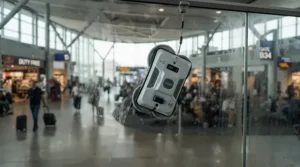
A glass door cleaning robot works best where the glass is flat, big and mostly uninterrupted. ECOVACS says the WINBOT W2 OMNI‘s frame detection supports shower glass doors and other frameless panes, and it handles surfaces tilted between 60° and 120°. HOBOT lists the HOBOT SP-10 iScraper for windows, glass doors, mirrors, mirrored wardrobes, shop windows and shower enclosures.
For patio doors, the main hurdle is the handle and any raised frame. A glass door cleaning robot with edge-leak sensing, such as the HOBOT S7 Pro, is reassuring on frameless balustrade glass. Be realistic about shower screens. Heavy limescale and soap film can overwhelm a damp pad, and ECOVACS cautions against oil stains and condensation. Pre-wipe the worst of it and check the pane is dry before attaching.
Finally, curved or irregular glass is out. ECOVACS lists arched and irregular shapes as restricted, so a glass door cleaning robot is strictly a flat-glass tool.
Vertical Window Robot Cleaner Review: What the Evidence Actually Says
A fair vertical window robot cleaner review starts with an admission. Genuine, verifiable owner feedback is thinner than the web suggests. Several 2026 “best of” pages are affiliate-driven, and some are near-duplicates of each other. What I could verify is small: a 4.5/5 average from seven ratings for the HOBOT S7 Pro at one retailer, plus rankings that disagree. eufy leads with the HOBOT S7 Pro, while another roundup puts the ECOVACS WINBOT W3 OMNI first.
Themes that recur
Across published roundups and manufacturer guidance, the recurring points are consistent. Good models need strong safety systems, sensible edge detection and regular pad maintenance. Even eufy’s FAQ concedes that robots struggle with very dirty windows, uneven surfaces and tight corners.
How to read any vertical window robot cleaner review
- Prefer reviews that state window type and frame style
- Distrust perfect scores with no stated drawbacks
- Look for mentions of edge behaviour and battery backup
- Note whether the reviewer actually owned the model
Vertical Glass Cleaning Robot vs Traditional Cleaning
| Factor | Vertical Glass Cleaning Robot | Ladder and Bucket | Professional Cleaner |
|---|---|---|---|
| Ongoing cost | Upfront spend, low running cost | Cheap, but your time | Roughly £25–£40 an hour |
| Safety | Rope plus backup power | Ladder fall risk | Insured, trained crews |
| Edges and corners | Variable by model | Excellent | Excellent |
| Effort | Move robot between panes | High | None |
| Best For | ECOVACS WINBOT W2 OMNI (large glass) | Small windows | Heavy build-up, odd shapes |
The table shows robots excel on large flat panes and lose on edges and awkward shapes. For recurring maintenance, a HOBOT S7 Pro or HUTT W8 can replace several paid visits. For gutters, frames and oddly shaped glass, a pro or a squeegee still earns its keep.
The safety angle
HSE’s guidance on working at height whilst window cleaning says to avoid work at height where reasonably practicable, for example by cleaning from inside. That guidance is aimed at businesses, but the principle applies at home. A robot cuts ladder time, though you still need to secure its rope and keep surfaces dry.
Long-Term Cost and Maintenance: What Owning One Really Costs
Think in total cost of ownership. Illustratively, if a professional visit costs around £30 and you’d book four a year, that’s about £120 annually. A robot costing roughly £300 would then pay back in around two and a half years, before counting your time. Those numbers are an example, not a promise.
Running costs
- Pads: replacement pads are sold separately, as for the WINBOT W2 family, so budget for a few sets.
- Battery and cord: check the rope and cable for wear, since a frayed lead is a safety risk.
- Solution: many models ship with cleaning solution, but you’ll refill eventually.
The hidden variable
Your habits. A robot that sits in a cupboard saves nothing. Models with stations or lighter bodies, such as the ECOVACS WINBOT W2 OMNI and ECOVACS WINBOT MINI, tend to be easier to use regularly, which is where value really lives.
FAQ
❓ How much does a vertical glass cleaning robot cost in the UK?
❓ Can a glass door cleaning robot handle a shower screen?
❓ Is it safe to run a robot cleaner for double glazed windows in winter?
❓ Do window robots work without a plug socket nearby?
❓ What if my frame is thinner than the sensors expect?
Conclusion
A vertical glass cleaning robot won’t replace every squeegee, but on large, flat, hard-to-reach glass it earns its place. The ECOVACS WINBOT W2 OMNI suits big glazing, the HOBOT S7 Pro and HOBOT SP-10 iScraper favour finish and edge handling, the ECOVACS WINBOT MINI tackles small panes, and the HUTT W8, SYTEH Electric Window Cleaner and Yoolax Window Cleaning Robot cover the budget end.
The practical lesson is that frame thickness compatibility, double-glazing suitability and cleaning path patterns matter more than any headline suction number. Measure your panes and frames, check the manual’s limits, and test on a forgiving window first. Remember too that verified owner feedback is thin, so buy with eyes open and keep the safety rope attached.
✨ Ready to put your Saturdays back?
🔍 Pick the vertical glass cleaning robot that fits your windows, click any highlighted product name to check current pricing and availability, and let the glass look after itself.
Recommended for You
- Safest Robot Window Cleaner: 7 Proven Picks For UK Homes (2026)
- Robot Window Cleaner Under £200: 7 Best Picks For UK Homes (2026)
- Robot Window Cleaner: 7 Best Picks For UK Homes (2026)
Disclaimer: This article contains affiliate links. As an Amazon Associate, I earn from qualifying purchases. If you purchase products through these links, we may earn a small commission at no additional cost to you.
✨ Found this helpful? Share it with your friends! 💬🤗
