
In This Article
Nobody has ever looked at a smeary patio door on a sunny Sunday and thought, “Lovely, I’ll spend the afternoon on a stepladder.” Yet British weather keeps laying down a film of grime the moment the squeegee goes back in the cupboard. A robot window cleaner offers a way out. It clings to the glass, wipes in tidy lines and keeps your feet firmly on the ground.
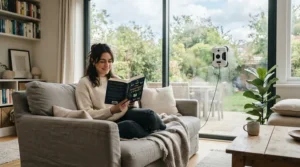
Does it deliver? TechRadar’s reality check on whether robot window cleaners are any good lands somewhere sensible. These machines shine at routine upkeep of large flat panes. They are not miracle workers on baked-on bird mess, odd-shaped glazing or the last few millimetres beside a frame. That balance runs through this robot window cleaner buying guide.
Here is how I’ve approached it. I haven’t hands-on tested any of these machines, so you won’t find invented anecdotes. Instead, I’ve cross-checked manufacturer specifications, UK retailer listings and independent reviews, then translated the numbers into what they mean on your windows. Where evidence is thin, I say so.
You’ll get seven real models, from sub-£200 budget buys to premium cordless systems. You’ll also get plain-English explainers on window cleaning robot suction technology, the safety tether and the squeegee cleaning path. And you’ll see which window robot for homes suits flats, period properties and big glass extensions. Prices are ranges only, because they move constantly. Check current price before buying.
Quick Comparison: Seven Robot Window Cleaner Options at a Glance
| Product | Standout trait | Maker-quoted suction | Price range | Best For |
|---|---|---|---|---|
| Ecovacs Winbot W2S Pro Omni | Corner scrubbers, cordless station | 10,000 Pa | £500-£550 | Big glazing, edge-fussy owners |
| Ecovacs Winbot W2 Pro Omni | Cordless, charges while cleaning | 2,800 Pa (5,500 Pa emergency) | Premium; check current price | Windows far from sockets |
| Hobot S7 Pro | Dual vibrating pads | 4,800 Pa | £300-£350 | Large flat panes |
| Ecovacs Winbot Mini2 | Compact body, five modes | Check listing | Around £250 | Small-to-medium panes |
| Hutt W8 | Self-adjusting suction | 1,850-3,800 Pa | £200-£250 (verify UK listing) | Mixed glass and tiles |
| Kärcher RCW 2 | Established brand, remote | 3,300 Pa (max 5,000 Pa) | Under £200 | Cautious budget buyers |
| AlfaBot X7Pro | Lowest entry price | Varies by listing | Under £200 | Tight budgets |
Reading across the rows, the Kärcher RCW 2 and AlfaBot X7Pro undercut everyone on price. The two premium Ecovacs machines only justify their cost if cordless freedom matters to you. The Hobot S7 Pro sits in the sweet spot for big panes, while the Ecovacs Winbot Mini2 is the logical choice when your panes are small. Suction numbers aren’t directly comparable between brands, so treat them as safety indicators rather than a league table.
💬 Just one click — help others make better buying decisions too!😊
Top 7 Robot Window Cleaner Picks: Expert Analysis
Each entry below blends published specs with aggregated review sentiment from real sources. None of it comes from personal testing.
1. Ecovacs Winbot W2S Pro Omni — best premium all-rounder with edge scrubbers
Most robots stop a few centimetres short of the frame. The Ecovacs Winbot W2S Pro Omni adds four corner scrubbers and TruEdge 2.0 to creep closer.
Ecovacs quotes 10,000 Pa suction, a triple-nozzle spray, eight cleaning modes and WIN-SLAM 4.0 path planning. The Omni station charges, stores and controls the robot, giving up to 110 minutes of cordless running. In practice, that big suction figure is safety headroom rather than scrubbing force. The station means you aren’t hunting for a socket beside every pane. A leash with carabiner is included as the safety tether.
Based on the spec comparison, this is the model for long runs of glazing such as bifolds and orangery panes, where dirty edges show most. At this price, it only makes sense if you have a lot of glass.
Review sentiment is the honest gap. It launched in September 2026, so I couldn’t verify a meaningful pool of independent owner reviews yet. Treat it as promising rather than proven. Its close relative, covered next, has a stronger paper trail.
Pros:
- ✅ Corner scrubbers target the frame-edge gap
- ✅ Cordless station supports up to 110 minutes
- ✅ High quoted suction gives safety headroom
Cons:
- ❌ Brand new, so owner feedback is scarce
- ❌ Top-tier price for modest window counts
Price range: £500-£550 at launch. Value verdict: superb for large glass, overkill for a terrace of sash windows.

2. Ecovacs Winbot W2 Pro Omni — best proven cordless performer
The party trick here is that, unlike the standard W2 Omni, the Pro version can clean while its battery charges. That matters when a large window takes longer than one battery run.
Specs worth translating: 2,800 Pa in normal use, jumping to 5,500 Pa in emergency mode if the robot senses trouble. It has seven cleaning modes, a 12-stage safety system and WIN-SLAM 4.0 route planning. The station gives around 110 minutes cordless, and Ecovacs’ own figures suggest roughly 55 m² per run. Its 5.5 m retractable cable reportedly doubles as a 100 kg-rated safety tether, so there is no separate rope to lose.
The cordless station is the real upgrade over cheaper corded robots. It suits homes where the nearest socket sits awkwardly far from the glass, such as garden rooms and patio doors.
Reviewers largely back the concept. TechRadar’s reviewer said it exceeded expectations on filthy windows using little fluid, but noted it costs more than the Hobot S7 Pro. CyberShack liked the “complete system” feel while calling the app limited and noting periodic firmware updates. UK stock was sold out when TechRadar published, so availability can be patchy.
Pros:
- ✅ Cordless station with charge-while-cleaning
- ✅ Retractable cable doubles as safety tether
- ✅ Strong results in published reviews
Cons:
- ❌ Premium pricing versus corded rivals
- ❌ Inconsistent UK stock reported
Price range: its newer siblings list from roughly £450 to £550, so budget in that region and check current price. Value verdict: the most convincing premium choice if cordless matters.
3. Hobot S7 Pro — best for big, flat panes on a mid-range budget
Where rivals use rotating discs, the Hobot S7 Pro uses two vibrating pads that move side to side up to 600 times a minute, mimicking a hand buff.
It quotes 4,800 Pa suction, dual ultrasonic sprayers and roughly 2.6 minutes per square metre. Edge-leakage bumper sensors help it cope with frameless glass. A 20-minute backup battery and safety rope guard against power cuts. It is mains-powered, with a cable of around 4 m listed by retailers. It zigzags horizontally, then vertically, which is useful to understand before you meet the squeegee cleaning path section below.
TechRadar’s Hobot S7 Pro review called it a big help for big windows, praising accurate navigation on glass partitions. The same outlet’s explainer reported visible track marks where it pivoted. A European retailer reviewer noted a roughly 1 cm dead zone at the sides, a 2 cm one in corners, and no joy on sloping glass. Hobot’s Trustpilot page contains similar warnings about slopes.
Pros:
- ✅ Accurate navigation on large flat glass
- ✅ Handles framed and frameless windows
- ✅ Respectable 20-minute backup battery
Cons:
- ❌ Pivot track marks reported
- ❌ Edge and corner dead zones remain
Price range: £300-£350. Value verdict: the safest all-round buy for large panes.
4. Ecovacs Winbot Mini2 — best compact option for smaller panes
Size is the point. The original Mini measured about 21 cm per side versus 27 cm for bigger Ecovacs models. The Ecovacs Winbot Mini2 carries that idea forward.
Ideal Home’s Editor-in-Chief tested it on huge floor-to-ceiling sliding doors. She found setup easy and quick going, with a couple of smears that needed buffing. The retailer lists five smart cleaning modes. For the original Mini, specs quoted 3,200 Pa, obstacle clearance up to 50 mm and compatibility with window handles. Mini2 reportedly adds TruEdge side brushes to get nearer the frame. Verify the exact Mini2 figures before buying, because I could only confirm the original’s suction rating.
Here the analysis is about fit, not power. Small windows leave a bigger robot nowhere to turn, so a compact body is a genuine advantage. A Galaxus tester of the original Mini found it no faster than doing it by hand and needing a socket nearby. Its emergency battery held the robot on for 39 minutes after a power cut, which is a reassuring safety margin.
Pros:
- ✅ Compact body copes with small panes
- ✅ Positive editor feedback on big doors
- ✅ Quick, simple setup
Cons:
- ❌ Needs a socket close to the window
- ❌ Some smears may need buffing
Price range: around £250. Value verdict: great for a window robot for homes full of modest panes.
5. Hutt W8 — best self-adjusting suction for mixed surfaces
The Hutt W8 quietly varies its grip. Its HUTTHINK algorithm adjusts suction between 1,850 and 3,800 Pa depending on what it senses.
Specs behind that: 90 W, an 80 ml tank, laser edge sensors, dual spray, a remote control and voice prompts. HUTTSLAM 2.0 offers three route types, and a 650 mAh safety battery covers suction dips. Retailers quote up to 35 m² per fill. It also suits tiles, marble and shower glass, so it can double as a bathroom helper.
Analysis: self-regulating suction is clever, because it saves battery on lightly soiled glass while keeping a firm hold on damp or pre-treated panes. A European retailer’s Q&A claims it handles sloping glass such as conservatory roofs, but owners of other brands report slopes defeating robots. Confirm with Hutt before trusting that claim.
Review sentiment is modest but useful. One retailer reviewer cleaned bathroom walls successfully but warned that overly wet pads cause streaks. Another noted you must carry the robot from window to window. I found no large verified UK review pool.
Pros:
- ✅ Self-adjusting 1,850-3,800 Pa grip
- ✅ Works on tiles and shower glass
- ✅ Three route options, remote included
Cons:
- ❌ Slope claims unverified
- ❌ Overwet pads can streak
Price range: £200-£250, based on European listings, so verify the UK price. Value verdict: strong versatility for the money.

6. Kärcher RCW 2 — best brand-backed budget pick
Kärcher is the best-known name in UK window vacs, which brings reassurance at a low price. The Kärcher RCW 2 keeps things simple.
It has two rotating microfibre discs, two ultrasonic nozzles, 3,300 Pa suction (maximum 5,000 Pa) and about 3 minutes per square metre. Four automatic modes cover quick, intensive, spot and polishing, plus a remote for manual control. It needs a window of at least 35 × 35 cm. It has a 5 m power cord, a 4 m safety rope and a tank listed at 70 ml. The emergency battery is quoted as up to 40 minutes on Kärcher’s UK page, but a Finnish retailer lists a minimum of 20 minutes. Assume the lower figure.
Analysis: a recognisable brand means easier spares and support, and Ideal Home highlights it as a budget-friendly route. Independent reviews were scarce when I searched, so I can’t summarise owner sentiment honestly.
Pros:
- ✅ Recognised brand with UK presence
- ✅ Four automatic modes plus manual
- ✅ Safety rope and emergency battery included
Cons:
- ❌ Limited independent review evidence
- ❌ Conflicting backup-battery figures
Price range: under £200. Value verdict: a low-risk entry point for modest glass.
7. AlfaBot X7Pro — best rock-bottom price
Sometimes the cheapest robot is the right one. The AlfaBot X7Pro comes in under £200.
Listings for the wider X7 family vary. One lists around 2,500 Pa, another about 3 kPa, with 30-minute backup power and a safety rope. Marketing figures differ by configuration, so verify the Pro model’s exact numbers on the listing. Ideal Home notes most robots in this class offer at least 30 minutes of cleaning power.
The practical read is that cheap robots trade polish for price: smaller tanks, simpler navigation, fewer smart features. A French reviewer called it the most economical pick of three, useful but not a replacement for manual washing. Spec sheets for budget models rarely mention these limits, but review patterns do.
Pros:
- ✅ Lowest entry price on this list
- ✅ Includes safety rope and backup power
- ✅ Simple, no-fuss operation
Cons:
- ❌ Spec figures vary between listings
- ❌ Limited UK-specific review data
Price range: under £200. Value verdict: decent for testing the concept, though it won’t match premium finish.
| Product | Power set-up | Safety backup (as listed) | Best For |
|---|---|---|---|
| Ecovacs Winbot W2S Pro Omni | Station, up to 110 min cordless | 12-stage safety, leash with carabiner | Large glazing |
| Ecovacs Winbot W2 Pro Omni | Station, ~110 min, charges while cleaning | 12-stage safety, 5.5 m cable tether | Remote sockets |
| Hobot S7 Pro | Mains, ~4 m cable | 20-minute UPS, safety rope | Big flat panes |
| Ecovacs Winbot Mini2 | Check listing (original Mini corded) | Emergency battery, tether | Small windows |
| Hutt W8 | Mains | 650 mAh safety battery, rope | Mixed surfaces |
| Kärcher RCW 2 | 5 m cord | 20-40 min battery, 4 m rope | Budget with brand backing |
| AlfaBot X7Pro | Corded | Backup power, rope (verify) | Tightest budgets |
The safety column should weigh as heavily as price. Every model includes some form of backup, but the Ecovacs Winbot W2 Pro Omni neatly merges power and tether in one retractable cable. The Hobot S7 Pro and Kärcher RCW 2 are both reassuring on a short outage. For upper floors, favour the models with the clearest published backup times.
What Is a Robot Window Cleaner? How Suction-Mounted Cleaning Works
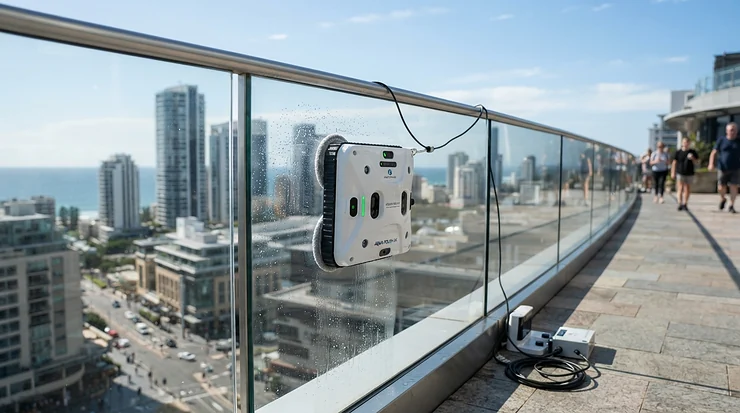
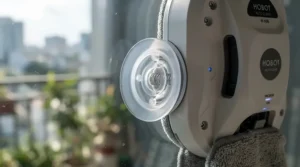
A robot window cleaner is a compact, powered device that sticks to glass using suction, then travels across the pane on tracks while spraying fluid and wiping with microfibre pads. Sensors detect frame edges, a route planner covers the surface methodically, and a safety tether plus backup battery guard against falls.
That is suction-mounted cleaning in a nutshell. A motor pulls air from beneath the body, creating a pressure difference that pins the robot to the glass. Caterpillar belts or wheels do the moving, and pads do the cleaning. It is a bit like a robot vacuum that has traded gravity’s friend, the floor, for a vertical wall.
The upside is obvious: flat glass is done hands-free, inside and out. The catch is that it isn’t a whole-home automaton. You still carry it between panes, fill the tank and move the cable. Tinted, arched or heavily textured glass can cause problems, and wet or condensation-covered windows weaken the seal. Ideal Home specifically warns against use in rain or on condensation.
Window Cleaning Robot Suction Technology: What the Numbers Really Mean
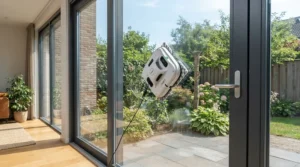
Suction is the headline figure on every box, but window cleaning robot suction technology is more nuanced than “bigger is better”.
Pascals measure the pressure difference holding the robot on. Higher numbers mean more margin if glass is damp or a seal leaks. But the number doesn’t clean anything; the pad and spray do. One buyer’s guide I reviewed put it bluntly: never choose a window robot purely on its suction rating.
What matters is how intelligently that suction is used. Hutt W8 self-regulates between 1,850 and 3,800 Pa. Ecovacs Winbot W2 Pro Omni runs at 2,800 Pa and jumps to 5,500 Pa in an emergency. Ecovacs says its brushless motor improves cleaning efficiency by around 30%, and quotes an 800 N holding force for a heavier robot. The Hobot S7 Pro adds leak-detecting bumpers that react when air escapes at a frame edge.
Practical translation: look for adaptive suction and leak detection, not just a bigger number. Check that your glass is flat and dry, and confirm the robot suits your window type. Slopes, textured glass and curved panes are where suction-mounted cleaning is most likely to disappoint.
Squeegee Cleaning Path: How Robots Plan Their Route
A confession: most robot window cleaners don’t use a rubber squeegee blade at all. They push damp microfibre across the glass. But the squeegee cleaning path is still the right mental model, because it describes the overlapping strokes that leave no gaps.
A human squeegee user works top to bottom in overlapping lines, wiping the blade between passes. Robots imitate that logic with route planning. Hobot’s models zigzag horizontally, then vertically. Hutt W8 offers three route types via HUTTSLAM 2.0. Ecovacs uses WIN-SLAM 4.0 to map efficient paths, and Kärcher RCW 2 uses systematic navigation with automatic return to start.
Why does this matter? Path planning decides whether your window gets full coverage or leaves stripes. A double pass catches missed streaks, but it also doubles the time. The pivots are where trouble tends to appear: as TechRadar’s reporting on the Hobot S7 Pro noted, track marks can show where the robot turns. A quick buff with a dry microfibre cloth afterwards solves most of it.
Think of the squeegee cleaning path as the robot’s handwriting. Tidy, methodical lines are good; scribbled turns are where you may need to step in.
Safety Tether: The Non-Negotiable Backup
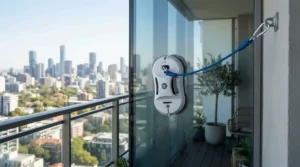
Let’s be blunt. If a robot loses grip on an upstairs window, the only thing between it and the patio is the safety tether. Ideal Home notes that a tether anchor prevents falls from height and can even provide extra power if the battery runs flat.
Real-world failures happen. In a lab test by Australian consumer group CHOICE, a different Hobot model fell off the glass once. That’s one reason to treat the safety tether as mandatory kit rather than an optional extra.
Different brands handle it differently. The Ecovacs Winbot W2 Pro Omni has a retractable cable reportedly rated for 100 kg. The Kärcher RCW 2 includes a 4 m rope, and the Hobot S7 Pro a safety rope plus a 20-minute UPS. The Ecovacs Winbot Mini2 is supported by the original Mini’s 39-minute hold after a power cut in a Galaxus test, which is a reassuring figure.
Follow the manual on anchor points. Clip the safety tether to a secure fixing, never to something that could move or open. Keep the area below clear when working outside, and never leave a robot running unattended. Suction-mounted cleaning is clever, but gravity always wins an argument.
Robot Window Cleaner Buying Guide: How to Choose in 7 Steps
Use this quick robot window cleaner buying guide to narrow your shortlist.
- Measure your glass. Check minimum window size against the specs, such as 35 × 35 cm for the Kärcher RCW 2. Tiny panes suit compact robots.
- Check window type. Frameless needs edge-leak detection. Sloped glass is risky.
- Count your sockets. If power is far from the glass, a cordless station like the Ecovacs Winbot W2 Pro Omni earns its price.
- Judge suction technology sensibly. Prefer adaptive suction and leak detection over raw numbers.
- Insist on a safety tether and backup battery. Read published backup times, not marketing adjectives.
- Assess edge performance. If frames bother you, look at corner scrubbers like those on the Ecovacs Winbot W2S Pro Omni.
- Set a realistic budget. Under £200 buys a capable starter, £300-£350 buys refinement, £450+ buys cordless convenience.
Also look for UKCA or CE marking and a UK plug. If a listing hides basic specs, treat that as a red flag.
Robot Window Cleaner vs Traditional Window Cleaning
| Factor | Robot window cleaner | Squeegee, bucket and pole | Professional cleaner |
|---|---|---|---|
| Safety at height | Tethered, no ladder | Ladder or pole risk | Handled by cleaner |
| Time and effort | Hands-free, you move it | High effort | None for you |
| Edges and corners | Often missed | Excellent control | Excellent |
| Upfront cost | £150-£550 | Low | None |
| Ongoing cost | Pads, fluid | Minimal | Per visit |
| Best For | Frequent upkeep of big glass | Fussy finishes | One-off deep cleans |
The robot’s real advantage is turning an awkward job into background maintenance. If you value perfect edges and mess removal, hand work still wins. For reference, one retailer blog quotes Checkatrade figures of £25-£40 an hour for professionals, which helps frame the payback.
Window Robot for Homes: Who Benefits Most
The best window robot for homes depends on how your glass is laid out.
Flats and apartments. Hard-to-reach exterior glass on upper floors is exactly where a tethered robot helps, as long as your lease allows outside use.
Period properties. Small sash panes with glazing bars are poor territory. Compact models like the Ecovacs Winbot Mini2 cope better than bigger robots.
Modern extensions. Floor-to-ceiling doors and glass walls are the sweet spot. The Hobot S7 Pro and the cordless Ecovacs models suit large flat panes.
Those wary of ladders. HSE guidance flags ladders as a common cause of falls, which is covered further below. A robot reduces how often you need one.
Bathrooms. The Hutt W8 is marketed for tiles and shower glass as well as windows.
If you only have a handful of easy windows, you probably don’t need one. A good manual routine may be cheaper and more satisfying.
Long-Term Cost and Maintenance
The sticker price is only part of the story. Ongoing costs are modest: detergent, which you don’t strictly need, and replacement pads. Ideal Home argues a robot is generally cheaper than regular professional cleaning over time, though the upfront bill is high, with premium models near £500.
An illustrative sum: if you paid a professional for an hour four times a year at £25-£40 an hour, that’s £100-£160 annually. A robot costing around £250 could pay for itself in roughly two years. That is an illustration, not a promise, because window counts vary. Ecovacs says robot window cleaners typically last three to five years with proper care, which is a brand claim rather than independent data.
| Tier | Models | Price range | Value logic | Best For |
|---|---|---|---|---|
| Budget | Kärcher RCW 2, AlfaBot X7Pro | Under £200 | Try the concept cheaply | Occasional use |
| Mid | Hutt W8, Ecovacs Winbot Mini2 | £200-£250 | Versatility, compact size | Mixed homes |
| Upper-mid | Hobot S7 Pro | £300-£350 | Refined cleaning | Large panes |
| Premium | Ecovacs Winbot W2S Pro Omni, Ecovacs Winbot W2 Pro Omni | £450-£550 | Cordless convenience | Big glass |
Budget buyers should note the cheapest models lean on corded power and simpler navigation. Premium buyers pay for convenience, not dramatically better cleaning. For most homes, the upper-mid tier is where value peaks.
Practical Setup Guide: Your First 30 Days
A few habits make the difference between a clever gadget and a dust-gathering gadget.
Day one: prep. Wipe the pane’s edges and brush off loose grit. Fit clean pads and fill the tank, using the maker’s recommended solution where specified. Check the safety tether anchor and that the glass is dry.
First run: stay close. Watch the robot for the first cycle and don’t leave it unattended. Note where it pivots, since that’s where track marks appear.
Week one: learn its squeegee cleaning path. Run a second pass on dirty panes, and buff any smears with a dry microfibre cloth.
Weeks two to four: build a routine. Wash pads after each session, check suction seals and clean the cable. Update the app firmware if prompted.
Common first-month mistakes: using too much fluid, ignoring pad condition and running the robot on damp glass. Suction-mounted cleaning depends on a good seal, so a dirty pad or wet pane is the usual culprit.
Real-World Scenarios: Matching Robots to Real Homes
Scenario 1: The ladder-avoider. You live in a three-storey townhouse with high exterior windows and dislike ladders. HSE guidance notes that around a third of falls from height involve ladders and stepladders, and you can read more on HSE’s falls from height guidance. A tethered Hobot S7 Pro or Ecovacs Winbot W2 Pro Omni cuts the need for climbing. Budget: £300-£550, weekly to monthly use.
Scenario 2: The new-build flat. Two balcony doors and four standard windows, with the freedom to buy on a budget. A Kärcher RCW 2 or AlfaBot X7Pro under £200 handles light maintenance. Use the safety tether every time.
Scenario 3: The glass extension. A big bifold door run, with a garden and a long extension lead. A cordless Ecovacs Winbot W2S Pro Omni saves hunting for sockets and tackles edges. Budget around £500+, used monthly.
Problem and Solution: Fixing Common Robot Window Cleaner Issues
Problem: streaks at turning points. Solution: use a second pass, cut back fluid and finish with a dry microfibre buff.
Problem: the robot slips or won’t stick. Solution: dry the glass, clean the pads and check seals. If you’ve bought on suction numbers alone, review the window cleaning robot suction technology section above.
Problem: missed edges and corners. Solution: accept that edge gaps are normal. Corner scrubbers on the Ecovacs Winbot W2S Pro Omni help, otherwise wipe frames by hand.
Problem: no socket near the window. Solution: use an extension lead rated for the job or choose a cordless Ecovacs station.
Problem: sloped or curved glass. Solution: contact the manufacturer before buying, and expect disappointment on conservatory roofs.
FAQ
❓ How much does a robot window cleaner cost in the UK?
❓ Is a robot window cleaner worth it for large windows?
❓ Does a robot window cleaner work on frameless glass?
❓ Can I use a window robot for homes with double glazing outside?
❓ What backup should a robot window cleaner have?
Conclusion
The right robot window cleaner turns a dreaded chore into background maintenance. For most buyers, the Hobot S7 Pro is the balanced all-rounder for large panes. The Ecovacs Winbot W2 Pro Omni earns its premium if sockets are scarce, and the Ecovacs Winbot W2S Pro Omni suits large glazing where edges matter. Small panes call for the Ecovacs Winbot Mini2, while the Hutt W8, Kärcher RCW 2 and AlfaBot X7Pro keep costs down.
Remember the rules from this robot window cleaner buying guide: judge suction technology by intelligence rather than raw numbers, respect the squeegee cleaning path and always use the safety tether. A window robot for homes with plenty of flat glass is a smart investment. Suction-mounted cleaning has limits, though, so manage expectations on edges, slopes and stubborn marks.
Recommended for You
- Self-Emptying Robot Vacuum Bag Replacement Cost: 7 Smart Picks (2026)
- Self-Emptying Base Vs Manual Emptying Robot Vacuum: 7 Best Picks 2026
- Quietest Self-Emptying Robot Vacuum Base: 7 Best UK Picks (2026)
Disclaimer: This article contains affiliate links. As an Amazon Associate, I earn from qualifying purchases. If you purchase products through these links, we may earn a small commission at no additional cost to you.
✨ Found this helpful? Share it with your friends! 💬🤗
