
In This Article
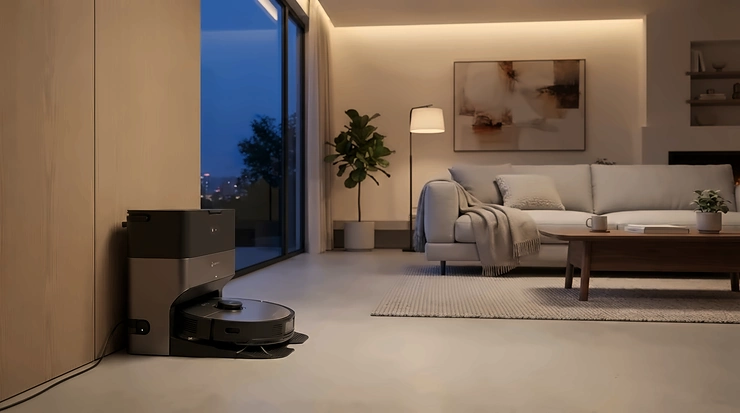
Here’s the dirty little secret of the robot vacuum world: the robot is rarely the problem. A modern machine gliding across laminate in quiet mode can sit near the level of a quiet library. Then it trundles home, the dock fires up, and a few seconds of dust-sucking thunder rattle the hallway like a tiny jet engine. If you’ve ever been jolted awake at 3am by your own appliance, you already know why the quietest self-emptying robot vacuum base is a separate purchase decision from the robot itself.
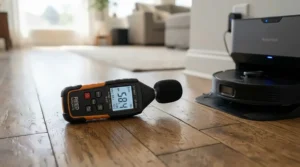
This guide is built around that distinction. Most “quiet robot vacuum” round-ups rank machines by how loud they are while cleaning, then wave vaguely at the dock. Here, the dock gets top billing. I’ve pulled together independently measured figures where they exist, flagged manufacturer claims where they’re all we have, and been blunt about the gaps. Nobody publishes a neat, standardised dock noise test, so some numbers below are approximate.
You’ll find seven real models, a robot vacuum base decibel comparison, advice on motor insulation, a practical night-time emptying schedule, and three household scenarios. Prices are shown as ranges only (my conversions from US and euro figures, so treat them as ballpark and check amazon.co.uk). Ready? Let’s make your home a calmer place.
Quick Comparison: The Quietest Self-Emptying Robot Vacuum Base Options at a Glance
| Product | Quiet-mode cleaning noise | Dock emptying noise | Price range (approx.) | Best For |
|---|---|---|---|---|
| Roborock Saros 10R | ~50 dB | ~66.4 dB (measured) | £800-£1,000 | Best all-round quiet dock |
| Narwal Freo X Ultra | ~53-59 dB | Sources conflict (see review) | £900-£1,100 | Buyers obsessed with dock noise |
| Ecovacs Deebot X2 Omni | ~40 dB | ~75 dB | £500-£600 | Quiet cleaning on a budget |
| Roborock Saros 20 | ~38 dB | ~72 dB | £1,200-£1,400 | Near-silent daytime cleaning |
| Narwal Freo Z Ultra | ~53-58 dB (claimed) | Marketed as “silent” compression | Premium bracket | Hygiene plus low noise |
| Dreame X60 Max Ultra Complete | ~57-58 dB | ~70-72 dB | £1,200-£1,400 | Carpets and heated mopping |
| Eufy Omni C20 | ~55 dB (claimed) | Not independently verified | £450-£550 | Slim, affordable all-in-one |
The pattern is clear. Cleaning noise and dock noise are not the same thing, and the champion of one is rarely the champion of the other. The Ecovacs Deebot X2 Omni wins the quiet-cleaning-per-pound contest, but the Roborock Saros 10R has the calmest measured traditional dock. If your robot docks while you sleep, prioritise the right-hand column.
💬 Just one click — help others make better buying decisions too!😊
What Is the Quietest Self-Emptying Robot Vacuum Base?
The quietest self-emptying robot vacuum base is the charging dock that moves dust from your robot’s bin into a larger bag or tank at the lowest measured noise level. Judge it by its emptying burst in decibels, not the robot’s cleaning volume, and by whether you can schedule or block cycles overnight.
Why the distinction? Because the transfer is violent by nature. Pulling debris out of a bin in a few seconds takes a sharp suction burst, and one manufacturer’s own guidance admits such bursts can reach 70 dB or higher. Wikipedia’s overview of robotic vacuum cleaners notes that marketing materials tend to quote noise somewhere between the high 50s and high 70s in decibels, which tells you how wide the spread is across the category.
Think of the dock as a very short, very rude guest. The robot is the polite housemate who tiptoes about for 90 minutes. The dock barges in for ten seconds and slams a door. A low noise auto-empty base simply slams it more softly, or lets you choose when it visits.
Top 7 Quietest Self-Emptying Robot Vacuum Base Options: Expert Analysis
A quick word on method. Noise figures below come largely from measurements aggregated by Smart Home Explorer from outlets such as Vacuum Wars, MBReviews and NotebookCheck, typically taken at about one metre. Where I only had a manufacturer’s claim, I say so. I haven’t verified UK stock for every model, so confirm availability on amazon.co.uk before you commit.
1. Roborock Saros 10R — calmest measured traditional dock
The headline is a measured dock emptying figure of about 66.4 dB, the lowest of any traditional self-empty dock in the aggregated data. Cleaning sits around 56 dB standard and about 50 dB in quiet mode, so the robot and its dock behave like a matched pair rather than a whisper and a shout.
On paper, that 8.6 dB gap versus a 75 dB rival means roughly seven times less sound energy, or around 1.8 times quieter to the ear. The Multifunctional Dock 4.0 handles emptying, washing, refilling and drying, and StarSight LIDAR navigation keeps paths smooth, so fewer suction spikes from fumbling around chair legs. The 3.14-inch profile also means fewer manual top-ups under sofas.
My honest take: this is the pick for light sleepers in flats where the dock sits near a bedroom. Reviewers praise the Do Not Disturb implementation, which blocks cleaning and dock operations during set windows. A recurring gripe is app complexity for casual users, and mopping is described as adequate rather than class-leading. I couldn’t verify aggregate UK review scores, so treat sentiment here as drawn from the expert reviewers named above.
Pros:
- ✅ Lowest measured traditional dock noise in the group
- ✅ Granular Do Not Disturb scheduling
- ✅ Ultra-slim body reaches under low furniture
Cons:
- ❌ Quiet mode isn’t the quietest around
- ❌ App can overwhelm casual users
Price range: roughly £800-£1,000 at the time of research; check current price. Good value if dock noise is your top priority, steep if it isn’t.
2. Narwal Freo X Ultra — the dock-noise wildcard
This one needs a careful, honest paragraph, because the sources disagree. Smart Home Explorer describes the Narwal Freo X Ultra as a self-contained base with no pneumatic emptying blast, scoring it top for dock noise. Narwal’s own Australian guide, however, lists it as louder when self-emptying (about 70 dB) and mentions an optional self-emptying base.
What does that mean for you? Possibly that the answer depends on configuration, and that you should read the exact UK listing before buying. Reported cleaning noise is about 62 dB standard and 53-59 dB in quiet mode, wider than the Ecovacs or Roborock, so the robot is not the whisper champion. Reviewers noted its navigation avoids getting stuck, a quiet bonus because stuck robots tend to rev up.
Who is it for? Anyone who wants hot-water mop washing alongside tidy, low-drama noise behaviour, and who will do the homework on which dock variant is bundled. Mopping coverage per pass is reported as narrower than Roborock’s, which means more run time.
Pros:
- ✅ Strong obstacle handling avoids noisy stuck moments
- ✅ Do Not Disturb covers dock operations too
- ✅ Self-contained base design with all-in-one cleaning
Cons:
- ❌ Dock noise claims conflict between sources
- ❌ Louder quiet-mode range than rivals
Price range: around £900-£1,100; check current price. Worth it only after you’ve confirmed the dock variant.
3. Ecovacs Deebot X2 Omni — quietest cleaning for the money
At about 40 dB in quiet mode (MBReviews’ measurement) and roughly 52 dB standard, this is the quietest cleaner in the group. That puts it below the level most people consciously notice, which makes it ideal for a flat where you work from the sofa.
The catch is the dock. Emptying lands at about 75 dB, second loudest in the aggregated group, so it needs scheduling discipline. The unusual square body reaches into corners without much spin-and-retry behaviour, shortening runs and total noise minutes. Battery life is around 260 minutes, enough for most flats twice over.
My read: buy it if you’ll set emptying for daytime, and treat Night Mode as non-negotiable. Reviewers report the app’s night mode properly suppresses cleaning and dock operations. The same reviewers note it occasionally snags on cables that the Roborock would route around, which seems forgivable at this price.
Pros:
- ✅ Lowest cleaning noise measured in the group
- ✅ Square body speeds corner coverage
- ✅ Cheapest premium-feeling option here
Cons:
- ❌ Dock emptying around 75 dB
- ❌ Weaker obstacle avoidance than Roborock
Price range: roughly £500-£600; check current price. Excellent value, provided the schedule is set sensibly.
4. Roborock Saros 20 — near-silent daytime cleaning
A 38 dB quiet-mode reading at one metre, measured by NotebookCheck, is the party piece here. The reviewer noted much of that is wheel noise, because suction drops so aggressively. Standard mode sits around 60 dB.
The trade-off is real. On thick carpet, that quiet mode won’t pick up like standard mode, so carpeted homes may end up running louder settings. The dock lands around 72 dB, which is disappointing at this price when the cheaper Roborock Saros 10R measures 66.4 dB. Launched in March 2026, it brings StarSight 2.0, an AdaptiLift chassis for crossing thresholds up to 85mm, and Dock 5.0 with hot-water mop washing.
Who is it for? Home workers on hard floors who take calls while the robot runs. Granular scheduling handles cleaning and dock operations separately, which helps manage that louder dock.
Pros:
- ✅ Lowest quiet-mode figure recorded in the group
- ✅ Separate scheduling for cleaning and dock
- ✅ Strong obstacle recognition and threshold climbing
Cons:
- ❌ Dock noise doesn’t match flagship pricing
- ❌ Quiet mode weakens carpet pickup
Price range: around £1,200-£1,400; check current price. Fine for hard-floor homes, hard to justify for dock-quiet buyers.
5. Narwal Freo Z Ultra — hygiene-first with “silent” compression
Narwal’s own marketing positions the Narwal Freo Z Ultra as its quietest model, quoting 53-58 dB operation and describing silent dust compression alongside hot-water mop washing. That’s a manufacturer claim. I found no independent dock decibel measurement, so treat it as promising rather than proven.
What does “compression” mean in practice? Rather than relying purely on a sharp burst, the design compresses collected dust inside the base, which on paper should reduce the shock of a transfer. But the spec sheet won’t tell you how loud the transfer is at your bedroom door, and no verified UK measurement turned up.
My view: shortlist it if you like the idea of a dock that prioritises hygiene and calmer behaviour, then look for independent reviews quoting measured dock decibels before paying premium money. Narwal’s own page also lists the sister Narwal Freo X Ultra as louder during emptying, which suggests the Narwal Freo Z Ultra is meant to improve on it.
Pros:
- ✅ Marketed around quiet dust compression
- ✅ Hot-water mop washing for hygiene
- ✅ Narwal positions it as its quietest model
Cons:
- ❌ No independent dock decibel data found
- ❌ UK pricing and availability unverified
Price range: premium bracket; I couldn’t verify a UK figure, so check current price. Value verdict: wait for measurements.
6. Dreame X60 Max Ultra Complete — power first, calm second
This is the strongest cleaner here, with 35,000 Pa suction and heated mopping that tackles dried stains in one pass. Quiet mode lands around 57-58 dB, usable in daytime, but standard mode sits near 63-65 dB, the loudest of the premium group.
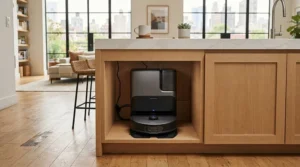
The dock empties at roughly 70-72 dB, tied for second-worst. In plain terms, you’re paying flagship money for middle-tier acoustics. The DreameHome app does block dock operations in night mode, so scheduling can rescue the noise problem. The dock is compact for everything it contains, roughly a large bin’s footprint.
Who is it for? Carpeted homes and pet owners where cleaning power matters more than hush, and where the household is out all day. Reviewers praise carpet performance but say the app learning curve is steeper than Roborock’s. For a pure low noise auto-empty base search, it isn’t the winner.
Pros:
- ✅ Class-leading suction and heated mopping
- ✅ Night mode blocks dock operations
- ✅ Compact all-in-one dock footprint
Cons:
- ❌ Louder standard mode than rivals
- ❌ Dock emptying around 70-72 dB
Price range: roughly £1,200-£1,400; check current price. Excellent for performance, poor for acoustic value.
7. Eufy Omni C20 — slim and affordable entry point
The Eufy Omni C20 is the budget-leaning entry here, listed in Eufy’s European range at 599 euros, roughly the £450-£550 bracket. It stands about 3.35 inches tall and is rated at 7,000 Pa, a modest figure that suggests it doesn’t need to scream to do its job.
Eufy markets its quiet range at around 55 dB, which is a manufacturer claim. What I couldn’t find is an independent measurement of the dock’s emptying burst. Third-party round-ups note that dock emptying is typically louder than the robot, and you should assume that applies here until proven otherwise.
Who should look? Buyers who want an all-in-one without flagship pricing and are willing to schedule emptying for daytime. Lower suction generally means lower motor noise, though it can also mean extra passes on carpet.
Pros:
- ✅ Lower price than the flagship group
- ✅ Slim body fits under lower furniture
- ✅ Modest suction suggests calmer motor behaviour
Cons:
- ❌ No independent dock decibel figure found
- ❌ Likely weaker on deep carpet
Price range: roughly £450-£550; check current price. A sensible value pick if you schedule smartly.
Robot Vacuum Base Decibel Comparison: Reading the Decibel Ratings Properly
A fair robot vacuum base decibel comparison starts by separating three numbers: standard-mode cleaning, quiet-mode cleaning and dock emptying. Brands love quoting the second. The third is the one that wakes you up.
| Product | Standard mode | Quiet mode | Dock emptying | Dock scheduling | Data confidence |
|---|---|---|---|---|---|
| Roborock Saros 10R | ~56 dB | ~50 dB | ~66.4 dB | Full Do Not Disturb | Independent |
| Narwal Freo X Ultra | ~62 dB | ~53-59 dB | Conflicting | Do Not Disturb covers dock | Mixed |
| Ecovacs Deebot X2 Omni | ~52 dB | ~40 dB | ~75 dB | Night mode | Independent |
| Roborock Saros 20 | ~60 dB | ~38 dB | ~72 dB | Separate dock scheduling | Independent |
| Narwal Freo Z Ultra | Not independently verified | ~53-58 dB claimed | Not verified | Not verified | Manufacturer claim |
| Dreame X60 Max Ultra Complete | ~63-65 dB | ~57-58 dB | ~70-72 dB | Night mode blocks dock | Independent |
| Eufy Omni C20 | Not verified | ~55 dB claimed | Not verified | Not verified | Manufacturer claim |
Looking at the table, the Roborock Saros 10R is the only model pairing a sub-70 dB measured dock with a respectable quiet mode. The Ecovacs Deebot X2 Omni and Roborock Saros 20 win on cleaning noise but concede on the dock. Anything marked “claim” deserves scepticism until an independent meter has been near it.
Now the physics. Decibels are logarithmic, and every 10 dB roughly doubles perceived loudness, so 75 dB isn’t “a bit louder” than 66 dB. Context helps too. Boots Hearing Care recommends keeping everyday noise at 60 dB or below and notes that hearing loss affects around one in six people in the UK. A few seconds of dock noise isn’t a hearing hazard, but it’s an annoyance, which is why decibel ratings matter for sleep rather than safety.

How to Choose a Low Noise Auto-Empty Base
Choosing a low noise auto-empty base is about priorities, not specs. Work through these steps in order.
- Find the dock decibel figure first. Ignore the headline “quiet mode” number. Search for independent measurements of the emptying burst, because manufacturers rarely publish it.
- Check whether you can block dock cycles. A Do Not Disturb setting that covers dock operations (not just cleaning) is worth more than a few decibels.
- Match suction to your floors. Quiet modes cut suction, so thick carpet may force louder settings and cancel the benefit.
- Consider dock placement. A dock in a hallway outside a bedroom matters more than any spec, so measure your layout before buying.
- Value the navigation. Smooth pathfinding means fewer suction spikes and fewer stuck, whirring moments.
- Weigh the price gap honestly. Paying £500 more for a 38 dB robot with a 72 dB dock makes little sense if emptying is your problem.
- Confirm UK availability and spares. Bags and filters should be easy to order before you commit.
Motor Insulation: Why Some Docks Sound Calmer Than Others
Here’s a plain-speaking disclaimer: no brand I found publishes motor insulation specifications for its dock. So this section is reasoning, not verified engineering data.
In theory, a quieter dock comes down to how its fan motor is mounted and enclosed. Rubber mounts reduce vibration that would otherwise turn the housing into a drum. Dense, sealed chambers around the bag area dampen airborne noise. Brushless motors run on electromagnetic fields rather than brushes, creating less friction, and one buying guide suggests they commonly sit around 50-60 dB in standard modes on the robot side.
What should you actually do with this? Read measured decibel ratings as the outcome of those design choices, since they are the only part you can verify. If a manufacturer talks about shock-absorbing chassis design, that’s a hint, but a number from an independent meter beats an adjective every time. Dreame, for instance, highlights a shock-absorbing chassis for reducing rattle across floor transitions, though that concerns the robot rather than the dock.
A practical trick: place the dock on a firm, solid surface rather than a hollow floor section, where resonance can amplify low-frequency thumping. It’s my suggestion rather than a manufacturer claim, but it costs nothing.
Silent Self-Emptying Dock Robot Vacuum: Marketing Myth or Achievable?
Let’s be straight. A genuinely silent self-emptying dock robot vacuum does not exist in the data I found. Even the best measured traditional dock reached about 66.4 dB, roughly the level of a normal conversation. What exists is a spectrum, from “refrigerator compressor” to “small shop vac.”
So where does the “silent” language come from? Largely from design approaches that either shorten the burst, compress dust inside the base, or avoid a traditional burst entirely. The Narwal Freo Z Ultra leans on compression, and the Narwal Freo X Ultra is described by one reviewer as having no pneumatic blast, although Narwal’s own materials suggest otherwise. That’s the disagreement worth watching.
A reasonable expectation: choose a dock that is quiet enough not to wake you, then use scheduling to make it irrelevant. The Ecovacs Deebot X2 Omni at about 75 dB is perfectly liveable if it only empties at 2pm while you’re at work. Silence, in practice, is a schedule problem more than a hardware one.
Night-Time Emptying Schedule: A Step-by-Step Setup
A good night-time emptying schedule is really a daytime emptying schedule with a bedtime lockout. Here’s a practical way to set it up.
Step 1: Define your blackout window. Choose the hours you’re asleep or on calls, say 10pm to 8am, and set Do Not Disturb to cover cleaning and dock operations. Check that your app blocks both.
Step 2: Schedule cleaning for when you’re out. Run the robot mid-morning. The dock empties when it returns, while you’re at work.
Step 3: Test manual emptying. Know how to trigger a cycle yourself, so you can pick the moment.
Step 4: Review in week one. Watch for any late return that pushes emptying into your blackout window, then adjust.
Common mistakes in the first 30 days:
- ✅ Setting night mode but forgetting dock operations are separate on some apps
- ✅ Placing the dock against a bedroom wall
- ✅ Scheduling a long run that finishes at bedtime
- ✅ Ignoring a full bag, which can mean extra attempts
If your night-time emptying schedule is rock solid, even a 75 dB dock becomes background trivia.
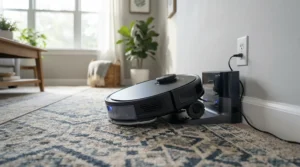
Real-World Scenarios: Matching the Quietest Self-Emptying Robot Vacuum Base to Your Home
Scenario 1: The one-bed flat with a thin bedroom wall. Budget around £800-£1,000, hard floors, daily use. The dock sits in the hallway six feet from the bed. The Roborock Saros 10R makes sense here because its measured 66.4 dB dock and granular blackout windows protect your sleep.
Scenario 2: The family home with a light-sleeping baby. Budget around £500-£600, mostly hard floor with one rug, runs every other day. Daytime nap windows are the issue. The Ecovacs Deebot X2 Omni at about 40 dB quiet mode is gentle during cleaning, and you schedule dock emptying for when the baby is awake or out.
Scenario 3: The home worker with video calls and a dog. Budget £1,200-£1,400, hard floors, daily runs. The Roborock Saros 20 offers a 38 dB floor for call-friendly cleaning, but carpet pet hair may force standard mode, so keep the schedule tight. If the household is carpeted and the budget stretches, the Dreame X60 Max Ultra Complete offers stronger carpet pickup with night-mode dock blocking.
The thread through all three: match the quiet to the moment that matters. Cleaning noise is a daytime issue. Dock noise is a bedtime issue.
Self-Emptying Base vs Traditional Alternatives
| Option | Noise pattern | Effort | Best For |
|---|---|---|---|
| Self-emptying base (e.g. Roborock Saros 10R) | Short loud burst, then silence | Very low | Busy households |
| Manual bin emptying | No burst, but daily dust | High | Dust-sensitive, tight budgets |
| Self-emptying with night lockout (e.g. Ecovacs Deebot X2 Omni) | Burst only when you choose | Low | Light sleepers |
| Dock-free basic robot | Constant robot noise only | High | Minimal budgets |
Looking at the comparison, a self-emptying base trades a short, sharp noise for a lot of convenience, and scheduling shrinks the cost. Manual emptying is quieter in the narrowest sense but makes you handle dust daily, which is unpleasant for allergy sufferers. For most people, a scheduled dock beats both.
Features That Actually Matter (And Those That Don’t)
Matter: measured dock decibel ratings, separate dock scheduling, smooth navigation, and a sensible quiet mode. These affect your sleep.
Matter less than marketing suggests: headline suction figures. A 36,000 Pa number is irrelevant if you only ever run quiet mode, which cuts suction anyway. Likewise, “silent” labels without a meter reading are just adjectives.
Worth a glance: hot-water mop washing and drying. They’re hygiene features, but they add running time, which means more total noise minutes.
How do independent labs judge noise? Consumer Reports says it measures with a decibel meter at ear level, which captures what the user experiences. That’s worth keeping in mind: figures taken at one metre and figures taken at ear height aren’t always directly comparable, so compare within a single source where you can.
✨ Don’t Miss These Quiet Wins!
🔍 Take your hunt for the quietest self-emptying robot vacuum base to the next level with these carefully selected models. Click on any highlighted product name to check current pricing and availability on amazon.co.uk. A calmer, quieter home is only a schedule away!
FAQ
❓ Can I stop a robot vacuum base emptying overnight?
❓ Do manufacturers publish dock emptying noise?
❓ Is the Roborock Saros 10R worth it over the Ecovacs Deebot X2 Omni for quiet?
❓ Will a quiet-mode robot still wake light sleepers?
❓ Where should I put the dock to keep noise down?
Conclusion
If you remember one thing, make it this: the quietest self-emptying robot vacuum base is judged by its emptying burst, not its marketing. On the evidence I could verify, the Roborock Saros 10R has the calmest measured traditional dock at about 66.4 dB and the best balanced quiet profile. The Ecovacs Deebot X2 Omni is the quiet-cleaning bargain, as long as you schedule its roughly 75 dB dock for daytime. The Roborock Saros 20 brings a remarkable 38 dB floor but a louder dock.
Meanwhile, the Narwal Freo X Ultra and Narwal Freo Z Ultra are intriguing, but conflicting or missing dock figures mean you should verify before spending premium money. The Dreame X60 Max Ultra Complete is a cleaning powerhouse rather than a quiet champion, and the Eufy Omni C20 is a sensible budget-friendly option if you accept unverified dock noise.
Whichever you pick, set a night-time emptying schedule, place the dock sensibly, and keep expectations realistic. A truly silent self-emptying dock robot vacuum remains a unicorn. A well-scheduled one, though, is the next best thing.
✨ Ready to Enjoy a Quieter Home?
Check current prices and UK availability on your favourite pick above, and let the dust vanish without waking the household!
Recommended for You
- Self-Emptying Robot Vacuum Base For Large Homes: 7 Best Buys (2026)
- Robot Vacuum Base For Pet Hair: 7 Best Hassle-Free Picks (2026)
- Hot Air Drying Dock Robot Vacuum: 7 Best Picks For UK Homes (2026)
Disclaimer: This article contains affiliate links. As an Amazon Associate, I earn from qualifying purchases. If you purchase products through these links, we may earn a small commission at no additional cost to you.
✨ Found this helpful? Share it with your friends! 💬🤗
