In This Article
Picture a big family house on a Sunday. Three bedrooms of crumbs. A hallway that collects mud like it’s being paid for it. A dog shedding with the commitment of a full-time job. You bought a robot vacuum to escape that loop, and now every other morning you’re tipping its tiny bin into the kitchen bin. Not quite the liberation on the box.
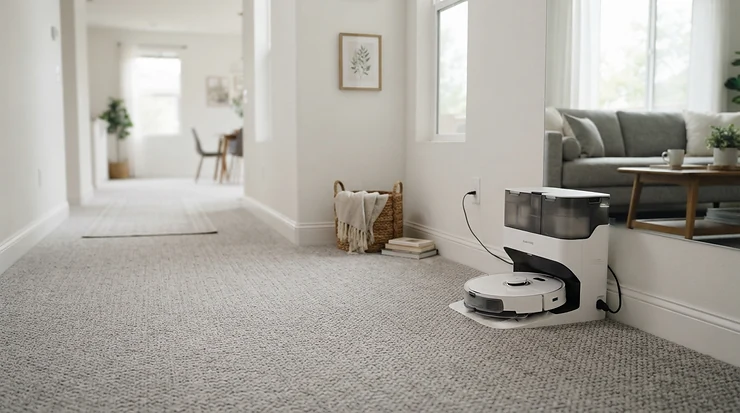
This is where a self-emptying robot vacuum base for large homes earns its space on the skirting board. The idea is hardly new: robotic vacuum cleaners were imagined with a recharging dock in a 1956 novel, long before anyone owned one. Today’s docks do far more than recharge. They swallow the contents of the robot’s bin after each run and store them in a bag or tank for weeks.
In a big house the base matters more than the robot’s headline suction figure. A sprawling floor plan means more debris per run. A small base fills quickly, and the weeks-long convenience you paid for shrinks to days.
I haven’t lived with any of these machines, so nothing here is a hands-on claim. Everything comes from published specifications, retailer listings and the review themes I could verify. Where evidence is thin, I say so. You’ll get seven real options, honest reasoning about what the numbers mean, and a few dock-siting tricks the product pages skip.
Quick Comparison: Seven Bases Built for Weeks Between Bag Changes
| Product | Dock storage | Indicative price band | Best For |
|---|---|---|---|
| Dreame X50 Ultra Complete | 3.2L bag | Premium (£900–£1,300) | Longest hands-off stretch |
| Roborock S8 MaxV Ultra | 2.5–2.7L bag | £700–£1,000 | Balanced premium all-rounder |
| Shark PowerDetect Self-Empty Robot Vacuum | Bagless base | Around £500 | Avoiding bag costs |
| Eufy X10 Pro Omni | 2.5L bag | Around £500 | Honest, household-scaled claims |
| Ecovacs Deebot X8 Pro Omni | 3L bag | £500–£800 | Big-bag value |
| iRobot Roomba Combo j9+ | About 2.3L bag | £700–£1,000 | Easy bag sourcing |
| Dreame L50 Ultra | About 3.2L (0.85 gallon) bag | £500–£800 | Mid-range long cycles |
Bands are indicative tiers rather than quotes, because prices move constantly. Check current prices before buying.
The pattern is clear: bag volume clusters between roughly 2.3L and 3.2L. The two Dreame models sit at the top of that range, while the iRobot Roomba Combo j9+ sits at the lower end. If you want the best value, the Shark PowerDetect Self-Empty Robot Vacuum and Eufy X10 Pro Omni both sit around £500. The premium tiers mostly buy extra automation, not extra storage.
💬 Just one click — help others make better buying decisions too!😊
Top 7 Picks for a Self-Emptying Robot Vacuum Base for Large Homes: Expert Analysis
Which? says it has tested 15 robot vacuum cleaners and puts prices from around £200 to over £1,000. The ranking below is different. It’s built around the dock, because the dock decides how long a big household can ignore its robot.
1. Dreame X50 Ultra Complete — longest claimed hands-off stretch
If a dock is judged by how long it lets you forget it exists, this is the headline act. A Currys listing describes a 3.2L dust bag in the station and up to 100 days of automatic emptying. The robot’s own bin is just 0.3L, so the dock does the heavy lifting. Add 20,000Pa suction and a 200-minute run time, and a large floor plan is covered in fewer outings.
The ProLeap system, which climbs obstacles up to about 6cm, helps in older British homes with chunky thresholds. On paper, the 3.2L bag is roughly a quarter to a third bigger than the 2.3–2.5L bags elsewhere in this guide.
Treat 100 days as a ceiling, not a promise. One spec database notes there’s no bag-full indicator, so in a busy house set a phone reminder around week eight.
Reviewers on Australian retailer pages praise the auto-empty feature, and one household with two Labradors reports it coping with heavy shedding. I couldn’t find a large verified UK review pool.
Pros:
- ✅ Largest bag in this round-up at 3.2L
- ✅ Climbs thresholds up to roughly 6cm
- ✅ Three-year guarantee listed by Currys
Cons:
- ❌ Tall 57cm dock is awkward under shelves
- ❌ No bag-full indicator reported
Indicative band £900–£1,300; check current price. It’s worth it if your floor area is large and you value long gaps between chores.
2. Roborock S8 MaxV Ultra — balanced premium with proven bag format
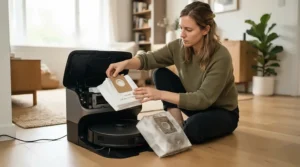
This one rewards buyers who want a mature, well-supported dock. Roborock’s compatible 2.5L bag is advertised as providing up to seven weeks of debris storage. Another retailer lists a 2.7L bag under model code SDCD05RR. The same bag fits several newer Qrevo and Saros models, which is handy if you ever upgrade the robot and keep the dock ecosystem.
Seven weeks sounds modest next to 100 days. For most large homes, though, it’s a realistic multi-week emptying cycle, closer to what a working household might actually achieve than a lab-condition maximum.
My analytical take: it suits people who prefer a conservative claim they can beat over an aggressive one they’ll miss. The bag format is also widely stocked by third parties, so replacements are rarely a headache.
Verified independent review data for this exact model was thin in my research, so I won’t summarise sentiment I couldn’t confirm. Check recent buyer reviews on the product page.
Pros:
- ✅ Seven-week bag claim is realistic
- ✅ Bag fits several Roborock docks
- ✅ Widely available spare bags
Cons:
- ❌ Shorter claim than the Dreame models
- ❌ Premium pricing for a mid-size bag
Indicative band £700–£1,000. It’s a safe, sensible choice if you want fewer surprises.
3. Shark PowerDetect Self-Empty Robot Vacuum — bagless base with a 60-day claim
Bagless is the unusual pick here, and that’s the appeal. Shark UK listings say the base holds up to 60 days of dirt and debris, with an anti-allergen seal and an anti-odour cartridge. With no bags to buy, running costs shrink. The robot claims about 100 minutes of run time and returns to recharge and resume.
That 100 minutes matters in a large home. Expect more recharge-and-resume cycles than with the 200-minute Dreame X50 Ultra Complete, so a full clean takes longer even though it still finishes.
Bagless means you eventually empty the base yourself. Done carefully outdoors, it’s fine, but it’s messier than lifting out a sealed bag. The anti-allergen seal helps while the dock is in use, not during disposal.
Reviews for this exact model were limited in what I could verify, so I won’t characterise them. The two-year guarantee requires registration.
Pros:
- ✅ No replacement bags to buy
- ✅ 60-day base capacity claimed
- ✅ Anti-allergen seal and odour cartridge
Cons:
- ❌ Disposal is dustier than a sealed bag
- ❌ Roughly 100-minute run time
Around £500 at the time of research. It’s strong value if you want to avoid bag costs.
4. Eufy X10 Pro Omni — honest, household-scaled claims
Most brands give one optimistic number. Eufy gives three. Its 2.5L antibacterial bag is described as good for 60 days in a three-person household without pets, 45 days with one pet, and 30 days with two. That honesty is useful, and it exposes how quickly real life shrinks a headline claim.
My take: if your home has two pets, plan on monthly bag changes with any 2.5L dock. A UK comparison site rated the Eufy X10 Pro Omni highly at around £499 while flagging that replacement bags are proprietary and costlier than standard alternatives. Treat that as one source’s view, not a verdict.
Which? has tested other Eufy robots, including the Omni C20 and S1 Pro, but I haven’t verified Which?’s scores for this exact model.
Pros:
- ✅ Claims scale by household and pets
- ✅ Antibacterial 2.5L bag
- ✅ Competitive price for a full dock
Cons:
- ❌ Proprietary bags may cost more
- ❌ 30 days with two pets is modest
Around £500; check current price. It’s good value, particularly for pet owners who prefer realistic numbers.
5. Ecovacs Deebot X8 Pro Omni — big 3L bag for the money
If the stat that matters most to you is bag volume per pound, look here. A retailer listing describes a 400ml onboard bin feeding a 3L bagged dock, alongside 18,000Pa suction, dToF LiDAR navigation and a 6,400mAh battery. The listing also gives dimensions of roughly 53cm high, 48cm wide and 35cm deep, with a weight around 7.6kg.
I couldn’t verify an official “days” claim. A 3L bag should, by volume, rival the best here. The 400ml onboard bin is also bigger than the 0.3L bin on the Dreame X50 Ultra Complete, which means fewer mid-clean trips back to the dock in a large home.
Ecovacs’s UK shop lists an antibacterial three-pack of bags, so replacements look easy to source. One Australian listing cited a 30-month warranty, so check UK terms.
Retailer reviews are positive about the mop washing and drying, the automatic bin emptying, and the tank refilling. They also describe it as quiet.
Pros:
- ✅ 3L bag with 400ml onboard bin
- ✅ UK bag supply listed
- ✅ LiDAR navigation for big floor plans
Cons:
- ❌ No verified “days” claim
- ❌ Dock is bulky at about 53cm tall
Indicative band £500–£800. A solid value-for-capacity buy.
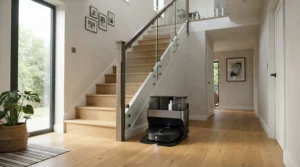
6. iRobot Roomba Combo j9+ — easiest bag sourcing, with a full-bag light
Roomba’s party trick is ecosystem maturity. iRobot says the Clean Base Auto-Fill dock handles 60 days of dirt disposal and 30 days of liquid replenishment. The bag is listed at around 2.3L and fits all Clean Base docks across the i, s and j ranges, so spares are plentiful. A 12-pack listed on iRobot’s UK store comes in just under £50, which works out at a few pounds a bag.
There’s a useful safety feature too. A solid red light signals a full bag, and iRobot warns that overfull bags can clog the dock and stop emptying. That’s the opposite of the Dreame X50 Ultra Complete‘s reported lack of an indicator.
At nearly 10kg, the Clean Base is a heavy, committed piece of furniture, so site it once.
Which? has reviewed other Roomba models, but I couldn’t verify sentiment for this one.
Pros:
- ✅ Full-bag light prevents clogging
- ✅ Bags fit many Clean Base docks
- ✅ 60-day dirt claim
Cons:
- ❌ Smaller bag than Ecovacs or Dreame
- ❌ Heavy dock, about 10kg
Indicative band £700–£1,000. A dependable choice for owners who prize simplicity.
7. Dreame L50 Ultra — mid-range long cycles
This is the sleeper pick. Dreame’s Canadian pages list up to 100 days of auto-empty and a 0.85-gallon bag, about 3.2L, matching the Dreame X50 Ultra Complete on dock capacity. Check UK listings, because availability and specs can vary by region.
Dreame’s own category page says its sealed bag system holds up to 60–90 days of dirt, while flagship pages say 100. My analysis: treat 60–90 days as the planning figure and 100 as the best case.
Compared with the premium flagship, you’re likely giving up some robot-side extras rather than dock capacity. If big-bag convenience is your priority and you’re less bothered about every gadget, that’s a clever trade.
I couldn’t find enough verified review data for this model to summarise sentiment honestly.
Pros:
- ✅ Large 3.2L-class bag
- ✅ Up to 100 days claimed
- ✅ Cheaper than the flagship
Cons:
- ❌ Claims vary between pages
- ❌ Limited verified reviews found
Indicative band £500–£800; check current price. It’s strong for big-bag value.
What Is a Self-Emptying Robot Vacuum Base for Large Homes?
A self-emptying robot vacuum base for large homes is a charging dock that sucks debris from the robot’s small bin into a much larger bag or container after each run. In bigger properties, that storage capacity decides how many weeks the robot works before you touch any dust.
Three ingredients define a good one. The first is storage volume, usually 2.3L to 3.2L for bagged docks. The second is the filtration and sealing that keep dust from escaping when bags are swapped. The third is signalling, meaning whether the base tells you when it’s full. Evetech’s 2026 explainer says most self-emptying models run between about one and nine weeks before you touch the bag, depending on dust capacity and home size.
Not all docks do the same job. An entry-level dock only empties the bin. More expensive docks also wash and dry mop pads and refill water tanks, which adds tanks, trays and filters to your maintenance list. So a self-emptying base removes the daily chore, not all upkeep. Keep that in mind as you shop.
How to Choose a Self-Emptying Robot Vacuum Base for Large Homes
Which?’s robot vacuum buying guide is a useful companion. These seven steps focus on the dock specifically.
- Check bag or tank volume first. Bigger is better for large homes. In this guide, 2.3L is the low end and 3.2L the high end.
- Read the claim as a ceiling. The Eufy X10 Pro Omni‘s 60, 45 and 30-day scale shows how pets cut claims. Plan on the lower figure.
- Look for a full-bag signal. The iRobot Roomba Combo j9+ has a red light. Without one, set reminders.
- Compare the onboard bin. A 400ml bin, as on the Ecovacs Deebot X8 Pro Omni, needs fewer mid-clean trips than a 0.3L bin.
- Price the bags. Proprietary bags add up, as the 12-pack figure for the iRobot Roomba Combo j9+ shows. Bagless bases such as the Shark PowerDetect Self-Empty Robot Vacuum avoid this.
- Measure your dock spot. Docks stand 50cm or more tall, so check clearance before buying.
- Check run time. Large floors favour long runs. The Dreame X50 Ultra Complete lists 200 minutes.
Large Capacity Auto-Empty Base: Reading the Litres and Days
A large capacity auto-empty base is about more than a headline number. Litres tell you how much the dock can hold. Days tell you how long a manufacturer thinks that takes under assumed conditions. In a large house, assumptions tend to be generous.
| Product | Claimed hands-off | Reality check | Best For |
|---|---|---|---|
| Dreame X50 Ultra Complete | Up to 100 days | No bag-full indicator reported | Disciplined reminder-setters |
| Roborock S8 MaxV Ultra | Up to 7 weeks (bag) | Conservative claim | Predictable routines |
| Shark PowerDetect Self-Empty Robot Vacuum | Up to 60 days | Bagless, so you empty the base | Bag-cost avoiders |
| Eufy X10 Pro Omni | 30–60 days by household | Scales with pets | Pet households |
| Ecovacs Deebot X8 Pro Omni | Not verified | 3L bag by volume | Big-bag shoppers |
| iRobot Roomba Combo j9+ | Up to 60 days | Red light flags full bag | Simplicity seekers |
| Dreame L50 Ultra | Up to 100 days (60–90 elsewhere) | Claims vary by page | Mid-range long cycles |
Read across the table and you’ll see the biggest numbers come with the fewest safeguards. The Dreame X50 Ultra Complete promises the most days but reportedly has no indicator. The iRobot Roomba Combo j9+ claims less but warns you before the dock clogs. For a large home, extended bag capacity is only helpful if you also know when it’s reached.
Self-Emptying Base Multi-Floor Homes: One Dock or Two?
A self-emptying base for multi-floor homes raises a question the product pages skip. How do you handle a robot that has to clean upstairs?
LiDAR-based robots can remember multiple floor maps, so the software side is solved on most modern models. The physical side isn’t. The dock sits on one level. If you carry the robot upstairs, it can only empty when it returns to a dock. With a small onboard bin, such as the 0.3L bin on the Dreame X50 Ultra Complete, a heavy upstairs clean could fill the bin before the job’s done.
There are three practical strategies. First, treat the dock floor as the robot’s home and carry it up for scheduled sessions, accepting you may need to intervene. Second, buy a second, cheaper robot for the other floor. Third, pick a robot with a larger onboard bin, such as the 400ml bin on the Ecovacs Deebot X8 Pro Omni, which handles one level without a mid-clean dock visit.
Heavy docks make moving the base itself unrealistic. The iRobot Roomba Combo j9+ Clean Base weighs nearly 10kg, so site it once. For three-storey homes, a base on the busiest floor and a carry-up routine for the rest is usually the most realistic arrangement.
Robot Vacuum Base Extended Bag Life: Stretching Multi-Week Emptying Cycles
You can influence a robot vacuum base’s extended bag life. A few habits turn a 30-day reality into something closer to the claim.
Empty the robot’s own filter and brush regularly. Clogged filters make the robot work harder and leave finer dust for the base. iRobot notes that cleaning or replacing the robot’s filter helps the dock perform.
Keep fine debris out of the mix. Plaster dust, ash and soil clog bags fast. Vacuum those manually with a corded machine.
Don’t wait for the clog. iRobot warns that a full bag can clog the dock and stop emptying. Replace at around 80% of the claimed interval, not 100%.
Keep spares. Docks with proprietary or limited-stockist bags, such as those flagged by one UK comparison site, make a spare pack a smart purchase. Multi-week emptying cycles only work if the next bag is already in the cupboard.
Consider reusable bags carefully. Third-party reusable zip bags exist for some Roborock S7, S8 and Q-series docks. Check model compatibility and warranty position first, because they aren’t made by the manufacturer.
Schedule runs sensibly too. Daily whole-house runs fill the bag faster than a focused clean of high-traffic zones with a weekly full pass.
Dock Placement: A Practical Guide to Siting Your Base
Good dock placement is the cheapest upgrade in this entire guide. Here’s a short setup routine.
- Choose a wall with a socket. An Evetech explainer notes the dock needs a permanent spot near a wall socket, with clearance around it, ideally on a hard floor.
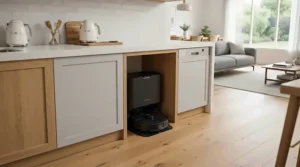
- Check the height. One buying guide warns tall docks may not fit under low cabinets. The Dreame X50 Ultra Complete dock stands 57cm high, and the Ecovacs Deebot X8 Pro Omni about 53cm.
- Leave breathing room. Manuals commonly ask for around half a metre either side and a metre or so in front. Check yours.
- Pick a central, low-traffic spot. A hallway nook beats a bedroom corner for large floor plans.
- Mind Wi-Fi. Place the dock where the signal is strong, since app mapping depends on it.
- Put it on hard flooring. Docking cleanly is easier on a hard floor than on deep pile.
- Run a first supervised dock cycle. Watch the robot find the dock and empty at least once.
Common mistake in the first 30 days: wedging the dock into a corner behind furniture. The robot then approaches awkwardly, fails to dock, and your “weeks of hands-free” cleaning stalls on day three.
Real-World Scenarios: Matching Docks to Large Homes
Scenario one: the four-bed detached with two cats. Around 190 square metres, mostly hard floors, daily runs. Cat litter scatter and shedding fill bags fast. The Dreame X50 Ultra Complete or Dreame L50 Ultra offers the largest bags, but plan on 30–45 days in practice, using the Eufy X10 Pro Omni‘s pet scale as a guide. Budget: £500–£1,300 depending on pick.
Scenario two: the three-storey townhouse, two adults, no pets. Stairs matter more than dust. A Roborock S8 MaxV Ultra with a carry-up routine suits this, and its seven-week bag claim fits low-debris living. Clean twice weekly, not daily, and the bag will comfortably outlast the claim.
Scenario three: the budget-conscious bungalow with a dog. Single-level living and a firm £500 ceiling. The Shark PowerDetect Self-Empty Robot Vacuum fits, with no bag costs and a 60-day base. Accept the dustier disposal job every couple of months, and do it outdoors.
The pattern: pets and debris decide your real emptying interval, stairs decide your logistics, and budget decides how much automation sits around the dock.
Long-Term Cost and Maintenance: Bagged vs Bagless
The dock’s sticker price is only the opening bid. Running costs matter over three to five years.
Bagged systems cost money in perpetuity. iRobot’s UK store lists a 12-pack of bags for just under £50, which suggests a few pounds per bag. If a household changes a bag every six weeks, that’s about nine bags a year, so a pack lasts more than a year. One comparison site flagged Eufy X10 Pro Omni bags as costlier than standard alternatives and the Dreame L10s Ultra bags as limited to select UK stockists. Cost per year depends heavily on brand and supply.
Bagless systems such as the Shark PowerDetect Self-Empty Robot Vacuum have no bag cost, but a replacement base is pricey. SharkNinja lists one at roughly £480, so that’s a significant outlay if it fails.
Don’t forget everything else: filters, side brushes, mop pads and cleaning solution. A self-emptying dock removes the most repetitive chore but not all upkeep, so budget accordingly.
My verdict: for large homes with steady debris, bags are an affordable convenience. For minimal ongoing cost, bagless wins.
Self-Emptying Base vs Manual Emptying
| Factor | Self-emptying base | Manual emptying | Best For |
|---|---|---|---|
| Chore frequency | Every 4–14 weeks | After most runs | Base wins for big homes |
| Dust exposure | Sealed bag swap | Open-bin tipping | Allergy-conscious households |
| Upfront cost | Higher | Lower | Manual wins on price |
| Running cost | Bags or base replacement | None | Manual wins on cost |
| Footprint | Bulky dock | Compact | Manual in tiny spaces |
| Large-home suitability | Strong | Poor | Base wins |
In a small flat, manual emptying is perfectly sensible. The upfront saving may outweigh the minor chore. In a large home, the maths flips. A robot filling a 0.3L bin multiple times per week turns a minor chore into a nuisance, and a dock fixes that.
Shark claims its dock reduces dust exposure compared with manual emptying, though that figure comes from its own commissioned testing on a cordless model. Treat it as manufacturer-supplied rather than independent.
UK Safety, Disposal and Take-Back Rules
Docks are mains-powered appliances, so basic safety applies. Use the supplied power cable, keep the base away from water splashes where it isn’t designed for them, and check UKCA or CE markings on anything bought through third-party sellers.
When it’s time to retire an old robot vacuum, UK law helps. Under GOV.UK guidance for retailers, sellers of electrical equipment must offer to take back waste of the same type as the item a customer buys. Retailers also have to tell customers which take-back service they provide, including how to recycle the equipment. So when you buy a replacement robot, ask about the free take-back.
Used dust bags are general waste, and robot batteries should never go in household bins. Check your council’s guidance for battery recycling.
FAQ
❓ Do self-emptying robot vacuum bases need special bags?
❓ Are bagless self-emptying bases better than bagged ones?
❓ Can I buy a self-emptying robot vacuum base separately?
❓ Is a self-emptying robot vacuum worth it for a large home?
❓ How loud is a self-emptying base when it empties?
Conclusion
The best self-emptying robot vacuum base for large homes isn’t simply the one with the biggest number on the box. It’s the one whose numbers survive contact with your house.
If you want the longest claimed gap between chores, the Dreame X50 Ultra Complete and Dreame L50 Ultra lead on bag size. If you prefer cautious claims and widely stocked bags, the Roborock S8 MaxV Ultra and iRobot Roomba Combo j9+ are safer bets. For value, the Eufy X10 Pro Omni and Ecovacs Deebot X8 Pro Omni deliver big docks without flagship pricing, and the Shark PowerDetect Self-Empty Robot Vacuum sidesteps bag costs completely.
Remember the three rules: plan around the lower end of any days claim, site the dock thoughtfully, and keep a spare bag in the cupboard. Do that and the multi-week emptying cycles you’re paying for become real.
✨ Ready to pick your base?
🔍 Click any highlighted product name to check current pricing and availability, then match the dock to your floors, your pets and your stairs. Your future self, bin-free on a Sunday, will thank you. 🏡
Recommended for You
- Robot Vacuum Base For Pet Hair: 7 Best Hassle-Free Picks (2026)
- Hot Air Drying Dock Robot Vacuum: 7 Best Picks For UK Homes (2026)
- Auto Mop-Wash Dock Robot Vacuum: 7 Brilliant Picks For UK Homes 2026
Disclaimer: This article contains affiliate links. As an Amazon Associate, I earn from qualifying purchases. If you purchase products through these links, we may earn a small commission at no additional cost to you.
✨ Found this helpful? Share it with your friends! 💬🤗
