In This Article
Your dog sheds. Your cat sheds more. And somewhere between the sofa and the skirting board, a tumbleweed of fur is quietly plotting its comeback.
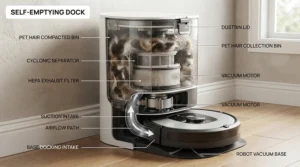
A robot vacuum base for pet hair is the unglamorous box that decides whether your robot actually wins that war. The robot’s own bin holds only about a quarter to a third of a litre. Pet hair is bulky, so it fills that space far faster than ordinary dust. Without a self-emptying dock, you’re back to pulling out fur by hand every day or two, which defeats the point of owning a robot at all. A good base swallows the contents after each run, seals them away, and leaves you in peace until the next bag change.
This guide compares seven real models on what matters to fur-covered homes. That means bag capacity for fur, brushes that resist wrapping, and whether a pet hair auto-empty base clog-free is realistic or just a brochure line. We also look at which options work as a self-emptying base for shedding pets and which struggle once the moult begins.
One transparency note: this is analysis of manufacturer specifications, independent test data and published reviews, not hands-on testing. Where verified review data is thin, I’ll say so rather than paper over it.
What Is a Robot Vacuum Base for Pet Hair?
A robot vacuum base for pet hair is a docking station that charges your robot and automatically sucks its bin contents into a bag or bagless chamber after each run. For pet owners, the best bases pair a high-capacity dust bag with anti-tangle brush technology, so fur leaves the system instead of clogging it.
The idea isn’t new. Robotic vacuum cleaners have been on sale since Electrolux launched the Trilobite in 1996. But emptying the bin is the chore that has only recently been automated.
Robot Vacuum Base for Pet Hair: Quick Comparison Table
| Product | Base type and size | Claimed empty interval* | Standout pet feature | Price range | Best for |
|---|---|---|---|---|---|
| Dreame L40 Ultra | 3.2L bag | Up to 75 days | TriCut cutter-head brush | £600–£850 | Heavy shedders |
| Roborock Qrevo Curv | 2.5L bag | Up to 7 weeks | DuoDivide brush, FlexiArm side brush | £700–£950 | Long hair plus pets |
| Ecovacs DEEBOT T30 OMNI | Bag, roughly 3L class | About 90 days | ZeroTangle brush system | £450–£650 | Compact docks |
| eufy Clean X8 Pro with Self-Empty Station | 2.5L bag | 30–60 days by household | Active Detangling roller | £500–£650 | Carpeted homes |
| eufy Clean L60 with Self-Empty Station | 2.5L bag | Up to 60 days | Hair-slicing dock | £350–£450 | Tight budgets |
| Roomba Combo j9+ | Enclosed bag | Up to 60 days | Avoids pet waste | £900–£1,200 | Puppies, accidents |
| Shark PowerDetect NeverTouch Pro | Bagless base | Up to 60 days | Anti-allergen base seal | £850–£1,000 | No-bag fans |
*”Up to” figures are manufacturer claims, not heavy-shedding guarantees.
Looking at the comparison above, the Ecovacs DEEBOT T30 OMNI and Dreame L40 Ultra quote the longest gaps between bag changes. The eufy Clean L60 with Self-Empty Station undercuts everything on price without shrinking its 2.5L bag. Every “up to” figure assumes ordinary household dust, and the eufy Clean X8 Pro with Self-Empty Station is the only one here that publishes pet-adjusted numbers. Those numbers roughly halve the interval for two pets. Price ranges are indicative and move with promotions, so check current price before deciding.
💬 Just one click — help others make better buying decisions too!😊
Top 7 Robot Vacuum Base for Pet Hair Picks: Expert Analysis
Each pick below is judged on its dock, its brush and its upkeep, because for fur-heavy homes those three things matter more than headline suction.
1. Dreame L40 Ultra — biggest bag plus hair-cutting brush
The headline is a 3.2L dust bag that Dreame says can go around 75 days between changes. That is the kind of high-capacity dust bag pet hair households dream about. The robot’s own bin is only about 300 ml, so the dock does the heavy lifting, vacuuming the bin out after runs and sealing everything in the bag.
Suction is rated at 11,000 Pa, which looks modest beside some rivals. But the TriCut roller brush uses cutter heads to chop long strands before they wrap. That matters more than raw pascals: a brush that doesn’t wrap doesn’t stall, which is how a pet hair auto-empty base clog-free becomes real rather than promised.
Based on the spec comparison, this is the strongest “set it and forget it” claim here for homes with two or more heavy shedders. The biggest bag and a cutting brush attack the two chores owners complain about most. Treat 75 days as a ceiling, though, because it assumes typical dust, not a moulting spaniel.
I couldn’t verify a large body of independent UK reviews for this exact model, so the hair-handling claims remain largely manufacturer-led. Dreame’s own comparison admits the single-brush TriCut design may snag on very long hair compared with the dual-roller L40s Ultra.
Pros:
- ✅ Largest bag in this guide at 3.2L
- ✅ Cutter-head brush chops long strands
- ✅ App offers pet-zone and pet-care settings
Cons:
- ❌ Modest 11,000 Pa suction rating
- ❌ May snag on very long hair
Expect roughly £600–£850 at the time of research. That’s good value if bag changes are your biggest irritation.
2. Roborock Qrevo Curv — tested tangle-free on long hair
Independent testing site Vacuum Wars logged zero tangling in its 7-inch hair test for the Roborock Qrevo Curv. Third-party data like that is worth more than a marketing slogan.
The dock takes a 2.5L bag, and Roborock’s bag listing rates that at up to seven weeks of debris. The robot pairs a DuoDivide main brush with a curved FlexiArm side brush to minimise wrapping, and it is rated at 18,500 Pa. The robot’s own bin is about 330 ml. Dock 3.0 also washes mop pads with hot water and dries them, a genuine bonus if muddy paws are in the picture.
Seven weeks is the shortest headline interval among the bag-based leaders here, so a two-dog household may swap bags more often than a Dreame L40 Ultra owner. Where this model pulls ahead is hair management on the brush itself. If someone in your home has long hair as well as a shedding pet, that zero-tangle result matters.
Vacuum Wars scored it 86 on its flattened pet-hair pickup test and gave it 4.45 out of 5 for pet suitability. Coolblue’s robot vacuum expert noted the dock is quite noisy for short spells while emptying and drying.
Pros:
- ✅ Zero tangling in independent 7-inch hair test
- ✅ Strong 18,500 Pa suction rating
- ✅ Dock washes and dries mop pads
Cons:
- ❌ Shorter bag interval than rivals
- ❌ Dock is noisy during emptying cycles
Budget around £700–£950. It’s worth it if tangles, not bag changes, are your main headache.
3. Ecovacs DEEBOT T30 OMNI — ninety-day bags, slimmer station
Ecovacs says one dust bag lasts about 90 days, the longest quoted interval of any model here. That makes it a serious contender for anyone chasing a high-capacity dust bag pet hair setup. The wider T30 family uses a roughly 3L bag.
The Mini OMNI Station is about 30% smaller by volume than the previous generation, according to Ecovacs. That helps if the dock lives in a hallway. Ecovacs also says the upgraded filtration needs cleaning only about once every 150 days. The ZeroTangle system combines a V-shaped bristle main brush with a redesigned side brush. Ecovacs’s lab claim of zero tangling on related T30-family models covers dry hair under 25 cm.
Most pet hair is shorter than that limit, so it’s rarely a barrier. Long-haired humans, though, can exceed it, so don’t treat “zero tangle” as literal. On balance, the small footprint and long bag life make this a smart flat-dweller’s choice.
Verified review data for this exact model is thin. Owner reviews of newer Ecovacs models in the same family at retailers mention hair not wrapping the brush, with replacement-bag cost as the recurring gripe.
Pros:
- ✅ Longest quoted bag interval in this guide
- ✅ Compact Mini OMNI station
- ✅ Tangle-resistant main and side brushes
Cons:
- ❌ Replacement bags are a recurring cost
- ❌ Little independent UK test data
Broadly £450–£650 at the time of research. Check current price, since this range moves with promotions.
4. eufy Clean X8 Pro with Self-Empty Station — honest, pet-adjusted bag figures
eufy publishes bag life by household type. The 2.5L bacteriostatic bag lasts up to 60 days in a three-person home with no pets, up to 45 days with one pet, and up to 30 days with two. That’s the most realistic bag capacity for fur guidance in the category.
Twin turbines, each rated 4,000 Pa, pull fur from carpet. An Active Detangling roller brush deals with wrapped hair, and iPath laser navigation maps the home. A pre-installed bag means you can start straight away.
Those tiered numbers work as a yardstick for every rival. If eufy needs 30 days with two pets, assume the “up to” claims elsewhere shrink in a similar way. This is the pick for people who value honest sizing over headline days. It’s also a step up from the eufy Clean L60 with Self-Empty Station on suction for carpeted homes.
I couldn’t verify a robust aggregate of independent reviews for this model, so the bag-life data is the manufacturer’s own. It is at least transparent about pets.
Pros:
- ✅ Pet-adjusted bag-life guidance
- ✅ Twin-turbine suction for carpet fur
- ✅ Active Detangling roller brush
Cons:
- ❌ Bag life drops to about 30 days with two pets
- ❌ Pricier than the L60 for the same bag size
Around £500–£650 range. It’s fair value if carpets are your battleground.
5. eufy Clean L60 with Self-Empty Station — hair-slicing dock on a budget
The dock itself has a hair detangling feature that slices hair wrapped around the roller brush. It’s a rare case of the base fighting clogs rather than just storing dust.
The 2.5L bag is rated at up to 60 days, and suction is 5,000 Pa. There’s a single side brush, iPath laser navigation, and a dustbin of roughly 350 ml. eufy’s own FAQ advises shedding homes to use maximum suction and set self-emptying to every 30 minutes. That’s sound advice for any self-emptying base for shedding pets.
Based on the spec comparison, 5,000 Pa suits hard floors and short-haired cats well. If you have deep-pile carpet and a Husky, step up to the eufy Clean X8 Pro with Self-Empty Station. Expect a bag change every four to six weeks rather than the headline 60 days.
Argos’s listing for the L60 Hybrid sibling showed a rating of roughly 4.7 out of 5 at the time of research. I couldn’t confirm the review volume, and it’s a sibling model, so treat it as a rough indicator.
Pros:
- ✅ Station cuts hair off the roller brush
- ✅ Lowest price in this guide
- ✅ 2.5L bag matches pricier docks
Cons:
- ❌ 5,000 Pa suits hard floors best
- ❌ Single side brush limits corner work
At roughly £350–£450, it’s the best budget value here.
6. Roomba Combo j9+ — best at dodging pet accidents
PrecisionVision navigation recognises pet waste, cords, socks and shoes. If you own a puppy or an elderly dog, that is arguably worth more than extra bag litres.
The dock’s enclosed bag holds up to 60 days of debris, and the Auto-Fill base also refills liquid for up to 30 days. The dock weighs about 9.94 kg, and a spare bag comes in the box. The robot maps faster than earlier generations and makes two cleaning passes.
You’re paying a premium here for avoidance, not for fur capacity, since 60 days is mid-pack. The dock is big and heavy, so check your space before ordering.
Expert Reviews’ pet-hair round-up named the j9+ best for dodging pet poo in its 2024 edition. That is useful reviewer sentiment, though it speaks to navigation rather than long-term bag performance.
Pros:
- ✅ Recognises and avoids pet waste
- ✅ Enclosed bag seals dust inside
- ✅ Voice assistant and app control
Cons:
- ❌ Premium price for mid-pack bag life
- ❌ Heavy, bulky base
Roughly £900–£1,200. It’s worth it if accidents, not fur, are your nightmare.
7. Shark PowerDetect NeverTouch Pro — bagless base with allergen seal
This is the self-emptying base for shedding pets that suits owners who hate recurring consumables. The bagless base holds debris for up to 60 days, so there are no bags to buy.
Shark says the Anti-Allergen Complete Seal traps up to 99.9% of dust, allergens and irritants inside the base. An anti-odour system and a self-cleaning Anti Hair Wrap brush-roll complete the pet-friendly kit. The base also self-refills the mop tank (1.7 litres of clean water, up to 30 days of mopping). The robot’s bin is about 0.3 litres, and the UK model code is RV2800ZEUK.
Bagless means you handle the fur when you empty the chamber. That may not suit more sensitive allergy sufferers, who may prefer a sealed bag. No spec sheet can tell you how a bagless chamber behaves under months of fur, so this is the pick I’d research hardest before buying.
I couldn’t find a substantial UK review sample. One isolated retailer review of a related Shark model reported emptying faults, which is an anecdote rather than a pattern.
Pros:
- ✅ No bags to buy
- ✅ Allergen seal and odour control in base
- ✅ Self-cleaning Anti Hair Wrap brush-roll
Cons:
- ❌ Emptying a bagless chamber exposes you to fur
- ❌ Top-end price and large footprint
Roughly £850–£1,000. Worth considering only if avoiding bag costs is a priority.
Pet Hair Auto-Empty Base Clog-Free: Setup and Maintenance Guide
Even the best pet hair auto-empty base clog-free design needs a little help from you. Here’s how to start well.
Setup. Put the dock on a hard floor against a wall, with clear space around it. Check your manual for exact clearances, as they vary by model. Brush your pet before the first run, ideally outdoors, so the brush isn’t overloaded on day one. Then set the auto-empty frequency. eufy suggests every 30 minutes for shedding homes on the eufy Clean L60 with Self-Empty Station, so look for a similar setting in your app.
Maintenance schedule:
- Weekly: pull hair off the side brush and glance at the dock inlet.
- Monthly: rinse any washable filter and wipe the sensors.
- Each bag cycle (30–75 days): swap the bag, preferably before the app complains.
- Every 3–6 months: replace brushes and filters. eufy sells accessory kits on roughly that cadence.
Common mistakes in the first 30 days:
- Letting the robot run over dog leads and cables.
- Ignoring the bag-full alert.
- Running full cycles during a heavy moult without brushing first.
- Tucking the dock somewhere cramped, which can hamper docking.
Real-World Scenarios: Which Self-Emptying Base for Shedding Pets Fits You?
Scenario 1: the one-cat flat. Budget £350–£450, 55 m² of mostly laminate, a short-haired cat, daily runs. The eufy Clean L60 with Self-Empty Station is the sensible match. 5,000 Pa is plenty on hard floors, and the station’s hair-slicing helps with long strands from human housemates. Plan on a bag every month or so.
Scenario 2: the two-Labrador family home. Budget £600–£850, a three-bed semi with carpeted stairs, daily runs plus extra after muddy walks. The Dreame L40 Ultra or Ecovacs DEEBOT T30 OMNI make sense here. Their large bags still stretch to five or six weeks even if you halve the headline figures. Buy spare bags in advance.
Scenario 3: the long-haired household. Someone with waist-length hair plus a golden retriever, mixed floors, runs every other day. The Roborock Qrevo Curv is the logical choice, given its zero-tangle result in independent testing. Accept the shorter bag interval as the trade-off.
Scenario 4: the accident-prone puppy. Budget £900+, open-plan living, frequent wee-pad misses. The Roomba Combo j9+ earns its premium, because avoiding a mess beats cleaning one.
✨ Don’t Miss These Pet-Friendly Picks!
🔍 Take your robot vacuum base for pet hair setup to the next level with these carefully selected models. Click on any highlighted product name to check current pricing and availability. These tools will help you create a fur-free home your whole family will love! 🐕
Problem and Solution Guide: Fixing Clogs, Smells and Overflowing Bags
Problem 1: hair clumps jam the dock inlet. Stop the cycle, remove the clump and check the path between robot and bag. Shorter, more frequent auto-empty cycles help, and a cutting brush like the Dreame L40 Ultra‘s keeps clumps smaller.
Problem 2: the dock smells. A sealed bag helps, as does the odour control on the Shark PowerDetect NeverTouch Pro. Wash pet bedding often, since that is usually the real source.
Problem 3: the bag fills far faster than advertised. That’s normal. Remember eufy’s own figures: a two-pet home gets roughly half the pet-free interval. Swap on the app alert rather than the calendar.
Problem 4: hair keeps wrapping the side brush. This is where the Ecovacs DEEBOT T30 OMNI‘s redesigned side brush and the Roborock Qrevo Curv‘s curved FlexiArm earn their keep. Trim wrapped strands weekly regardless.
How to Choose a Robot Vacuum Base for Pet Hair
The short answer: pick on bag capacity for fur, brush design and running costs, in that order. The steps:
- Halve the headline figure. eufy’s own numbers show two pets roughly halving bag life, so use that as a rule of thumb for any “up to” claim.
- Judge the brush. Cutting heads, detangling combs and dual rollers all fight wraps differently, and long-haired households should weigh this above suction.
- Choose bagged or bagless. Bagged bases cost more to run but are cleaner to empty. Bagless saves money but exposes you to dust.
- Match suction to floors. Hard floors and short coats don’t need 18,500 Pa. Deep carpet and thick undercoats do.
- Check consumables. Bags, filters and brushes are model-specific, so confirm they are easy to buy before you commit.
- Measure your space. The Roomba Combo j9+ dock weighs almost 10 kg, while the Ecovacs DEEBOT T30 OMNI station is notably more compact.
- Consider noise. Emptying cycles are loud for short bursts, so avoid placing the dock next to a bedroom.
High-Capacity Dust Bag Pet Hair Guide: Bag Capacity for Fur Explained
Litres and days are not the same thing. The bag capacity for fur you actually get depends on your pets, not the packaging. By capacity, the lineup runs from the 3.2L bag in the Dreame L40 Ultra, through roughly 3L on the Ecovacs DEEBOT T30 OMNI, down to 2.5L for both eufy docks and the Roborock Qrevo Curv. The Roomba Combo j9+ uses an enclosed bag, and the Shark PowerDetect NeverTouch Pro has no bag at all.
Fur is light but bulky, which is why it consumes capacity far faster than dust. Expert Reviews makes the same point: robot bins are small, and pet hair takes up a fair amount of space compared with ordinary debris. It also notes that the more your pet sheds, the more regular cleaning the robot needs.
Use eufy’s tiers as your yardstick. If a 2.5L bag manages 30 days with two pets, a 3.2L bag might stretch to roughly 38 days under the same conditions, though that is an extrapolation rather than a published figure. A genuine high-capacity dust bag pet hair setup buys you weeks, not months. If you want fewer changes, size up, but still plan around your own shedding rather than the brochure.
Anti-Clog Bag Design: What Really Keeps Fur Moving
No manufacturer publishes blockage rates, so anti-clog bag design is best understood as a system rather than a single feature. Honest analysis points to four parts working together:
- A brush that doesn’t wrap. Cutting, detangling and dual-roller designs reduce clumps before they reach the dock.
- A sealed, easy-to-swap bag. Roborock’s bag listing describes a rubber seal and a push-pull handle. Dreame’s bags auto-seal when removed, and eufy uses a bacteriostatic bag.
- Frequent, short empties. eufy’s advice of every 30 minutes for shedders stops big clumps forming in the bin.
- Layered bag filtration. Roborock’s listing mentions a two-layer melt-blown filter rated to capture 99.97% of particles down to 0.3 microns, though that is the vendor’s claim.
On paper, the eufy Clean L60 with Self-Empty Station attacks the problem from the dock, while the Dreame L40 Ultra attacks it from the brush. Neither guarantees a jam-free life, but both reduce the odds.
Bag vs Bagless: Self-Emptying Base for Shedding Pets Compared
| Option | Mess when emptying | Running cost | Best for |
|---|---|---|---|
| Bagged base | Low, sealed bag | Ongoing bag purchases | Allergy-conscious homes |
| Bagless base | Higher, you tip out the chamber | Lowest, no bags | Cost-conscious owners |
| No base (manual bin) | Highest, daily | Cheapest upfront | Tiny flats, light shedding |
Looking at the comparison above, the Dreame L40 Ultra and Roborock Qrevo Curv suit people who want hair sealed away untouched. The Shark PowerDetect NeverTouch Pro suits those who’d rather not buy bags. For a self-emptying base for shedding pets, the trade-off is cost against cleanliness. A manual-bin robot only makes sense if shedding is light and the flat is small.
Filter Replacement: Schedules, Costs and Allergy Context
Filter replacement is the least glamorous cost, and the easiest to forget. Ecovacs says its upgraded filtration on the T30 family needs cleaning only about once every 150 days. It describes an E11-grade filter that captures 95% of particles at 0.3 microns. eufy’s accessory kits are positioned to last roughly three to six months, and Dreame ships spare filters and bags with some bundles.
As a sensible schedule, rinse washable filters monthly if the manual allows, and replace them every three to six months in a shedding household. Always follow your manual, because intervals differ by model.
There is an allergy angle. Cats are the commonest animal-allergy trigger in the UK, according to Frimley Health NHS Foundation Trust. It recommends weekly vacuuming of carpets and soft furnishings with a vacuum fitted with a micro-filter or HEPA filter. That makes the Shark PowerDetect NeverTouch Pro and its sealed base worth a look. This is general information, not medical advice, so speak to your GP or an allergy clinic if symptoms are significant.
Long-Term Cost and Maintenance of a Robot Vacuum Base for Pet Hair
The sticker price is only part of the story. Bags, filters and brushes recur every year.
| Product | Price range | Headline interval | Rough swaps per year, two shedding pets* |
|---|---|---|---|
| Dreame L40 Ultra | £600–£850 | Up to 75 days | About 10 |
| Roborock Qrevo Curv | £700–£950 | Up to 7 weeks | About 15 |
| Ecovacs DEEBOT T30 OMNI | £450–£650 | About 90 days | About 8 |
| eufy Clean X8 Pro with Self-Empty Station | £500–£650 | 30 days (two pets) | About 12 |
| eufy Clean L60 with Self-Empty Station | £350–£450 | Up to 60 days | About 12 |
| Roomba Combo j9+ | £900–£1,200 | Up to 60 days | About 12 |
| Shark PowerDetect NeverTouch Pro | £850–£1,000 | Up to 60 days | About 12 empties, no bags |
*Illustrative only: assumes roughly half the headline interval, in line with eufy’s pet-adjusted figures.
Looking at the table above, the Ecovacs DEEBOT T30 OMNI and Dreame L40 Ultra keep bag swaps lowest, while the Roborock Qrevo Curv needs the most. At the time of research eufy’s UK store listed a single replacement bag at around £20, so a dozen swaps a year adds up quickly. Run your own sums with multi-pack pricing before choosing. The Shark PowerDetect NeverTouch Pro avoids bag spend entirely, but its upfront price is among the highest.
Features That Actually Matter (And Those That Don’t)
What matters:
- Brush design. It determines how often you pick hair off the roller.
- Bag size and sealing. These decide how often you touch fur.
- Noise. Coolblue’s expert flagged the Roborock Qrevo Curv dock as noisy for short periods, and most docks are loud during emptying.
- Footprint. The Roomba Combo j9+ dock weighs nearly 10 kg.
- Obstacle avoidance. It matters if accidents happen.
What matters less:
- Peak suction numbers. Ratings range from 5,000 Pa on the eufy Clean L60 with Self-Empty Station to 18,500 Pa on the Roborock Qrevo Curv. Brands test differently, so don’t read them as a straight league table.
- Mopping. Hot-water pad washing is lovely but irrelevant to fur. Don’t pay extra for it unless you’ll use it.
- Gadget extras. Voice control and fancy apps rarely change how well hair gets removed.
FAQs
❓ How much do replacement bags for a robot vacuum base cost?
❓ Can a self-emptying base cope with long dog hair?
❓ Do I need a HEPA filter for pet allergies?
❓ Are robot vacuum bases noisy when emptying?
❓ Is a robot vacuum base for pet hair worth the extra cost?
Conclusion
A robot vacuum base for pet hair is where the real work happens. The right dock turns fur from a daily chore into a once-a-month bag change. The Dreame L40 Ultra offers the biggest bag and a hair-cutting brush, the Ecovacs DEEBOT T30 OMNI stretches bags furthest on paper, and the Roborock Qrevo Curv has the best independent tangle data. The eufy Clean X8 Pro with Self-Empty Station is the most honest about real-world bag life, and the eufy Clean L60 with Self-Empty Station brings a hair-slicing dock to a tight budget. For accidents, the Roomba Combo j9+ is hard to beat, while the Shark PowerDetect NeverTouch Pro suits anyone who wants no bags and a sealed base.
Whichever you choose, remember eufy’s lesson: halve the headline figures for shedding homes, and plan your bag and filter replacement budget accordingly. Pair your robot with sensible habits too. The Oxford University Hospitals NHS leaflet on pet allergy advises washing pet bedding at 60 degrees and vacuuming carpets and soft furnishings regularly, which is exactly the routine a good dock supports.
Recommended for You
- Hot Air Drying Dock Robot Vacuum: 7 Best Picks For UK Homes (2026)
- Auto Mop-Wash Dock Robot Vacuum: 7 Brilliant Picks For UK Homes 2026
- Auto-Empty Dust Bin Robot Vacuum: 7 Proven UK Picks (2026)
Disclaimer: This article contains affiliate links. As an Amazon Associate, I earn from qualifying purchases. If you purchase products through these links, we may earn a small commission at no additional cost to you.
✨ Found this helpful? Share it with your friends! 💬🤗
