
In This Article
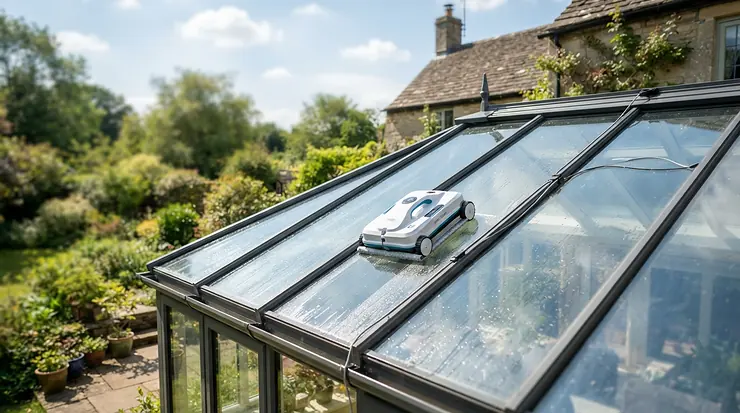
A robot window cleaner for large windows is a suction-mounted, self-propelled glass-cleaning machine that clings to a pane, sprays a fine mist and wipes it with microfibre pads along a planned route. Larger models add longer cables, bigger water tanks and sturdier safety systems, so they can tackle patio doors, bi-folds and floor-to-ceiling glass.
Window cleaning is the chore everyone postpones until low March sunlight reveals a year of thumbprints, rain spots and spider archaeology. Now add a bi-fold door, a conservatory and a stepladder you don’t quite trust. That’s when a robot window cleaner for large windows starts to look less like a gadget and more like a sensible truce with gravity.
The category is booming. Which? cites Google Trends data showing UK search interest up by roughly 850% in a year. It also admits it hasn’t tested these machines itself.
I haven’t tested them either, so this guide is built from manufacturer specifications, retailer listings and published reviews from outlets such as TechRadar and nextpit. I flag where the evidence is thin. If a verdict rests on a spec sheet rather than a proper test, I say so.
We’ll compare seven machines for a robot window cleaner large glass area, then look at cleaning path width and extended battery life. We’ll finish with a long look at conservatory glazing, where robots excel on vertical panes and get complicated on anything sloping.
Quick Comparison: Best Robot Window Cleaner for Large Windows at a Glance
| Product | Power set-up | Standout trait | Price range (check current price) | Best For |
|---|---|---|---|---|
| Ecovacs Winbot W2S Pro Omni | Battery station, up to 110 min | 120 ml spray tank | Premium, above the Ecovacs Winbot W2S Omni | Huge glass runs away from sockets |
| Ecovacs Winbot W2S Omni | Battery station, up to 110 min | Listed 65 m² per charge | Roughly £480–£580 | Conservatory side glazing and bi-folds |
| Ecovacs Winbot W2 Omni | Battery station, up to 110 min | Proven UK predecessor | Roughly £450–£550 | Battery freedom without top-tier cost |
| Hobot S7 Pro | Mains, 6.4 m cable, ~20 min backup | Big square body, frameless-edge sensors | Mid-£300s at launch | Patio doors near a socket |
| Kärcher RCW 2 | Mains, 5 m cable, 40 min backup | Familiar brand, modest price | Around £180–£200 | Budget first-timers |
| Hutt W8 | Mains, 6 m cable, 650 mAh backup | Laser edge sensors | Roughly £200–£300 | Mid-range corded buyers |
| Ecovacs Winbot Mini | Mains, short cable | Fits panes around 22 x 25 cm | £199–£299 range | Narrow top-lights and side lights |
Looking at the table, the Ecovacs Winbot W2S Omni and its siblings are the only machines here that run from a portable battery station. For a conservatory with no outdoor socket, that matters more than any suction figure. The Kärcher RCW 2 is the cheapest way in, while the Hobot S7 Pro has the longest cable and a large square body. The Ecovacs Winbot Mini is a specialist rather than a rival, and it belongs in your basket only if your glass includes small panes.
💬 Just one click — help others make better buying decisions too!😊
Top 7 Robot Window Cleaner for Large Windows Picks: Expert Analysis
1. Ecovacs Winbot W2S Pro Omni — biggest spray tank for big panes
The standout here is the 120 ml tank, a 50% jump over the 80 ml reservoir on the Ecovacs Winbot W2S Omni. On big glass, a tank that runs dry mid-pane is the quiet villain of the story.
European retailer listings show a 4,500 mAh, 24 V battery (about 98.5 Wh) in the portable station, with up to 110 minutes of runtime. They also list TruEdge 2.0 edge scrubbing, a three-nozzle spray, an integrated emergency battery and a minimum window size of 30 x 40 cm. In practice, nearly two hours of cordless running means a whole conservatory side with no extension lead trailing through a window.
Based on the spec comparison, this is the machine for someone whose problem is volume. TechRadar’s tester found a Hobot tank covered only one side of one patio-door pane, so a 120 ml reservoir looks well judged for large glass.
It’s also brand new, with retailers listing a September 2026 release, and I couldn’t find an independent tested review. The previous Pro generation could charge while cleaning, according to TechRadar, so check whether this one keeps that trick.
Pros:
- ✅ Largest tank in this group at 120 ml
- ✅ Portable battery station frees you from sockets
- ✅ Edge-focused TruEdge 2.0 scrubber
Cons:
- ❌ Too new for independent test verdicts
- ❌ UK stock and pricing need confirming
Expect it to sit above the Ecovacs Winbot W2S Omni‘s price band; check current UK pricing before you commit. It’s worth it only if you genuinely have acres of glass.
2. Ecovacs Winbot W2S Omni — best all-round battery workhorse
Its headline number is the listed 65 m² of coverage per charge, which suggests a whole house of glass between plug-ins. Treat that as a best case rather than a promise.
Retailer data lists a 110-minute battery, an 80 ml tank, a 5.5 m mains cable and a 27.1 cm square body weighing 1.6 kg. It also lists up to 8,000 Pa of suction, seven cleaning modes, 12-level protection and a 180-minute charge time. The Ecovacs UK store showed the robot in roughly the £480–£580 range at the time of research, depending on bundle.
The square body and TruEdge scrubber matter because earlier round-pad machines left unloved corners. A plugged-in “cool mode” is said to ease battery wear, a thoughtful touch if you mostly clean near sockets.
Reviewers’ views are broadly positive. Nextpit called it a worthwhile upgrade over the Ecovacs Winbot W2 Omni‘s Pro sibling, citing better edge cleaning, navigation and runtime. Teltarif reported faint lines after a first pass that mostly vanish on a second, occasional drips onto the sill, and poor suitability for windows broken up by glazing bars.
Pros:
- ✅ Cordless station suits sockets-free conservatories
- ✅ Square body and edge scrubber reach corners
- ✅ Two power modes (battery or plugged in)
Cons:
- ❌ Occasional drips onto the windowsill
- ❌ Slow and fiddly across glazing bars
Value verdict: in the £480–£580 range it’s pricey, but it’s the most convincingly rounded option here for serious glass.
3. Ecovacs Winbot W2 Omni — UK-proven predecessor, still capable
This is the model TechRadar says launched in the UK at around £520, with the cheaper Pro variant sold elsewhere. As successors arrive, expect it to appear in the £450–£550 range, so check current price.
It has a 60 ml tank, a 4,500 mAh battery in a 5.2 kg-class station, up to 110 minutes of runtime and a 5.5 m cable. Retailers list a 20.5 cm cleaning width and a minimum window size of 30 x 40 cm. Listed coverage per charge varies between 30 and 55 m² depending on the retailer, so I’d plan on the cautious figure.
The sensible reading: it’s the machine to buy if you want battery freedom and a heavy, reassuring anchor station without paying for the newest edge technology. TechRadar notes that the standard model can’t charge while cleaning, so top up before you head outside.
Reviewer sentiment is mostly warm. Nextpit praised thorough cleaning and good corner detection but found the app basic, obstacle detection imperfect and the fan rather loud. A German consumer test (Haus & Garten) rated large-area performance good to very good but flagged expensive consumables, since only the official cleaning fluid is approved.
Pros:
- ✅ Thorough cleaning with good corner detection
- ✅ Heavy station doubles as a safety anchor
- ✅ Cordless operation up to 110 minutes
Cons:
- ❌ Official cleaning fluid is pricey
- ❌ Basic app and imperfect obstacle detection
Value verdict: a solid battery option once discounts appear, but the Ecovacs Winbot W2S Omni is the better long-term buy if budgets stretch.
4. Hobot S7 Pro — big square body, longest cable
The standout is the 6.4 m total cable, which is helpful when the nearest socket is across the kitchen.
TechRadar lists the S7 Pro at 26.7 x 26 x 9 cm with two 80 ml tanks, up to 4,800 Pa of suction and an emergency battery that holds the robot for roughly 20 minutes. The list price at launch was £329, so expect the mid-£300s range, and check current price. Retailers list a 26 cm cleaning width and a minimum pane of 50 x 50 cm.
The square footprint leaves only a small margin at framed edges, and its edge-leakage bumper sensors stop it short of frameless glass. The same footprint is its weakness, because TechRadar found it flatly refused to clean a pane about 32 cm wide.
The independent verdict is mixed. TechRadar found lightly dirty indoor glass came out perfectly clear, but dirtier outdoor patio-door panes came out streaky. The reviewer also reported it fell off a window once, which is why the tether matters. A 1.3 m² pane took around 7 minutes 30 seconds.
Pros:
- ✅ Long cable reaches awkward windows
- ✅ Frameless-edge sensors worked as advertised
- ✅ Square body reaches near the frame
Cons:
- ❌ Streaky results on grubby exterior glass
- ❌ Refuses narrow panes; no true cordless mode
Value verdict: fair value in the mid-£300s for maintenance cleans of big patio doors; look elsewhere for heavy grime.
5. Kärcher RCW 2 — best-known brand at a sensible price
The pitch is a household name at a friendly price: Which? lists it at around £180.
Kärcher’s datasheet gives a 5 m cable, 70 ml tank, roughly 50 m² per tank fill, 3,300 Pa normal and up to 5,000 Pa maximum suction. It also lists a remote control, four cleaning modes plus manual, 62 dB of noise and a 1.1 kg body about 29 cm long. The emergency battery holds the robot on the glass for up to 40 minutes, the longest backup in this group, and a 4 m safety rope is included.
Which? likes the safety rope but warns the round pads might miss corners. The 35 x 35 cm minimum pane suits average-to-large glass rather than slivers.
I couldn’t find an independent test of this model, and Which? states it hasn’t tested any robots. One Swiss retailer’s category data shows a lower return rate for Kärcher than for Ecovacs (1.3% against 2.4%), but that’s one retailer’s figures.
Pros:
- ✅ 40-minute emergency battery is class-leading
- ✅ Low price for a name-brand robot
- ✅ Quiet at about 62 dB
Cons:
- ❌ Round pads may miss corners
- ❌ No app control listed
Value verdict: in the £180–£200 range it’s a sensible low-risk start for accessible glass.
6. Hutt W8 — laser sensors and a six-metre cable
The standout is laser edge and obstacle detection on a corded robot, which is unusual at this level.
Listings show a 241 x 241 x 83 mm body weighing 1.41 kg, an 80 ml visible tank and 6 m of cable. Suction is adjustable between 1,850 and 3,800 Pa, there’s a 650 mAh safety battery, and a remote control comes in the box. The maker claims up to 35 m² per fill and 65 dB of noise. European retailers list it at roughly €215–€335, so I’d expect something like £200–£300; check current UK pricing.
Adjustable suction is a smart touch. You can dial it down on delicate framed units and up on thick glass. The slim 650 mAh backup gives less hold time than the Kärcher RCW 2‘s battery, though, so use the tether every time.
I couldn’t verify a body of independent UK reviews, so treat any five-star claims with caution. One retailer Q&A answer claims it suits sloped conservatory roofs, but I found no manufacturer documentation, so that’s unverified.
Pros:
- ✅ Long 6 m cable
- ✅ Laser edge and obstacle sensors
- ✅ Adjustable suction (1,850–3,800 Pa)
Cons:
- ❌ Thin independent review evidence
- ❌ Small backup battery
Value verdict: promising spec for the money, but wait for stronger reviews before trusting it with roof-level glass.
7. Ecovacs Winbot Mini — for the panes the big robots refuse
This one is the specialist: small enough for narrow panes, and the natural partner to a larger machine.
Which? lists it at 21.5 x 21.5 x 5.5 cm with an ultrasonic spray and an emergency battery, and says it needs to stay plugged in. It plans Z-shaped or N-shaped routes, offers five cleaning modes in the app, and claims to clean within 1 mm of the edge. Retailer data lists a minimum window of 22 x 25 cm and a cable of around 4.7 m. TechRadar says it can clean windows under 25 cm wide.
On big glass it will be slower, so I wouldn’t buy it as the only robot in a large-glass home. As a second robot for transom lights, side lights and narrow top-lights, it fills the gap that kills the bigger bots, which can’t turn on small panes.
I couldn’t find independent tested reviews, and Which? hasn’t tested it.
Pros:
- ✅ Fits panes around 22 x 25 cm
- ✅ Claims edge cleaning within 1 mm
- ✅ App offers five cleaning modes
Cons:
- ❌ Slower on large panes
- ❌ Must stay plugged in
Value verdict: the £199–£299 range is fair as a specialist add-on, hard to justify as a standalone.
How to Set Up and Maintain Your Window Robot (First 30 Days)
Getting a good result from a robot window cleaner for large windows is about routine, not magic. These steps come from the tests and manuals reviewed above.
- Pre-wipe the frame. Brush loose dust, cobwebs and grit off frames and seals first so the cloth doesn’t drag grit across the glass. Kärcher’s conservatory guidance also advises clearing loose dirt and gutter debris before wet cleaning.
- Pick your moment. Overcast days avoid fast-drying streaks, which Kärcher notes are the main hazard on sunny or hot days.
- Tether every single time. TechRadar’s Hobot tester admitted being lax with the rope until the robot fell. Anchor the safety line to something solid indoors.
- Start with a gentle pass. Hobot itself suggests a no-spray first run on grubby glass, then a damp cloth pass. Work top to bottom so any spray lands on glass still to be cleaned.
- Rotate cloths. Wash the used cloth, use the spare, and wipe the corner sensors on Winbot models, which prompt you to do so regularly.
- Charge before heading out. With a battery station, fully charge indoors first. A mains-powered model’s backup cell is for safety only, not for working.
The most common first-month mistakes are skipping the tether, running dirty cloths and expecting set-and-forget. You still have to move the robot between panes, as Which? and TechRadar both stress.
Real-World Scenarios: Matching a Robot to Your Glass
These are illustrative profiles, not case histories. They show how the specs translate into decisions.
The bi-fold family house. Imagine a semi with a three-panel bi-fold, about 15 m² of glass each side, and an outdoor socket by the patio. Frequent cleaning is the goal, perhaps monthly. Here the Hobot S7 Pro or the Hutt W8 suits maintenance runs, with the Kärcher RCW 2 as the budget alternative. Because you’re near a socket, a cordless station adds little.
The conservatory owner. Picture a 4 m x 3.5 m conservatory with roughly 12 m² of vertical glazing and no external power. The Ecovacs Winbot W2S Omni fits, ideally with the Ecovacs Winbot Mini as a second robot for narrow side lights. Budget: roughly £700–£800 for both.
The mobility-limited homeowner. Imagine first-floor windows with a tricky exterior reach. The Kärcher RCW 2‘s 40-minute emergency battery and included rope give reassurance, but you still need to be able to place and retrieve the robot, which Which? flags.
If you can’t reach the glass at all, a robot is the wrong tool.
Problem → Solution Guide: Streaks, Drips, Falls and Fiddly Frames
Streaky exterior glass. Dirty outdoor panes defeated the Hobot S7 Pro‘s fine mist in TechRadar’s test, partly because breezes blew the mist away. Run a no-spray cycle first, then a damp pass, and try a deep or thorough mode if your robot offers one.
Drips on the sill. Teltarif noticed regular drips from the Ecovacs Winbot W2S Omni. Lay a folded towel along the cill and keep the tank sparingly filled.
Missed corners. Round pads may miss them, per Which?, and even square robots leave a small margin. Finish by hand with a microfibre cloth.
Suction alarms or falls. Dirty edges, worn seals or gaps can break the seal. Clean the frame, check the tether and keep the cable clear.
Stalling at glazing bars. No robot hops bars. Treat each pane as its own job and budget the extra repositioning time.
✨ Ready to Pick Your Pane-Saver?
🔍 Click any highlighted product above to check current pricing and availability. These robots will help you keep your glass bright with a lot less ladder work.
How to Choose a Robot Window Cleaner for Large Windows
Choosing a robot window cleaner for large windows comes down to seven checks:
- Measure your biggest and smallest panes. The biggest drives tank and runtime needs; the smallest decides whether a robot can turn.
- Decide mains or battery. If there’s no socket near the glass, battery stations like those from Ecovacs are the practical route.
- Count glazing bars. Which? says robots struggle with grids and multi-pane units, so each pane is a separate job.
- Check minimum pane size. Listings range from 22 x 25 cm for the Ecovacs Winbot Mini to 50 x 50 cm for the Hobot S7 Pro.
- Compare tank and cleaning path width. Both determine how often you refill and how many rows you need.
- Prioritise safety. Look for a tether, emergency battery and frameless-edge sensors.
- Price in consumables. Cloths and fluid add up over time.
Robot Window Cleaner Large Glass Area: Sizing Capacity to Square Metres
For a robot window cleaner large glass area, manufacturer coverage claims are best-case figures. Kärcher lists about 50 m² per tank fill and Hutt up to 35 m², yet TechRadar’s Hobot S7 Pro tank covered roughly one side of one patio-door pane plus a bit.
My rule of thumb: halve the claim, then plan refill breaks. A bigger tank, such as the Ecovacs Winbot W2S Pro Omni‘s 120 ml, is the clearest real-world advantage on big glass.
Cleaning Path Width: Why a Few Centimetres Change Everything
Cleaning path width is the swath of glass a robot covers per pass. Wider means fewer rows, less time and less chance of visible track marks. Retailer listings put the Ecovacs Winbot W2 Omni at 20.5 cm, the Hutt W8 at 24.1 cm and the Hobot S7 Pro at 26 cm.
As a rough illustration, across a 2.4 m floor-to-ceiling pane a 20.5 cm swath needs at least 12 rows, while a 26 cm swath needs around 10, before any overlap. TechRadar’s measured pace for the Hobot S7 Pro was about 1.3 m² in roughly seven and a half minutes, against Hobot’s advertised pace of about 2 minutes 36 seconds per square metre.
Wider isn’t automatically better. The same TechRadar review found the big square body refused a pane about 32 cm wide for lack of turning room. Check the path width against your tightest pane as well as your largest.
Extended Battery Life: How Long Can a Window Robot Really Run?
Extended battery life is the difference between cleaning your whole conservatory and unplugging halfway down the last pane. The Ecovacs Winbot W2S Omni, Ecovacs Winbot W2 Omni and Ecovacs Winbot W2S Pro Omni all list up to 110 minutes. TechRadar’s testers, reviewing the Pro generation, measured about 100 minutes from the station.
Mains-powered robots like the Kärcher RCW 2 (40 minutes) and Hobot S7 Pro (roughly 20 minutes) only use their batteries to hold the robot on the glass during a power cut. That’s a safety feature, not working time.
Window Robot Extended Runtime Large Panes: The Maths
Window robot extended runtime large panes comes down to three numbers: runtime, pace and tank. At the Hobot S7 Pro‘s measured pace of about 0.17 m² per minute, 110 minutes would cover only around 19 m². At Kärcher’s listed 0.33 m² per minute, it would cover around 36 m². Ecovacs’s 65 m² per charge claim implies a far quicker pace, so I’d treat it as optimistic.
Practical tips: charge indoors beforehand, avoid cleaning in very cold weather (lithium-ion cells lose capacity in the cold), and use plugged-in modes where sockets are close. In TechRadar’s Winbot review, the station weighed about 5.2 kg and doubled as a safety anchor.
Robot Window Cleaner vs Window Vac vs Professional Cleaner
| Method | Effort | Cost profile | Reach on large panes | Best For |
|---|---|---|---|---|
| Robot such as the Kärcher RCW 2 | Low once placed | One-off purchase plus cloths | Good on reachable panes | Frequent maintenance cleans |
| Window vac | Medium | Cheapest to buy | Needs reach or a pole | Accessible windows and condensation |
| Professional cleaner | None | Commonly quoted around £25–£40 per hour | Excellent | Heavy grime and roofs |
Which? says a window vac is cheaper and faster for easily reached glass, while a robot is the better option for hard-to-reach first or second-floor windows, though it costs more. TechRadar adds that robots won’t outperform a person with a good tool; they’re maintenance cleaners.
In short, a robot suits regular upkeep on big flat glass, a vac suits quick jobs, and professionals suit roofs, heavy grime and anything you can’t safely reach.
Long-Term Cost & Maintenance
Consumables are the hidden cost. The German test of the Ecovacs Winbot W2 Omni flagged that the only approved cleaning fluid is expensive. Cloths wear out, and lithium batteries fade with age. Ecovacs’s UK FAQ says robot window cleaners typically last three to five years with proper care, which is a manufacturer claim.
As an illustration, a robot costing around £330 and used monthly for four years works out at roughly £7 per clean before consumables. That’s competitive against a professional charged per hour, though not against a squeegee.
| Tier | Models | Typical range | Value verdict | Best For |
|---|---|---|---|---|
| Entry | Kärcher RCW 2, Ecovacs Winbot Mini | Around £180–£300 | Good value for accessible or small glass | First-timers and narrow panes |
| Mid-range | Hobot S7 Pro, Hutt W8 | Roughly £200–£350 | Solid for plug-in cleaning | Patio doors near sockets |
| Premium | Ecovacs Winbot W2S Omni, Ecovacs Winbot W2 Omni, Ecovacs Winbot W2S Pro Omni | Roughly £450 and up | Best for cordless, large glass | Conservatories and big glazing |
The table shows a clear step-up: you pay roughly double for battery freedom, which is only worth it if sockets are the constraint. Otherwise, the mid-range models deliver most of the benefit for much less.
Common Mistakes When Buying a Window Robot
Buying on suction alone. Suction keeps the robot attached; it doesn’t make glass cleaner. Pace, pad contact and spray matter just as much.
Ignoring pane size. The Hobot S7 Pro refused a pane about 32 cm wide, so check minimums against your smallest glass.
Skipping the tether. Reviews and Which? both stress it. A suction failure without a rope can wreck glass or whatever sits below.
Expecting autonomy. You still place, move and retrieve the robot between panes.
Neglecting cloths. Dirty pads spread grime, as Which? notes.
Forgetting glazing bars. Robots can’t cross them, so a gridded door could take longer than doing it by hand.
Conservatory Window Cleaning Robot Guide: What Works on Conservatory Glazing
A conservatory window cleaning robot can handle vertical side glazing well, but conservatory glazing brings extra complications: glazing bars, sloping roof panels and fragile materials.
Which? advises that robots aren’t suited to grid or multi-pane windows because they can’t navigate around the bars. For a typical conservatory, plan each pane as its own task. Check that your smallest panes exceed the robot’s minimum size.
Roofs and Sloped Glass
Ecovacs’s design-award entry says the W2 can clean inclined surfaces such as conservatories, but TechRadar notes that earlier reviews suggest the Hobot S7 Pro is suited only to perfectly vertical glass. A retailer Q&A answer claims the Hutt W8 suits sloped glass, but I couldn’t confirm that from documentation. Always check the manual before putting any robot on sloped glass, and keep people away from beneath it, with the tether anchored securely.
Never walk on a conservatory roof. HSE’s fragile surfaces guidance lists rooflights among materials that won’t support a person, and they can be hard to see in certain light. If you can’t reach the roof safely from inside or below, leave it to a professional.
Compliance and Safety
Buy from a reputable UK seller and check for UKCA or CE marking and a suitable UK plug. Use a protected socket outdoors, and keep cables and power supplies dry. If your conservatory roof is polycarbonate rather than glass, check the manual first, since these robots are designed for glass and similar smooth surfaces.
FAQ
❓ How long does a robot window cleaner take to clean a patio door?
❓ Are cordless window cleaning robots worth the extra money?
❓ Can I use a robot window cleaner on frameless glass?
❓ What is the best robot window cleaner for large windows under £300?
❓ Do robot window cleaners work on double-glazed units?
Conclusion
The right robot window cleaner for large windows depends less on suction numbers and more on your glass and your sockets. If you have plenty of reachable glass near power, the Kärcher RCW 2 and Hobot S7 Pro cover the basics at sensible prices. If you want a mid-range corded option, the Hutt W8 looks promising, though independent evidence is thin.
For conservatories and sockets-free runs, the Ecovacs Winbot W2S Omni is the most convincing all-rounder on paper, with the Ecovacs Winbot W2 Omni as the proven predecessor and the Ecovacs Winbot W2S Pro Omni the high-capacity option once reviews catch up. Add the Ecovacs Winbot Mini if narrow panes are in the mix.
Whatever you choose, use the tether, expect to move the robot between panes and treat roofs with respect. These are maintenance cleaners, not miracle workers, but on big flat glass they save a lot of effort.
Recommended for You
- Robot Window Cleaner For High-Rise Flats: 7 Safest Picks (2026)
- Vertical Glass Cleaning Robot: 7 Best Picks For UK Homes (2026)
- Safest Robot Window Cleaner: 7 Proven Picks For UK Homes (2026)
Disclaimer: This article contains affiliate links. As an Amazon Associate, I earn from qualifying purchases. If you purchase products through these links, we may earn a small commission at no additional cost to you.
✨ Found this helpful? Share it with your friends! 💬🤗
