
In This Article
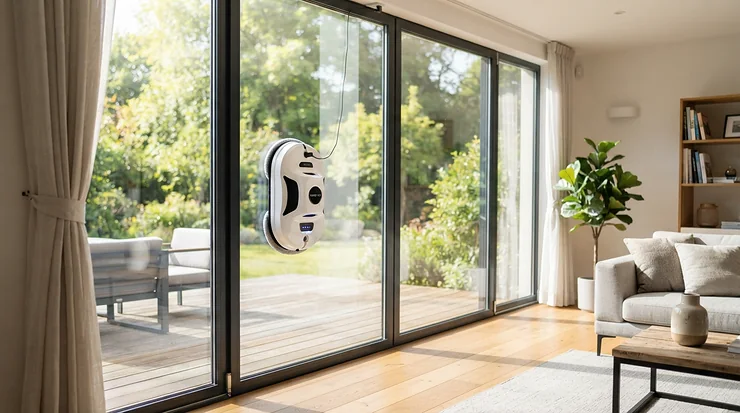
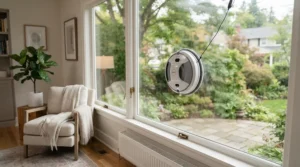
What is a robot window cleaner under £200? It is a compact, suction-clamped, battery- or mains-powered machine that crawls across flat glass, sprays or wets a microfibre pad and wipes as it goes. Budget models trade premium navigation and docking stations for simpler motors and fewer features, and they cost less than a couple of professional visits.
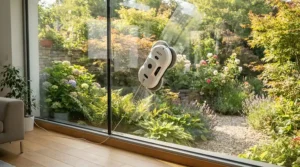
Let’s be honest about the market. Window robots are still a slightly odd idea. TechRadar’s hands-on look at robot window cleaners makes the sensible point that, unlike a robot vacuum, you can’t wander off and leave one to it. The same piece notes that most are mains-powered to keep the weight down. Expect a tidy helper, not a butler.
So why bother? Checkatrade figures quoted by Eufy put professional window cleaning at roughly £25-£40 an hour. A robot window cleaner under £200 can pay for itself in a handful of visits, if you buy the right one.
I’ve dug through manufacturer specs, retailer data and review roundups. I’ve sorted out which budget claims hold up and which are marketing gloss. Everything below is analysis, not hands-on testing.
Quick Comparison Table: Robot Window Cleaner Under £200 at a Glance
| Product | Standout | Claimed max suction | Power | Indicative price band | Best for |
|---|---|---|---|---|---|
| ECOVACS WINBOT Mini | Compact, ultrasonic spray | 7,500 Pa | Built-in battery + mains | £170-£250 | Narrow or framed windows |
| Tosima W5 | Cordless budget pick | 6,400 Pa | Built-in battery | £80-£150 | First-time buyers |
| HIXZAP X11 | High suction for the money | 6,400 Pa | Not confirmed | £90-£160 | Compact glass, small panes |
| FRUITEAM | Large review pool | Not verified | Not confirmed | £90-£130 | Standard residential windows |
| ChOVERY | Remote and manual mode | 5,600 Pa | Battery backup (about 20 min) | £90-£160 | Higher-up glass |
| SYTEH Electric Window Cleaner | Lowest-cost entry | Not verified | Not confirmed | £60-£120 | Tight budgets |
| ECOVACS WINBOT W2 PRO Omni | Station, premium navigation | Not verified | Mains + station | £350-£450 (above the cap) | Benchmark, large windows |
The bands are indicative. They come from review roundups and loose currency conversion, not live amazon.co.uk listings, so check current prices. The ECOVACS WINBOT Mini is the one to watch because it often sits right on the £200 line, while the Tosima W5, HIXZAP X11 and FRUITEAM sit comfortably below it. The ECOVACS WINBOT W2 PRO Omni is in the table as a ruler, to show what the extra money buys.
💬 Just one click — help others make better buying decisions too!😊
Top 7 Robot Window Cleaner Under £200 Options (Plus One Stretch Pick)
Six of these genuinely live in budget territory. The seventh deliberately doesn’t, and I explain why. All review sentiment below is aggregated from public roundups and retailer commentary. I have not invented ratings or quotes.
1. ECOVACS WINBOT Mini — compact enough for fiddly frames
The standout is size. At about 215 × 215 × 55 mm, the ECOVACS WINBOT Mini squeezes onto narrow windows and handled casements that bigger robots simply can’t clamp.
Listings quote roughly 3,200 Pa of suction while moving and 7,500 Pa at maximum. In practice that means it grips firmly while parked and keeps a gentler hold as it travels, which is what protects the glass from drag. It also has ultrasonic spray nozzles, WIN-SLAM path planning, a 60 ml tank and a safety tether.
Based on the spec comparison, this is the budget model for people with small, awkward panes rather than big patio doors. Reviewers describe it as stable and easy to use. One review points out that the central suction opening limits the usable cloth area. Some buyer comments mention the internal battery arriving flat, and that it refuses to run upside down.
Pros:
- ✅ Slim enough for narrow, framed windows
- ✅ Ultrasonic spray atomises detergent finely
- ✅ Multi-stage protection plus safety tether
Cons:
- ❌ Small effective cloth area slows large panes
- ❌ Often sits at or above the £200 line
Price band: roughly £170-£250, so it is under £200 only during promotions. Worth it for small windows if you catch it on offer.
2. Tosima W5 — cordless budget pick for first-timers
The hook is simplicity. The Tosima W5 is billed by one review roundup as the best budget cordless pick, with a straightforward start-and-go routine.
The listing quotes up to 6,400 Pa adaptive suction, auto-spray, a triple safety system and a remote control for smooth surfaces. “Cordless” here means it runs off an internal battery, so runtime is limited. Treat the 6,400 Pa figure as a ceiling. Those numbers are measured at a stationary peak, and budget motors rarely hold that while travelling.
The honest take: this suits tidy, flat, framed windows where you want minimal fuss. I couldn’t verify a large UK review pool for this model, so the sentiment I’d lean on is limited to roundups calling it easy to operate. Without a UK reviewer count, treat your own return window as your safety net.
Pros:
- ✅ Simple operation suits first-time buyers
- ✅ Remote control adds manual flexibility
- ✅ Auto-spray reduces pre-wetting effort
Cons:
- ❌ Battery runtime limits larger jobs
- ❌ Thin verified UK review data
Price band: roughly £80-£150. Strong value for small to medium panes.
3. HIXZAP X11 — high suction headline for the money
The standout is the suction ceiling. One roundup says the HIXZAP X11‘s 6,400 Pa maximum matches models costing twice as much, paired with an ultrasonic spray system.
The review notes an air pressure sensor that adjusts grip when the robot crosses from smooth glass to slightly textured areas, such as near a window handle. That matters on older UK windows with chunky handles and uneven seals. Those are the spots where cheap robots lose their grip and stall.
Where it fits: compact glass, bathroom windows and small panes. I’d treat it as a smart choice for people prioritising grip over navigation polish. Reviewer comments are good, but as with most budget robots, the “best value” label comes from a single roundup rather than a large verified UK review base.
Pros:
- ✅ Strong suction headline for the price
- ✅ Pressure sensing adjusts grip near handles
- ✅ Ultrasonic spray beats most budget rivals
Cons:
- ❌ Best on compact glass, not large panes
- ❌ Limited independent UK testing found
Price band: roughly £90-£160. Good value if you want grip over gadgetry.
4. FRUITEAM — large review pool, sensible limits
The standout here is track record. A roundup calls the FRUITEAM its budget pick to recommend to a friend, citing 1,800-plus reviews on the listing it checked, which is a big sample at this price.
The same piece says it shines on standard residential windows, framed glass doors and bathroom mirrors where the pane is under about 8 square feet, roughly 0.75 square metres. That’s a useful limit. It means the FRUITEAM is the right size for most UK terraced and semi-detached windows, but not for floor-to-ceiling glazing.
One practical tip from that roundup is to pre-wet the pad with a few sprays of cleaner before attaching the robot. That small step avoids a dry first pass that drags grit across glass. I couldn’t verify its suction rating, so I wouldn’t lean on a number.
Pros:
- ✅ Large review base for a budget model
- ✅ Right-sized for standard residential windows
- ✅ Good on mirrors and framed doors
Cons:
- ❌ Suction spec unclear on listings
- ❌ Struggles beyond about 0.75 square metres
Price band: roughly £90-£130. Reliable value for ordinary windows.
5. ChOVERY — remote control and a battery backup
The hook is control. The ChOVERY lists 5,600 Pa suction, three automatic modes plus manual driving via remote, and a battery backup of about 20 minutes.
That backup is the key spec. If the power lead gets knocked out or the socket trips, the robot keeps its grip for roughly twenty minutes rather than dropping. On higher windows, that gap gives you time to react. Remote driving also helps you steer it back over a missed corner.
Be realistic: 20 minutes is a safety cushion, not a working runtime, and one roundup says the model needs proper surface preparation for best results. That means wipe heavy grime first.
Pros:
- ✅ About 20 minutes of battery backup
- ✅ Manual remote driving for missed spots
- ✅ Three automatic cleaning modes
Cons:
- ❌ Needs pre-cleaning on grimy glass
- ❌ 5,600 Pa trails the highest budget claims
Price band: roughly £90-£160. A sensible choice for higher or awkward windows.

6. SYTEH Electric Window Cleaner — lowest-cost entry point
The standout is price. Eufy’s UK roundup describes the SYTEH Electric Window Cleaner as significantly more affordable than other robotic cleaners, and notes that it switches itself off after finishing the glass.
Auto shut-off sounds minor, but it matters. A robot that stops cleanly when done is less likely to wander over an edge or keep running on a half-dry pad. I couldn’t verify detailed suction or battery figures, so I won’t invent any. That gap is itself information. When a manufacturer doesn’t publish clear specs, assume the simplest possible motor.
This one suits rental flats, spare rooms and conservatory roof glass you’d rather not climb onto. Treat it as a way to test whether you like the idea before spending more.
Pros:
- ✅ Lowest entry price in this round-up
- ✅ Auto shut-off when the job’s done
- ✅ Low commitment for sceptics
Cons:
- ❌ Few verified specs to compare
- ❌ Likely basic motor and navigation
Price band: roughly £60-£120. Fine as a low-risk trial.
7. ECOVACS WINBOT W2 PRO Omni — the stretch pick above the cap
This one sits over the line deliberately. The ECOVACS WINBOT W2 PRO Omni is the benchmark: a multi-function station, charging while working, a triple-nozzle sprayer and a 12-level protection system, according to one roundup.
TechRadar’s feature notes a colleague tested the W2 Pro Omni and praised its cleaning, while the Hobot S7 Pro tested by the author left visible track marks where it pivoted. That contrast is the heart of the budget question. Navigation and spray design, not raw suction, separate the tiers.
Ecovacs’ own UK guide says quality models start around £200 and high-end ones reach about £400. That means the ECOVACS WINBOT W2 PRO Omni is a genuine step up. It isn’t a robot window cleaner under £200, and I include it so you know what you’d be giving up.
Pros:
- ✅ Docking station simplifies setup and storage
- ✅ Charges while working
- ✅ Strong safety layering
Cons:
- ❌ Well over the £200 budget
- ❌ Overkill for small windows
Price band: roughly £350-£450. Excellent, but not for this budget.
Specs Comparison: What the Differences Mean
| Product | Backup / safety | Water tank | Controls | Best for |
|---|---|---|---|---|
| ECOVACS WINBOT Mini | Internal battery, tether, 9-stage protection | 60 ml | App/button | Small framed windows |
| Tosima W5 | Triple safety system | Not verified | Remote | Beginners |
| HIXZAP X11 | Pressure sensor | Not verified | Not confirmed | Compact glass |
| FRUITEAM | Not verified | Not verified | Not confirmed | Standard windows |
| ChOVERY | About 20 min backup | Not verified | Remote + modes | Higher windows |
| SYTEH Electric Window Cleaner | Auto shut-off | Not verified | Not confirmed | Trial buyers |
| ECOVACS WINBOT W2 PRO Omni | 12-level protection, station | Not verified | App/station | Large windows |
The pattern is clear: the cheaper you go, the more cells say “not verified”. The ECOVACS WINBOT Mini and ChOVERY publish the clearest safety information, and that transparency counts when a machine hangs on glass above your patio. For safety-first buyers, those two lead. For pure value, the Tosima W5 and FRUITEAM make the most sense.

How to Choose a Robot Window Cleaner Under £200
Here is a decision path you can follow in about five minutes.
- Measure your largest pane. Anything bigger than about 0.75 square metres should push you to a model with better navigation, not just higher suction.
- Check the frame. Chunky handles and raised beading defeat budget robots. Models with pressure sensing, like the HIXZAP X11, cope better.
- Look for a safety tether. A rope and carabiner is non-negotiable above the ground floor.
- Prioritise battery backup. Even 20 minutes, as on the ChOVERY, gives you reaction time if power fails.
- Treat suction numbers as a ceiling. Peak Pa figures are stationary; travelling grip is lower, as the ECOVACS WINBOT Mini‘s dual rating shows.
- Confirm UK compliance. Look for a UKCA or CE mark and a UK plug.
- Check returns. Cheap robots vary, so a straightforward return window is your best protection.
Basic Suction Motors: What to Expect at This Price
Basic suction motors are the engine room of every robot window cleaner under £200, and they are where marketing numbers mislead most. A 6,400 Pa maximum, as quoted for the Tosima W5 and HIXZAP X11, sounds impressive. In practice, budget motors reach that only while parked or on perfectly smooth glass.
Think of it like a car’s top speed. It’s real, but you won’t see it on the school run. Travelling suction is lower, and the ECOVACS WINBOT Mini‘s quoted 3,200 Pa while moving is a more honest picture.
What do basic suction motors mean for you? They cope with flat, clean, framed glass. They struggle with textured glass, thick dirt and wet panes. They are also noisy. One listing for the Mini quotes sound levels in the 60s-80 dB range, so expect something between a hairdryer and a vacuum cleaner. Prepare the glass and accept that.
Battery Backup: The Feature You’ll Only Notice Once
Battery backup is the quiet hero of any affordable window cleaning robot. Most budget machines run from a mains lead to stay light, as TechRadar notes. If that lead is yanked or the socket cuts out, the robot relies on its internal battery to stay stuck to the glass.
A model like the ChOVERY, with about 20 minutes, buys you time to walk over and catch it. The ECOVACS WINBOT Mini includes a 3,000 mAh internal battery, and one retailer lists a 30-minute uninterrupted power system. Backup is not about extended cleaning. It is about not hearing a thud.
Check the listing for how long backup lasts, and charge the battery before first use. A flat battery in the box, as some buyer comments mention, defeats the whole point. Even on ground-floor windows, treat battery backup as essential rather than optional.
Manual Scheduling vs Smart Apps: Do You Need Automation?
Entry-level models rely on manual scheduling, which means you place the robot, press start and supervise. That is the reality of this price tier. One retailer’s data for the ECOVACS WINBOT Mini shows scheduled cleaning listed as “No”, even though the model has app connectivity.
Is that a problem? Less than you’d think. A window robot can’t safely run unattended. It needs placing, tethering and often a pad swap. Scheduling sounds clever, but it adds little for a machine that still needs you standing nearby.
Where manual scheduling does matter is routine. Pick a fixed day, say the first Saturday of each month, and treat it as a ten-minute habit. The Tosima W5 and ChOVERY both include remote control, which helps you steer the robot around missed patches. For most households, remote driving is worth more than any timetable feature.
Entry-Level Window Robot Review: What to Expect in Real Life
Here is the honest summary of an entry-level window robot review: a robot window cleaner under £200 is good at maintenance and mediocre at rescue. It will remove dust, rain marks and light grime from flat glass. It won’t strip months of baked-on dirt in a single pass.
TechRadar’s account fits that pattern: a decent job on surface dirt, with track marks where the robot pivoted. Another reviewer of the ECOVACS WINBOT Mini praised its use on hard-to-reach exterior glass but noted the small cloth area.
Cleaning time varies with pane size and pad condition. Expect to move the robot between panes, refill the tank and swap pads. Think of it as a very patient apprentice who needs to be shown each window. If you accept that, the reality matches the pitch.
Robot vs Traditional Window Cleaning
Window cleaning has a long history of ladders, squeegees and chamois leathers, and the traditional methods still work well. Here is how they stack up against a robot window cleaner under £200.
| Factor | Robot (budget) | Squeegee / DIY | Professional cleaner |
|---|---|---|---|
| Upfront cost | £60-£200 | £10-£30 | None |
| Ongoing cost | Pads, detergent | Detergent | £25-£40 per hour (quoted) |
| Effort | Low, still supervised | High | None |
| Streak quality | Good on flat glass | Excellent with skill | Excellent |
| Safety at height | Tethered, still risky | Ladder risk | Insured professional |
| Best for | Maintenance on flat glass | Small homes | Heavy dirt, high windows |
A robot beats a squeegee on effort and a professional on long-term cost, but never on finish quality or safety at height. Use the robot for frequent upkeep and book a professional once or twice a year for the awkward panes. That hybrid approach is cheapest and safest.
Cheap Robot Window Cleaner Deals: How to Shop Smartly
Searching for cheap robot window cleaner deals is tempting, but a lower price isn’t always a better deal. Start by checking the product name. Many budget robots are sold under several brand names with near-identical hardware, so compare specs, not logos.
Next, look at return conditions and warranty. A deal on a model with a clear UK returns policy beats a larger discount on an unknown seller. Also be wary of “was/now” pricing. Prices change often, so check current price before deciding.
Finally, consider timing. Retail events can make a model like the ECOVACS WINBOT Mini dip under the £200 line. Waiting for that moment can turn a borderline purchase into a good one. Buying through any link does not give you a better price, and nothing here is a verified promotion.
Price Range and Value Analysis
| Tier | Typical band | Example | Best for |
|---|---|---|---|
| Entry | £60-£120 | SYTEH Electric Window Cleaner, FRUITEAM | Trial, small windows |
| Value | £80-£160 | Tosima W5, HIXZAP X11, ChOVERY | Most households |
| Upper budget | £170-£250 | ECOVACS WINBOT Mini | Small framed glass |
| Premium | £350-£450 | ECOVACS WINBOT W2 PRO Omni | Large windows |
Here is the value logic. If a professional charges £25-£40 an hour and a basic round takes about an hour, a £120 robot pays back in three to five visits, assuming you’d otherwise hire help. The Tosima W5 and FRUITEAM make the strongest payback case, while the ECOVACS WINBOT Mini needs more use to justify itself. Remember to add the cost of pads and detergent over time.
Practical Usage Guide: Your First 30 Days
A robot window cleaner under £200 rewards good habits. Follow this routine.
- Charge first. Fully charge any internal battery before first use, particularly given buyer reports of flat batteries.
- Clean the glass edges. Wipe the frame with a damp cloth so grit doesn’t scratch the pane.
- Pre-wet the pad. A few sprays, as the FRUITEAM roundup advises, avoids a dry first pass.
- Always tether. Attach the safety rope to a fixed point, even at ground level.
- Start in the middle. Place the robot centrally and let it map the pane.
- Swap pads when grey. A dirty pad spreads grime instead of removing it.
Common mistakes in the first month: skipping the tether, using too much detergent, and trying frameless glass without checking compatibility. Wash the pads after every session and store the robot flat, away from direct heat. A fifteen-minute monthly routine keeps a budget machine reliable for years.
Real-World Scenarios: Which Robot Fits Your Home?
The flat dweller with small, handled windows. Floor-to-ceiling isn’t your problem, but awkward frames are. The ECOVACS WINBOT Mini fits narrow casements. If it’s over budget, the HIXZAP X11 with pressure sensing is a sensible alternative.
The family in a semi with standard windows. You’ve got a dozen average panes and little time. The FRUITEAM matches that window size, and the Tosima W5 adds remote control for anything fiddly. Budget around £100-£150.
The conservatory or upper-floor owner. Safety comes first. Look at the ChOVERY for its battery backup and manual remote driving. Always tether, and call a professional for the highest glass.
The sceptic. If you simply want to test the idea, the SYTEH Electric Window Cleaner is the cheapest way in. Treat it as an experiment, not an investment.
Across all four profiles, the pattern holds: match the robot to the pane size and frame type before you look at suction figures.
Safety and Compliance: UKCA, CE and Working at Height
Any mains-powered window robot sold in Great Britain should carry a UKCA or CE mark. GOV.UK’s guidance on using the UKCA marking explains that low-voltage electrical equipment falls within its scope. Look for the mark on the packaging or the robot, and be wary of listings that don’t show it.
Practical safety goes beyond paperwork. Use the tether every time, keep the power lead clear of walkways and never run a robot on a wet pane. Don’t operate it from a ladder or lean out of a window to place it. If a window is beyond safe reach, it is beyond a budget robot’s use.
Check the plug type too. UK-compliant products use a standard three-pin plug or a UK-approved adaptor, and a loose adaptor on a mains lead outdoors is a hazard you can avoid.
FAQ
❓ Can a robot window cleaner under £200 clean double glazing?
❓ Do cheap robot window cleaners work on frameless glass?
❓ How long does the battery backup last on an affordable window cleaning robot?
❓ Are entry-level window robots safe to use on upper floors?
❓ Where can I find cheap robot window cleaner deals in the UK?
Conclusion
A robot window cleaner under £200 is a maintenance tool, not a miracle. It excels at regular upkeep on flat, framed glass and falls short on heavy grime, frameless panes and truly high windows. Accept that, and the economics work.
For most households, the Tosima W5, HIXZAP X11 and FRUITEAM offer the best balance of price and practicality. The ChOVERY suits anyone who values battery backup and remote control, and the ECOVACS WINBOT Mini earns its place for small, awkward frames when it dips under budget. The SYTEH Electric Window Cleaner is a low-risk trial, while the ECOVACS WINBOT W2 PRO Omni shows what the next tier offers.
Whichever you pick, prepare the glass, use the tether and keep your expectations realistic.
✨ Ready to Make Window Day Painless?
🔍 Browse the options above, check current pricing and availability, and pick the robot that matches your windows. A little research now means sparkling glass for months to come!
Recommended for You
- Robot Window Cleaner: 7 Best Picks For UK Homes (2026)
- Self-Emptying Robot Vacuum Bag Replacement Cost: 7 Smart Picks (2026)
- Self-Emptying Base Vs Manual Emptying Robot Vacuum: 7 Best Picks 2026
Disclaimer: This article contains affiliate links. As an Amazon Associate, I earn from qualifying purchases. If you purchase products through these links, we may earn a small commission at no additional cost to you.
✨ Found this helpful? Share it with your friends! 💬🤗
