
In This Article
The safest robot window cleaner is a suction-clamped glass robot that stacks three independent protections. It has a rated safety tether anchored indoors, an emergency battery that holds suction through a power cut, and edge-detecting sensors that stop it driving off the pane. No single layer is enough on its own. The safest models combine all three, and they are honest about the limits of each.
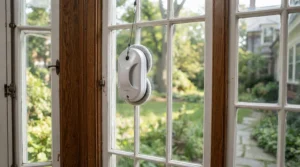
Here is the uncomfortable bit most buying guides skip. A robot window cleaner is a small appliance clinging to a sheet of glass by vacuum pressure, often several metres above a patio, a path or somebody’s head. When the suction works, you forget it’s there. When it doesn’t, gravity does the reviewing. Which?’s guide to robot window cleaners is blunt about it. If suction fails, the device can fall and damage the glass unless it’s secured with a safety tether inside the house.
That’s why this guide ranks safety first and sparkle second. Cleaning performance still matters, because a robot that leaves streaks ends up in a cupboard. But you can forgive a streak, and you can’t forgive a plummet.
I’ve looked at robot window cleaner anti-fall safety as a system across seven real models sold to UK shoppers in 2026. The system covers tether length and rating, backup battery duration, sensor design and how forgiving each machine is of human error.
One honest caveat. Which? says it hasn’t tested robot window cleaners, and I couldn’t find independent UK lab crash-testing either. What follows is spec analysis, professional reviews where they exist, and clearly labelled gaps.
Quick Comparison: Which Is the Safest Robot Window Cleaner at a Glance?
| Model | Backup after a power cut | Tether | Edge / fall sensing | Price range | Best For |
|---|---|---|---|---|---|
| Ecovacs Winbot W2 Omni | Built-in battery (about 110 min cordless) plus station | 100 kg-rated composite cable, plus 1 m station tether | 12-stage protection system | Premium, roughly £450-£650 | Upper floors, no nearby socket |
| Ecovacs Winbot Mini 2 | 30+ minutes | 3.3 m rope, 1,600 N | 5 hardware + 4 software protections | £300-£400 range | Small, narrow panes |
| Hobot S7 Pro | About 20 minutes | 4.5 m rope, up to 230 kgf (Hobot’s figure) | Edge-leakage bumper sensors | £300-£350 range | Big patio doors |
| Kärcher RCW 2 | 40 minutes (rated) | 4 m rope | Optical and pressure sensors | Under £200 | Value-minded first-timers |
| Hutt W8 | 650 mAh safety battery (runtime unverified) | Rope included (length unverified) | Laser edge sensors | Roughly £150-£250 | Budget with remote control |
| Memows Window Cleaner Robot | Emergency battery (runtime unverified) | 4 m tether | Pressure and optical sensors | Often under £150 | Tight budgets |
| AlfaBot X7Pro | Not confirmed | Check listing | Edge sensors, none for frameless glass | £100-£200 range | Ground-floor framed glass |
Looking at the comparison above, Ecovacs Winbot W2 Omni is the most layered design, but you pay for it. Kärcher RCW 2 is the sleeper. It quotes the longest backup in the table and sits well under £200, so budget buyers lose less safety than they might expect. AlfaBot X7Pro is the one to approach with caution if you have frameless glass.
💬 Just one click — help others make better buying decisions too!😊
Top 7 Picks: Which Is the Safest Robot Window Cleaner?
1. Ecovacs Winbot W2 Omni — best layered protection, docking-station tether
The standout is the portable station. It’s a 5.2 kg anchor with its own suction pod and a 1 m tether, a second line of defence most rivals don’t have.
Ecovacs quotes up to 800 N of suction for the station. The combined power-and-safety cable extends to around 5.5 m and is rated to withstand 100 kg. Robot suction peaks at 5,500 Pa. The internal battery gives roughly 110 minutes of cordless running, so a balcony window with no socket stops being a problem. In practice, the robot’s safety doesn’t hinge on one cable or one battery.
Based on the spec comparison, this is the most redundant design here. It suits upper-floor and balcony glass where a fall would be genuinely nasty. One nuance: 100 kg is roughly 980 N, which is lower than the 1,600 N rope on the Ecovacs Winbot Mini 2. The extra station tether is what makes up the difference. Ecovacs also advertises insurance against suction-loss damage, so read the terms for your region.
On reviews, I couldn’t verify a meaningful volume of independent UK owner feedback, and the Which? guide doesn’t cover this model. Treat the brand’s claims as claims until more independent testing appears.
Pros:
- ✅ Station adds a second suction-and-tether anchor
- ✅ Cordless battery mode for socket-less windows
- ✅ Frameless-glass edge sensing with 12-stage protection
Cons:
- ❌ Premium tier, usually the dearest in this list
- ❌ Extra kit to haul: 1.6 kg robot plus 5.2 kg station
Expect roughly £450-£650 (check current price); it’s worth it only if you have genuine height or no-socket problems.
2. Ecovacs Winbot Mini 2 — tightest edges, rope rated to 1,600 N
The standout is a compact 215 × 215 × 55 mm body that fits narrow panes the bigger robots refuse.
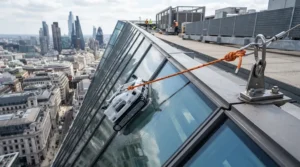
Ecovacs lists power-off protection of 30+ minutes, a 3.3 m nylon-and-latex rope rated to 1,600 N, and a ten-tier protection system. That system combines five hardware measures, four-stage software protection and accident insurance. Which? notes it’s mains-powered with an emergency battery, claims to clean within 1 mm of the edge, and must stay plugged in.
Here’s what the spec sheet won’t shout. A 30-minute reserve is a retrieval window, not a licence to finish the job. A retailer’s spec notes the backup is a safety feature and not intended for standby operation. This model suits small bathroom, kitchen or stairwell windows where the short cable and rope are a feature, not a flaw.
Which? has pulled this model together from retailer and search data but hasn’t tested it. I found no verifiable aggregated owner reviews that I’d feel comfortable summarising here.
Pros:
- ✅ Rope rating of 1,600 N is class-leading here
- ✅ 30-minute-plus backup after mains loss
- ✅ Slim body copes with narrow windows
Cons:
- ❌ Must stay plugged in throughout
- ❌ Rope is shorter than rivals’ for tall windows
Roughly £300-£400 (prices vary); good value if your windows are small and safety-critical.
3. Hobot S7 Pro — big panes, 4.5 m rope, frameless edge sensing
The standout is the Edge-Leakage-Bumper system, which senses suction loss at a pane’s edge and changes direction.
Hobot quotes 4,800 Pa suction, a 4.5 m rope rated up to 230 kgf, and about 20 minutes of backup. A retailer blurb quotes a lower rope rating of 148 kg, so confirm the figure on the box. In TechRadar’s hands-on review, the sensors stopped the robot short of frameless partition glass with a gap at the sides, exactly as advertised.
The reviewer also reported that it fell off a window once during testing. They only caught the rope because they were nearby, and they admitted being lax about attaching it. That’s the most honest data point in this entire category. It shows the rope is the real safety system and the backup battery is the polite one.
That reviewer also found app support missing at the time and the remote fiddly. Cleaning outdoors on dirty glass was streaky.
Pros:
- ✅ Edge sensors proven on frameless glass in review
- ✅ Long 4.5 m rope suits tall patio doors
- ✅ Large body covers wide panes efficiently
Cons:
- ❌ One reported unexplained fall during testing
- ❌ Too big for narrow windows (refused a 32 cm pane)
Around the £300-£350 range (check current price); a strong pick for big glass if you always clip the rope.
4. Kärcher RCW 2 — longest rated backup, 40 minutes
The standout is a 40-minute emergency battery (0.65 Ah, 14.8 V), the longest rated backup in this group.
Kärcher pairs it with a 4 m safety rope, optical and pressure sensors for edge detection, and a 35 × 35 cm minimum window size. Which? flags that the round pads may miss corners. There are four automatic modes plus remote-controlled manual, with voice prompts and LED indicators.
On paper, the Hobot S7 Pro quotes the same 650 mAh, 14.8 V cell with only 20 minutes of runtime, so treat any stated minutes as a rated claim and not a guarantee. Still, a well-known brand, a rope in the box and a long quoted reserve make this the sensible-shoes choice. It suits anyone wanting a first robot without a premium bill.
Which? lists it among popular models without testing it, so there’s no independent verdict on durability. I couldn’t verify a robust pool of owner reviews either.
Pros:
- ✅ 40-minute rated backup beats most rivals
- ✅ 4 m rope included in the box
- ✅ Optical and pressure sensors guard the edges
Cons:
- ❌ Round pads may miss pane corners
- ❌ No published rope force rating found
Under £200 (one UK retailer listed it around £180 per Which?); it’s the best safety-per-pound here.
5. Hutt W8 — budget remote control with laser edge sensors
The standout is a laser sensor array for edges and obstacles at a budget price.
The Hutt W8 has adjustable suction from 1,850 to 3,800 Pa, a 650 mAh safety battery, an 80 ml visible water tank and a supplied safety rope. Retailers list a two-year warranty. Self-regulating suction is meant to hold on wet or pre-treated panes. Remote control and voice prompts round out the kit.
The gap in my research is that I found no manufacturer-verified backup runtime or rope length. For a safety purchase, that’s a yellow flag. Confirm both on the listing before ordering, and don’t assume the 650 mAh cell behaves like Kärcher’s.
It suits flat, framed windows at a sensible height, such as a conservatory or ground-floor patio doors, where you want remote steering without the Ecovacs price.
I couldn’t verify aggregated owner reviews for this model with enough confidence to summarise them, so I won’t pretend otherwise.
Pros:
- ✅ Laser sensors for edge and obstacle detection
- ✅ Safety rope and remote both included
- ✅ Two-year warranty on official stock
Cons:
- ❌ Backup runtime and rope length unverified
- ❌ Lower peak suction than premium rivals
Roughly £150-£250 (check current price); decent value once you’ve verified the safety specs.
6. Memows Window Cleaner Robot — cheapest entry with a real tether
The standout is that it’s among the cheaper models on Amazon’s bestseller list, yet still ships with a 4 m tether.
Which? describes mains power with an emergency battery, pressure and optical sensors to detect boundaries, two rotating microfibre discs and a misting system. The water tank is a small 35 ml, so expect frequent refills. The 4 m tether is there for the moment it comes off the glass.
The analysis is simple. You’re getting the same basic safety architecture as dearer models, with fewer published specs to back it up. That’s fine for a ground-floor framed window with the rope clipped on. It’s not where I’d spend money for a third-floor frameless pane.
I found no verified runtime for the backup battery. Without independent testing, rely on the rope and on never leaving it unattended.
Pros:
- ✅ Very low entry price for a tethered robot
- ✅ Pressure and optical edge sensors included
- ✅ 4 m tether supplied in the box
Cons:
- ❌ Tiny 35 ml tank means constant refills
- ❌ Backup runtime not published in sources
Often under £150; fine for low, framed windows, but pay more for height.
7. AlfaBot X7Pro — dual spray, but a frameless-glass caveat
The standout is dual spray nozzles that mist in both directions of travel.
It has a 60 ml tank, edge-detection sensors, pre-programmed movement patterns and round spinning pads. The crucial detail comes from Which?. There aren’t sensors to stop it going too close to the edge of frameless glass. For a safety guide, that single line matters more than the spray system.
Frameless glass has no frame to bump into, and the suction seal can break at an unprotected edge. So this robot is a framed-window machine. It suits ground-floor sashes and casements where a bumper meets a frame.
I couldn’t confirm a backup battery or tether specification in the sources I trust, so check the current listing before buying. I found no verifiable aggregated reviews to summarise.
Pros:
- ✅ Dual spray wets glass in both directions
- ✅ Compact body suits smaller framed panes
- ✅ Budget-friendly versus branded alternatives
Cons:
- ❌ No frameless-edge sensors per Which?
- ❌ Backup and tether details unconfirmed
Roughly £100-£200 (prices vary); a cautious “only if framed and low” recommendation.
Side-by-Side Safety Specs: Tethers, Backup Runtimes and Power Modes
| Model | Tether (length / rating) | Backup runtime | Power mode | Best For |
|---|---|---|---|---|
| Ecovacs Winbot W2 Omni | Cable up to 5.5 m, 100 kg; plus 1 m station tether | Battery mode about 110 min | Battery or plugged in | Balconies, upper floors |
| Ecovacs Winbot Mini 2 | 3.3 m / 1,600 N | 30+ min | Mains | Small panes |
| Hobot S7 Pro | 4.5 m / up to 230 kgf (Hobot) | About 20 min | Mains | Large patio doors |
| Kärcher RCW 2 | 4 m / not published | 40 min (rated) | Mains | First-time buyers |
| Hutt W8 | Included / not verified | Not verified | Mains | Remote-control fans |
| Memows Window Cleaner Robot | 4 m / not verified | Not verified | Mains | Low windows |
| AlfaBot X7Pro | Not verified | Not confirmed | Not confirmed | Framed ground-floor glass |
The pattern is clear. Only three models publish enough detail to compare properly, and they’re the Ecovacs Winbot W2 Omni, the Ecovacs Winbot Mini 2 and the Hobot S7 Pro. Rope ratings aren’t standardised, so a 1,600 N figure and a “230 kgf” figure come from different test claims. Use them as a rough guide, not a league table. Brands that publish numbers deserve a modest trust premium over brands that don’t.
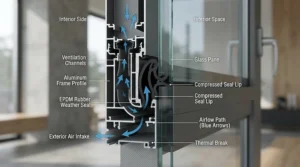
Safety Rope Attachment: A Step-by-Step Setup Guide
Safety rope attachment is where most real-world risk lives, as the TechRadar reviewer discovered. This is general good practice, so always follow your manual first.
- Pick a structural anchor. Use something fixed and load-bearing, such as a solid radiator bracket or a heavy fixed fitting. A window handle is rarely a rated anchor point.
- Clip before you place. Attach the carabiner to the robot first, then put the robot on the glass. Never the other way round.
- Mind the slack. Leave enough rope for the robot to travel, but not so much that a falling robot gains height-sized momentum.
- Check the carabiner gate. Make sure it’s fully closed and locked, then give the rope a firm tug.
- Clear the path. Keep the rope and mains cable from snagging on handles or hinges, and keep the cable out of the cleaning path.
- Stay present. TechRadar notes you can’t leave these robots unattended anyway, because you need to move them from pane to pane.
For first-30-day habits, inspect the rope for fraying before every session. Wipe the suction seal. Charge the backup battery the night before. These three habits cost five minutes and avoid most incidents.
A safety tether window cleaning robot setup is only as strong as its weakest link. That might be the anchor, the carabiner or the rope. It’s rarely the robot.
Real-World Scenarios: Matching the Safest Robot Window Cleaner to Your Home
Scenario 1: The second-floor flat with a balcony door (budget £500+, weekly use).
You’re cleaning glass over a drop with no external socket. The Ecovacs Winbot W2 Omni earns its premium here. Cordless battery mode removes the extension-cable trip hazard, and the station adds a second anchor. Read the insurance terms and use the rope every time.
Scenario 2: The Victorian terrace with narrow sash windows (budget £300-£400, fortnightly use).
Narrow panes defeat big square robots. The Ecovacs Winbot Mini 2 fits them and offers 30+ minutes of backup plus a 1,600 N rope. The short 3.3 m rope is a feature here because it limits any fall distance.
Scenario 3: The conservatory and wide patio doors (budget about £330, monthly use).
Large, flat, frameless-friendly glass suits the Hobot S7 Pro. TechRadar’s reviewer found the edge sensors worked on frameless partitions. Use the long 4.5 m rope and don’t wander off.
Scenario 4: The ground-floor bay window on a tight budget (under £200, occasional use).
Here the Kärcher RCW 2 offers the best published safety specs for the money, including a 40-minute rated backup. If you go cheaper with the Memows Window Cleaner Robot, treat the rope as non-negotiable.
If you’re torn, spend the extra on the model with published numbers. A brand that tells you its rope rating is usually a brand that tested it.
Problem → Solution: Fixing the Scary Moments
Problem 1: The robot beeps mid-clean and the lights go out.
Mains has failed. Don’t wait for the alarm to finish. The backup is for retrieval, so lift the robot off the glass using the handle while holding the rope. A power cut backup of 20-40 minutes is a window of calm, not a work session.
Problem 2: It slides or “hunts” at the edge of the glass.
Check the glass is clean, flat and free of frame silicone. Wipe the suction seal. Where sensors are weaker, as with the AlfaBot X7Pro on frameless panes, keep the robot away from unprotected edges entirely.
Problem 3: It refuses to start on a small window.
The Hobot S7 Pro refused a 32 cm pane in review, and the Kärcher RCW 2 lists a 35 × 35 cm minimum. Choose a robot whose minimum size fits your smallest window, or use a narrow-body model like the Ecovacs Winbot Mini 2.
Problem 4: Streaks on outdoor glass.
That’s cleaning performance, not safety, but it matters because annoyed owners skip safety steps. TechRadar’s reviewer found that running a no-spray pass first and drizzling a little cleaner on the pads improved results on dirtier outdoor panes.
Problem 5: The cable keeps snagging.
Tape nothing to the glass. Re-route the cable over a fixed point on the inside, and keep the rope separate (unless your model uses a composite cable like the Ecovacs Winbot W2 Omni).
How to Choose the Safest Robot Window Cleaner
Here is a framework for choosing the safest robot window cleaner, in order of importance.
- Check the tether first. Look for a supplied rope with a published length and force rating, and a lockable carabiner. A model that doesn’t publish its tether specs hasn’t earned your trust yet.
- Verify the backup runtime. Aim for 20 minutes at minimum. Treat the minutes as a rated claim. They are a retrieval window, not a cleaning session.
- Match fall-prevention sensors to your glass. Frameless panes need edge-leakage or optical sensing. Framed windows are more forgiving, because a bumper meets a frame.
- Match size to your smallest window. Large square robots refuse narrow panes. Check the minimum window size before you buy.
- Confirm UK suitability. Look for UKCA or CE marking and a UK plug or supplied adaptor. Check that the warranty is honoured in the UK.
- Read the insurance small print. Some brands advertise cover for damage caused by suction loss. Check the scope, exclusions and region.
- Be honest about your windows. Which? notes these robots can’t navigate grid or multi-pane windows, so they’re a poor fit there.
Do this in order and you’ll rarely regret the purchase. If a model fails step one, nothing later rescues it.
Fall-Prevention Sensors Explained: What Stops the Robot at the Edge?
Fall-prevention sensors decide whether a robot turns around at the edge or drives off it. They come in a few flavours, and the differences matter more on frameless glass.
Edge-leakage sensors detect a drop in suction as the robot reaches a gap. Hobot’s ELB system works this way, and TechRadar found it stopped short of a frameless edge on test glass. Optical sensors, used by Kärcher and Ecovacs, detect the glass boundary directly. Ecovacs quotes a response in a fraction of a second. Laser sensors, listed on the Hutt W8, do a similar job from a different angle. Pressure sensors on the Kärcher RCW 2 and Memows Window Cleaner Robot watch the seal itself.
Framed windows give every robot a physical bumper to bounce off. Frameless glass doesn’t, so sensors do all the work. That’s why the Which? note on the AlfaBot X7Pro matters. Edge detection exists, but nothing specifically protects frameless edges.
The takeaway is simple. For robot window cleaner anti-fall safety on frameless glass, buy a model that explicitly advertises frameless-edge sensing. For framed windows, any of the seven will do a fair job, provided the tether is clipped on.

Power Cut Backup: What the Battery Really Buys You
The backup cell inside a window robot works like a miniature uninterruptible power supply, which provides emergency power the moment mains fails. In a robot, it keeps the suction motor running so the machine stays on the glass.
For window robot backup battery power cut planning, think retrieval, not completion. Ecovacs quotes 30+ minutes on the Ecovacs Winbot Mini 2, Kärcher rates 40 minutes, and Hobot says about 20. A retailer’s spec on the Mini 2 states plainly that the cell is a safety feature and not for standby operation.
Two practical points follow. First, the battery only protects you if it’s charged. TechRadar’s Hobot review specifically reminds owners to keep the backup battery charged. The Mini 2’s safety battery takes around three hours to charge. Second, power cut backup runtime isn’t the whole story. The cable is the commonest cause of “power loss”, because somebody trips over it. Which? makes exactly that point.
The Ecovacs Winbot W2 Omni sidesteps part of the problem in battery mode, because there’s no mains lead to trip over. But always treat its rope as the primary insurance.
Common Mistakes When Buying the Safest Robot Window Cleaner
Common mistakes are mostly about trust, and they’re worth avoiding.
Trusting the battery alone. A 20-40 minute reserve doesn’t stop a seal failure. Only the tether does.
Skipping the rope on “low” windows. A ground-floor fall still lands on a patio slab, a path or a person. Clip on anyway.
Buying on suction numbers. Pascals are headline-friendly, but they say nothing about the tether, the sensors or the alarm. A 5,500 Pa robot with a flimsy rope is still a worry.
Ignoring minimum window size. Several models refuse small panes, which causes the “it won’t start” frustration that tempts people to bodge workarounds.
Assuming every model suits every glass. Which? notes grid or multi-pane windows are a bad fit. TechRadar’s reviewer says earlier reviews suggest the Hobot S7 Pro is for perfectly vertical surfaces only.
Assuming “safety rope included” means “rated safe”. Check the length and the force rating. Models that don’t publish them, such as the Hutt W8, deserve a verification email to the seller before you buy.
Leaving it unattended. TechRadar is explicit that you need to be around to move it between panes. A robot you can walk away from is a different, riskier product category.
Safest Robot Window Cleaner vs Ladders, Window Vacs and Professionals
Choosing the safest robot window cleaner makes sense only if the alternative is actually less safe. So here’s the comparison.
| Method | Fall risk | Effort | Upfront cost | Best For |
|---|---|---|---|---|
| Ladder plus squeegee | Highest | High | Low | Low windows, short jobs |
| Window vac | Moderate (ladder still needed upstairs) | Medium | Low | Condensation, reachable glass |
| Professional cleaner | Carried by the pro | Minimal | Ongoing | High or awkward glass |
| Tethered robot (e.g. Kärcher RCW 2) | Low, if tethered and attended | Low | Medium | Hard-to-reach, regular glass |
The honest comparison is a ladder versus a tethered robot. Guidance reproduced by Loughborough University from the HSE notes that around a third of reported fall-from-height incidents involve ladders and stepladders. These are workplace figures, but a useful reality check for home ladders too.
Which? says a window vac is cheaper and faster for accessible glass, while a robot suits hard-to-reach first- and second-floor windows, at a higher price. For robot window cleaner anti-fall safety, the sensible position is this. A tethered, attended robot can reduce your need to stand on a ladder, but it replaces one risk with a smaller, manageable one. It doesn’t remove risk entirely.
For very high or awkward glass, a professional is still the safest answer.
Long-Term Cost & Maintenance: What Safety Costs After Day One
Safety isn’t a one-off purchase. Pads need washing after every session. Which? warns that dirty pads simply spread grime. Spare microfibre pads and cleaning solution are small but recurring costs. The Kärcher RCW 2 ships with three pairs of pads, and the Hutt W8 includes four.
Rechargeable backup cells fade as lithium batteries do, so a robot that gave you 30 minutes in year one may give less later. Test it occasionally by checking the beep and hold behaviour on a low window with the rope clipped. Don’t test it at height.
Warranties matter more than usual. Retailers list a two-year warranty for official Hutt W8 stock, and a 24-month warranty appears on a Hobot S7 Pro listing. Check the terms for any model you buy.
Finally, consider cost per safe clean. A robot in the £300-£350 range used twice a month for three years is roughly 72 sessions. That works out to a few pounds a session, before pads and solution. Against a professional cleaner, whom Checkatrade-style quotes put at tens of pounds an hour, the maths is persuasive for regular, hard-to-reach glass. It’s much less persuasive if you clean twice a year.
FAQ
❓ Is a robot window cleaner safe on upstairs windows?
❓ How long does a robot window cleaner stay attached after a power cut?
❓ Do I still need a tether if my robot has a backup battery?
❓ Can a robot window cleaner damage frameless glass?
❓ Is it worth paying more for the safest robot window cleaner?
Conclusion
If you remember one thing, make it this. The safest robot window cleaner is the one whose tether, power cut backup and sensors are all verified, and whose owner actually uses the rope.
On the spec evidence, the Ecovacs Winbot W2 Omni is the most layered design for upper floors. The Ecovacs Winbot Mini 2 wins for small panes thanks to its 1,600 N rope and 30+ minute reserve. The Hobot S7 Pro suits big patio doors, with the caveat from TechRadar’s review that it once fell, which is a useful reminder to clip on. The Kärcher RCW 2 is the budget-sensible choice with the longest rated backup. The Hutt W8, Memows Window Cleaner Robot and AlfaBot X7Pro can work for low, framed glass, but verify their safety specs first.
Remember the limits. No independent UK lab has crash-tested these robots, Which? hasn’t tested them, and I’ve flagged every gap I found. Buy on published numbers, use the rope every time and never walk away.
Recommended for You
- Robot Window Cleaner Under £200: 7 Best Picks For UK Homes (2026)
- Robot Window Cleaner: 7 Best Picks For UK Homes (2026)
- Self-Emptying Robot Vacuum Bag Replacement Cost: 7 Smart Picks (2026)
Disclaimer: This article contains affiliate links. As an Amazon Associate, I earn from qualifying purchases. If you purchase products through these links, we may earn a small commission at no additional cost to you.
✨ Found this helpful? Share it with your friends! 💬🤗
