In This Article
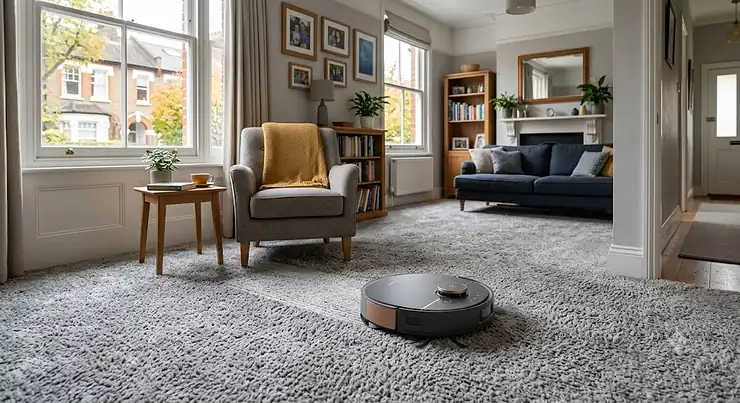
Carpet is where robot vacuums go to die. Fine on laminate, breezy on tile, then it meets your living room rug and either stalls dead against the pile, skates over the top like a toddler on an ice rink, or quietly clogs its brushroll within a fortnight. If you’ve bought one before and felt personally betrayed by it, you’re not imagining things — carpet genuinely is the harder test.
A proper robot vacuum for carpets needs three things working together: enough raw suction to lift dirt out of the fibres rather than just skimming the surface, a brushroll design that won’t strangle itself on hair within a week, and enough clearance to climb over the door thresholds that separate carpet from hardwood in most British homes. Get any one of those wrong and you’ve bought an expensive dust-pusher.
This guide covers seven real, currently available models spanning budget to premium, tested and reviewed by independent outlets, so you can see what genuinely works on thick pile, Berber weave, and deep-pile rugs before you spend a penny. We’ll also unpack what “carpet boost mode” actually does, why roller brush design matters more than the spec sheet suggests, and how climb threshold height quietly makes or breaks the whole experience in older UK properties with raised doorway strips. No fluff, no invented five-star reviews — just what the data and the testers actually found.
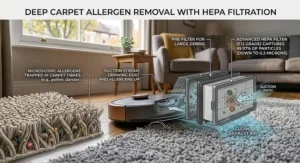
There’s a genuine health angle here too, not just a tidiness one. Carpets are a well-documented reservoir for house dust mite allergens, and regular high-filtration vacuuming is one of the few practical steps households can take to reduce exposure without ripping out the flooring entirely.
What Is a Robot Vacuum for Carpets?
A robot vacuum for carpets is an autonomous cleaning robot engineered with higher suction power (typically 8,000Pa or above), carpet-detecting sensors that automatically increase suction on contact, and a brushroll built to resist hair tangling on pile fibres — as opposed to a general-purpose bot optimised mainly for hard floors.
Quick Comparison Table
| Model | Suction | Carpet Boost | Threshold Climb | Best For |
|---|---|---|---|---|
| Roborock Q7 M5 | 10,000Pa | Yes | 2cm | Best all-round value |
| Eufy RoboVac 11S Max | ~2,000Pa | Yes (BoostIQ) | Low-pile only | Cheapest entry point |
| Shark Matrix Plus | Not disclosed | Yes | Standard | Anti-tangle for pet hair |
| Eufy X10 Pro Omni | 8,000Pa | Yes | Moderate (struggles on high thresholds) | Hands-free mop + vacuum |
| Ecovacs Deebot T30 Pro Omni | 11,000Pa | Yes (ultrasonic detection) | 20mm | Deep pile all-rounder |
| iRobot Roomba Combo j9+ | High (100% more than i-Series) | Yes (Dirt Detective) | Standard | Smartest carpet prioritisation |
| Roborock Qrevo Curv 2 Pro | 20,000Pa | Yes | Hovering lift system | Thick, shag and deep-pile carpets |
Looking at the table, the gap between the two cheapest options and everything above them isn’t subtle — the Roborock Q7 M5 and Eufy RoboVac 11S Max both use carpet-boost logic, but only one of them has the suction ceiling to make that boost meaningful on anything thicker than a thin hallway runner. Meanwhile, the Roborock Qrevo Curv 2 Pro‘s 20,000Pa and self-lifting chassis exist specifically because ordinary robots physically can’t push through shag-pile without stalling. If threshold height worries you more than suction numbers, the Ecovacs Deebot T30 Pro Omni‘s 20mm climb is currently one of the more generous figures on this list.
💬 Already got a favourite in mind? Skip ahead and compare it properly in the full breakdown below!😊
Top 7 Robot Vacuums for Carpets: Expert Analysis
1. Roborock Q7 M5 — best all-round value for thick carpets
The headline number here is 10,000Pa of suction, which independent bench testing at Vacuum Wars actually confirmed rather than dismissed as marketing gloss — its suction score ranked among the highest ever recorded for a robot in this price bracket. That matters in practice: most budget bots top out around 2,500-4,000Pa, which is roughly the difference between properly extracting grit from your carpet fibres and just relocating it. The Q7 M5 pairs that suction with LiDAR-based PreciSense navigation, meaning it maps your rooms once and remembers them, rather than bumbling around randomly.
Who’s this for? Honestly, most first-time buyers with a mix of carpet and hard flooring who don’t want to spend flagship money to get flagship-adjacent carpet performance. Its floating roller brush with anti-tangle comb copes reasonably with everyday debris, though reviewers note it still wraps with roughly four in ten long-hair strands — so households with waist-length hair or long-haired dogs should temper expectations. Aggregated reviewer sentiment consistently flags the mopping as an afterthought rather than a genuine feature, and battery life in real use runs noticeably shorter than the advertised figure.
Pros:
- ✅ Exceptional suction for the price bracket, verified independently
- ✅ Reliable LiDAR navigation with genuine room memory
- ✅ Automatic carpet-boost suction increase built in
Cons:
- ❌ Struggles with long hair tangling in the brushroll
- ❌ Mopping function is basic and largely passive
Price sits in the £180-£260 range depending on retailer promotions and whether you choose the self-emptying Plus variant — for the suction-per-pound ratio alone, this is one of the strongest value picks on the market right now.
2. Eufy RoboVac 11S Max — cheapest way to try automated carpet cleaning
This is Eufy’s entry-level workhorse, built around BoostIQ technology that automatically ramps up suction the moment it senses a transition from hard floor to carpet. There’s no LiDAR, no app-guided room mapping, and no fancy obstacle avoidance — it navigates with a bump-and-redirect system that feels dated next to anything on this list above it, and that’s worth being upfront about rather than dressing it up.
Here’s what the spec sheet won’t spell out plainly: at roughly 2,000Pa on boost, this isn’t a deep-clean machine for anything beyond low or medium pile. Testers found it handled fine dust and everyday debris on hard floors and thin carpets competently, but genuinely struggled to give medium and thick-pile carpets a thorough clean. If your home is mostly laminate with the odd thin rug, that’s a non-issue. If you’ve got a lounge full of shag-pile Berber carpet, it’s the wrong tool. Reviewers do praise its low 7.2cm profile for sliding under sofas and beds where dust collects most.
Pros:
- ✅ Genuinely the most affordable route into robot vacuuming
- ✅ Low profile clears furniture other robots can’t reach under
- ✅ BoostIQ senses carpet and lifts suction automatically
Cons:
- ❌ No mapping — cleans in a random bump pattern
- ❌ Noticeably weaker on medium and thick pile carpet
At under £160 in typical UK pricing, this is squarely a starter model — buy it to test whether robot vacuuming suits your household, not to replace a proper upright on demanding carpet.
3. Shark Matrix Plus — best anti-tangle brushroll for pet hair on carpet
Shark built its reputation on cordless and upright vacuums, and the Matrix Plus is essentially that hair-fighting DNA transplanted into a robot chassis. The self-cleaning brushroll uses rubber anti-tangle flaps rather than traditional bristles, specifically engineered to stop long hair wrapping around the roller — a genuine point of difference from bristle-brush competitors, where hair wrap is consistently the top maintenance complaint.
Independent testing found the Matrix line performed strongly across both hard floors and carpet, scoring competitively against models costing two or three times as much, and it beat the well-known Roomba i3+ EVO comfortably in head-to-head scoring. What most buyers overlook about this model is its Matrix Clean mode, which cleans from multiple angles in a precision grid rather than a single pass — useful in heavy-traffic hallways, though testers note its usefulness elsewhere is more limited. The SharkClean app is functional but noticeably less feature-rich than the Chinese-brand apps on this list; don’t expect granular no-go-zone customisation on the same level as Roborock or Ecovacs.
Pros:
- ✅ Anti-hair-wrap brushroll genuinely reduces maintenance
- ✅ Strong debris pickup on carpet, verified by independent testing
- ✅ Bagless self-empty base holds weeks of debris
Cons:
- ❌ App is basic compared with Roborock or Ecovacs rivals
- ❌ Initial mapping can be unreliable on first setup
Expect to pay in the £400-£500 range for the Plus 2-in-1 model with self-empty base — a sensible mid-tier pick specifically if pet hair on carpet is your primary battle.
4. Eufy X10 Pro Omni — best hands-free mop-and-vacuum combo
The X10 Pro Omni’s whole pitch is minimal ongoing effort: the all-in-one dock empties the dustbin, washes the mop pads in hot water, dries them with hot air, and refills the water tank automatically. You set a schedule once and, in Vacuum Wars’ own words, it’s a feature-rich, affordable flagship that punches well above its price bracket.
On carpets specifically, its 8,000Pa suction proved exceptional at deep-cleaning embedded debris like sand — one of the better scores recorded in that particular test. The dual mop pads carry a genuinely clever trick for carpet-heavy homes: a 12mm auto-lift that raises the mops the instant carpet is detected, so you’re never manually switching between vacuum-only and vacuum-and-mop modes room by room. Where it stumbles, according to TechRadar’s own testing, is with larger doorway thresholds — the robot “occasionally struggles” to climb over them, which is a genuinely relevant caveat for older UK homes with pronounced carpet-to-hardwood transition strips.
Pros:
- ✅ Fully hands-off dock: empties, washes, dries, refills itself
- ✅ Strong embedded-debris pickup on carpet in independent tests
- ✅ Auto-lifting mop pads mean zero manual mode switching
Cons:
- ❌ Struggles with larger or uneven doorway thresholds
- ❌ Base station is bulky and needs generous clearance
Typical UK pricing sits in the £500-£650 range. If your home genuinely mixes carpet and hard floor room by room, this is one of the more convincing all-rounders here.
5. Ecovacs Deebot T30 Pro Omni — strongest all-round suction for deep pile
At 11,000Pa, the T30 Pro Omni currently out-suctions most of its direct rivals on paper, and Ecovacs’ own lab data claims a 99.4% large-particle pickup rate on carpet at maximum power — a figure worth treating as a manufacturer claim rather than gospel, but one broadly consistent with what independent reviewers have reported about its carpet performance. The standout feature for pile-heavy homes is ultrasonic carpet recognition, which the brand says identifies carpet with unusual precision and automatically lifts the mopping plates to keep rugs dry — a genuinely useful failsafe if you’ve ever had a robot leave a damp patch on your good rug.
Threshold climbing is rated at 20mm, among the more generous figures in this guide, which should smooth over the raised carpet-grip strips common in Victorian and Edwardian UK terraces. The anti-tangling roller brush uses dual comb-teeth arrays designed to prevent hair wrap during suction, addressing the exact complaint that dogs owners raise most about cheaper bots. TechRadar’s hands-on testing did flag one honest limitation: on carpets that are already heavily soiled with tangled hair or fur, even 11,000Pa has its ceiling — a useful reminder that suction numbers aren’t infinite magic.
Pros:
- ✅ 11,000Pa suction, among the strongest on this list
- ✅ Ultrasonic carpet detection with automatic mop-lift
- ✅ Generous 20mm threshold climb for raised UK doorways
Cons:
- ❌ Heavily soiled, deeply tangled carpets still challenge it
- ❌ Premium price puts it beyond true budget buyers
Expect the £700-£900 range for the full Omni station bundle — a strong pick if deep-pile rugs are your main concern and you want headroom above entry-level suction figures.
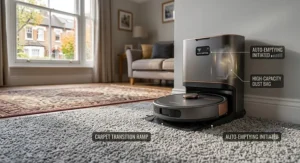
6. iRobot Roomba Combo j9+ — smartest carpet prioritisation
iRobot’s flagship leans less on raw Pascal numbers and more on intelligence: Dirt Detective, powered by iRobot OS, learns your cleaning history and automatically prioritises the rooms that get dirtiest fastest — usually, as the brand rather charmingly puts it, wherever the dog sleeps. It’s claimed to deliver 100% more suction than the older Roomba i-Series, and independent testing at Vacuum Wars backed that up, finding it as good as or better than any competitor on debris pickup across both carpet and hard flooring, with a particularly strong score on the carpet deep-clean test for embedded sand.
Here’s what actually matters day to day: the Auto-Retract Mopping System physically lifts the mop pad up and over itself the instant carpet is detected, functioning almost like a convertible roof folding back — a mechanical solution to the wet-carpet problem rather than a purely software-based one. Three levels of suction power combine with automatic Carpet Boost for genuinely adaptive cleaning. The trade-off, and it’s a real one, is cost: this sits at the very top of the market, and testers consistently flag ongoing part costs and ambient noise from the auto-empty base as things to budget for beyond the sticker price.
Pros:
- ✅ Dirt Detective learns and prioritises your dirtiest rooms
- ✅ Mechanical mop-retraction keeps carpets genuinely dry
- ✅ Independently verified best-in-class debris pickup
Cons:
- ❌ Among the most expensive options in this guide
- ❌ Auto-empty base is notably loud during emptying
UK pricing typically lands in the £1,000-£1,250 range. This is the pick for households that want the robot to make the prioritisation decisions for them, particularly with pets in the mix.
7. Roborock Qrevo Curv 2 Pro — best for shag and deep-pile carpets
This is the model built for the carpets that break other robots. TechRadar’s own testers, who specifically stress-test every robot vacuum on mid- and deep-pile carpet, described the Curv 2 Pro as soaring through that portion of the review — and with 20,000Pa of rated suction, it’s genuinely in a different tier from every other product on this list. Some reporting on Roborock’s 2026 lineup has also highlighted a hovering-style lift mechanism designed specifically to raise the robot to the correct height for cleaning thick carpet without getting physically stuck in the pile — a mechanical answer to a problem that pure suction alone can’t fully solve.
Based on the spec comparison with everything else here, this is not a value pick, and it isn’t trying to be. It’s aimed squarely at homes with genuinely deep-pile or shag-style carpet where cheaper bots simply give up. It launched in the UK at a list price of £1,199.99, available via Amazon.co.uk or direct from Roborock — reviewers note that list prices on Roborock’s flagship tier rarely hold for long, so patient buyers may see it discounted within a few months of any given launch window.
Pros:
- ✅ 20,000Pa suction, the highest figure in this guide
- ✅ Purpose-built lift mechanism for thick and shag-pile carpet
- ✅ Praised in hands-on testing specifically for deep-pile pickup
Cons:
- ❌ Premium price puts it out of reach for most budgets
- ❌ Overkill if your home is mostly hard flooring
Price sits around £1,100-£1,250 depending on promotions. If deep-pile or shaggy carpet has defeated every robot you’ve tried before, this is currently the most convincing answer on the market.
Practical Usage Guide: Getting the Most From Your Robot Vacuum on Carpet
Unboxing day matters more than people expect. Before the first run, walk the areas you want cleaned and physically remove trailing charging cables, loose socks, and anything with tassels or fringing — carpet-focused robots have powerful roller brushes, and fringe rugs are their natural enemy. Let the first mapping run complete uninterrupted; interrupting it partway through is the single most common cause of patchy, incomplete coverage later.
Once mapped, set carpet boost mode to activate automatically rather than manually toggling it room by room — nearly every model on this list detects the transition itself, so manual intervention just adds friction without adding a clean. In the first 30 days, check the roller brush weekly rather than monthly; hair and fibre wrap accumulates fastest during the settling-in period as the robot learns your floor plan and takes slightly inefficient routes. A rubber-flap brush like Shark’s needs less attention than a bristle design, but neither is maintenance-free.
For genuinely deep-pile carpets, consider scheduling a slower, single-pass “deep clean” mode weekly rather than relying purely on daily quick runs — most apps let you assign different cleaning intensities to different rooms, so your hallway laminate doesn’t need the same treatment as your lounge rug.
Real-World Scenarios: Which Robot Vacuum Fits Your Home?
Picture a first-floor flat with wall-to-wall mid-pile carpet, a couple of housemates, and a strict weekday schedule with no time for manual vacuuming. That’s the Roborock Q7 M5 territory — strong suction, LiDAR mapping that copes with a single-level layout, and a price point that doesn’t demand a group chat about splitting costs.
Now picture a Victorian terrace: hallway of encaustic tile, bedrooms carpeted, and a raised threshold strip between every room that’s been quietly tripping up robot vacuums since 2019. That’s exactly the scenario the Ecovacs Deebot T30 Pro Omni‘s 20mm threshold climb and ultrasonic carpet detection were built for — it’s designed to handle exactly this kind of mixed, uneven flooring without getting stuck at every doorway.
Finally, imagine a family home with two dogs, a cream-coloured deep-pile lounge carpet that shows every stray hair, and genuinely limited patience for maintenance. That combination points toward the iRobot Roomba Combo j9+, whose Dirt Detective learns which room the dogs favour and adjusts its cleaning intensity accordingly, paired with a mop system that mechanically retracts rather than risking a damp patch on that carpet.
🧹 Ready to Stop Vacuuming by Hand?
🔋 Whichever budget you’re working with, there’s a genuine match for your carpet type on this list. Tap through to check today’s availability and current pricing before your favourite sells out!
How to Choose a Robot Vacuum for Carpets
- Check the suction figure against your pile height. Low or medium pile can manage on 2,000-4,000Pa; thick or deep pile genuinely needs 8,000Pa or above to lift debris rather than push it.
- Confirm carpet boost mode is automatic, not manual. A robot that requires you to switch settings room by room defeats the point of buying one.
- Look at the roller brush design, not just the marketing name. Rubber anti-tangle flaps generally outperform traditional bristle brushes on long hair, based on aggregated reviewer sentiment across this guide.
- Measure your actual door thresholds. If your home has raised carpet-to-hardwood strips, prioritise a model with at least 15-20mm of climb threshold height.
- Weigh mop-lift mechanics if you’re buying a combo unit. Mechanical retraction (like iRobot’s) or a reliable auto-lift height (9-12mm, like Ecovacs and Eufy) both protect carpet from water damage.
- Factor in ongoing costs, not just the sticker price. Replacement filters, brushes, and dust bags add up over a year of ownership.
- Read independently verified suction and pickup tests, not just brand claims. Manufacturer-stated Pascal figures and independently bench-tested figures don’t always align. Which?’s own robot vacuum testing programme specifically scores models on threshold climbing and carpet debris pickup, which is a useful second opinion alongside manufacturer specs.
Common Mistakes When Buying a Robot Vacuum for Carpets
The most frequent mistake is buying on Pascal number alone without checking whether that suction is independently verified — as we’ve seen with the Roborock Q7 M5, some budget models genuinely deliver on their headline figure, but plenty of others inflate it. The second is ignoring threshold height entirely, then being surprised when the robot gets physically stuck at every doorway in a period property. The third, and possibly the most expensive one, is buying a premium flagship for a home that’s 80% hard flooring — paying for 20,000Pa of deep-pile-conquering suction when your actual challenge is laminate dust is money better spent elsewhere.
Robot Vacuum for Carpets vs Traditional Upright Vacuums
| Factor | Robot Vacuum for Carpets | Traditional Upright |
|---|---|---|
| Deep-clean power | Strong on top models, capped by pile depth | Generally higher raw suction and agitation |
| Daily convenience | Fully autonomous, scheduled | Manual, time-intensive |
| Edge and corner cleaning | Improving, still imperfect | Excellent with the right tool |
| Long-term cost | Higher upfront, low ongoing effort | Lower upfront, higher time cost |
| Best For | Maintenance cleaning between deep cleans | Periodic deep cleans and heavily soiled carpet |
Reading the table straight, robot vacuums genuinely excel at frequent, low-effort maintenance cleaning that keeps carpet fibres from becoming a dust reservoir between deeper cleans, but they’re not a full replacement for an upright on heavily soiled or genuinely shaggy carpet. Consumer testing bodies have consistently found that even strong robot vacuums lag behind full-sized uprights and canisters for true deep-cleaning power on carpet, which is worth knowing before you retire your old vacuum entirely.
What to Expect: Real-World Performance on Thick Pile and Deep Pile Rugs
Specs promise a lot; carpet fibre has other ideas. On a robot vacuum for thick pile carpet, expect a visible drop in cleaning speed compared with hard floors — the wheels work harder, the brushroll has to dig deeper, and battery drain increases accordingly. This is completely normal and not a fault; it’s physics.
For robot vacuum for deep pile rugs specifically, the practical reality is that models under roughly 8,000Pa will often glide across the surface without genuinely agitating the base of the pile, leaving embedded dust and pet dander behind even after several passes. This is precisely why the Roborock Qrevo Curv 2 Pro‘s 20,000Pa and hovering lift mechanism exist — deep pile doesn’t just need more suction, it often needs a mechanical solution to stop the robot sinking into the fibres in the first place. If your rugs are genuinely shag-style rather than a standard mid-pile weave, budget accordingly rather than assuming a mid-range model will cope.
Carpet Boost Mode Explained
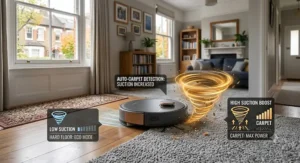
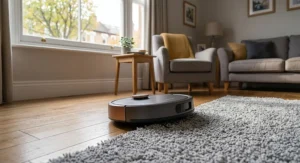
Carpet boost mode is the automatic suction increase that triggers the instant a robot vacuum’s sensors detect a transition from hard flooring to carpet — every model in this guide includes some version of it, from Eufy’s BoostIQ to iRobot’s Carpet Boost to Ecovacs’ ultrasonic detection system. What the marketing rarely explains clearly is that “boost” is relative to that model’s baseline suction, not an absolute figure — a 200% boost on a weak 1,000Pa base motor still won’t out-clean a strong 8,000Pa motor running at its normal setting.
The practical upshot: don’t assume carpet boost mode alone guarantees a thorough clean. It’s a genuinely useful feature for extending battery life on mixed-floor homes by only using high suction where it’s needed, but the underlying motor strength still does the heavy lifting.
Roller Brush Design: What Actually Matters
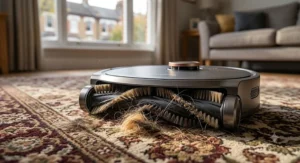
Roller brush design is arguably the single biggest predictor of long-term carpet performance, and it’s consistently underrated next to suction figures. Traditional bristle brushes — still used on models like the Roborock Q7 M5 — pick up debris effectively but are genuinely prone to hair wrap, with testing showing over 40% of long hair strands tangling around the brush in some cases. Rubber-flap anti-tangle designs, like Shark’s self-cleaning brushroll or Ecovacs’ dual comb-teeth arrays, are specifically engineered to reduce this, and aggregated reviewer sentiment across pet-owning households consistently rates them as lower-maintenance over months of use.
The trade-off worth knowing: rubber-flap brushes can occasionally be slightly less effective at deep-agitating thick pile than a well-designed bristle brush, since bristles physically penetrate fibre more aggressively. If you have short-haired pets or no pets at all, this trade-off matters less; if long hair is a daily reality in your home, prioritise the anti-tangle design even if the suction figure is marginally lower.
Climb Threshold Height: Why It Matters for UK Homes
Climb threshold height is the maximum step a robot vacuum can physically drive over without stalling, and it’s disproportionately important in the UK compared with newer-build markets, simply because so much of British housing stock — Victorian and Edwardian terraces especially — has raised carpet-to-hardwood transition strips at almost every internal doorway. A robot rated for only 10mm of climb can end up cleaning a single room brilliantly and never reaching the rest of the house.
Among the models covered here, the Ecovacs Deebot T30 Pro Omni offers a generous 20mm rating, while the Roborock Q7 M5 manages 2cm (20mm) as well. By contrast, testers found the Eufy X10 Pro Omni “occasionally struggles” with larger doorway thresholds despite its otherwise strong carpet performance — a useful reminder that climb threshold height doesn’t always correlate neatly with price or suction power. If you’re unsure, measure your actual thresholds with a tape measure before ordering; it’s a five-minute check that prevents a genuinely frustrating return process.
Long-Term Cost & Maintenance
The purchase price is only the opening bid. Replacement filters typically run £15-£35 depending on the brand and tend to need swapping every six to twelve months. Roller brushes wear down faster on carpet-heavy homes than hard-floor-only ones, given the extra friction, and third-party or own-brand replacements are usually a fraction of the official-brand price if you’re comfortable sourcing them. Self-emptying models add dust bags to the ongoing bill — budget roughly £1.50-£2.50 per bag from third-party sellers, considerably less if bought in bulk packs.
Over a two-year ownership window, a budget model like the Eufy RoboVac 11S Max will cost noticeably less in parts simply because it has fewer components to replace — no mop pads, no water filtration cartridges. A premium combo unit like the iRobot Roomba Combo j9+ carries higher ongoing costs by design, but that’s the trade-off for the convenience it delivers. Factor total cost of ownership into your decision, not just the number on the box.
Safety, Regulations & Compliance Guide
Any robot vacuum sold in the UK must carry UKCA marking (or CE marking during the current transitional recognition period) confirming it meets British electrical safety standards, so check for this marking on the product listing or packaging before buying from an unfamiliar retailer. Charging docks should always be plugged into a standard UK three-pin socket with adequate ventilation space around the unit — auto-empty stations in particular generate some heat during their cleaning cycles.
When a robot vacuum eventually reaches the end of its life, it falls under the UK’s Waste Electrical and Electronic Equipment regulations, meaning retailers are legally required to offer a take-back or recycling route rather than letting it go to landfill — worth remembering given how many working parts, including lithium batteries, these machines contain.
FAQ
❓ Do robot vacuums work well on thick carpet?
❓ What is carpet boost mode on a robot vacuum?
❓ Can a robot vacuum climb over a carpet threshold?
❓ How often should I clean the roller brush on a robot vacuum?
❓ Is a robot vacuum enough for carpets, or do I still need an upright?
Conclusion
Carpet has always been the honest test of a robot vacuum, and this guide has tried to be just as honest back: no model here is magic, and every one of them has a genuine trade-off somewhere between price, suction, and maintenance. If you want the strongest all-round value, the Roborock Q7 M5 earns its place through independently verified suction at a genuinely accessible price. If deep-pile or shag carpet has beaten every robot you’ve tried, the Roborock Qrevo Curv 2 Pro‘s 20,000Pa and purpose-built lift mechanism are currently hard to match. And if pet hair on carpet is your specific battle, the Shark Matrix Plus‘s anti-tangle brushroll deserves serious consideration before anything else on this list.
Whichever you choose, match the suction figure and roller brush design to your actual pile height and household — not the flashiest spec sheet in the shop window.
✨ Don’t Miss These Exclusive Deals!
🔍 Take your carpet cleaning routine to the next level with these carefully researched picks. Click through on any highlighted model to check current pricing and availability before you decide — genuinely clean carpets are one tap away!
Recommended for You
- Robot Vacuum For Pet Hair: 7 Tested UK Picks (2026)
- 7 Best Premium Robot Vacuum Picks for UK Homes
- Budget Robot Vacuum 2026: 7 Brilliant Picks That Won’t Break the Bank
Disclaimer: This article contains affiliate links. As an Amazon Associate, I earn from qualifying purchases. If you purchase products through these links, we may earn a small commission at no additional cost to you.
✨ Found this helpful? Share it with your friends! 💬🤗
