In This Article
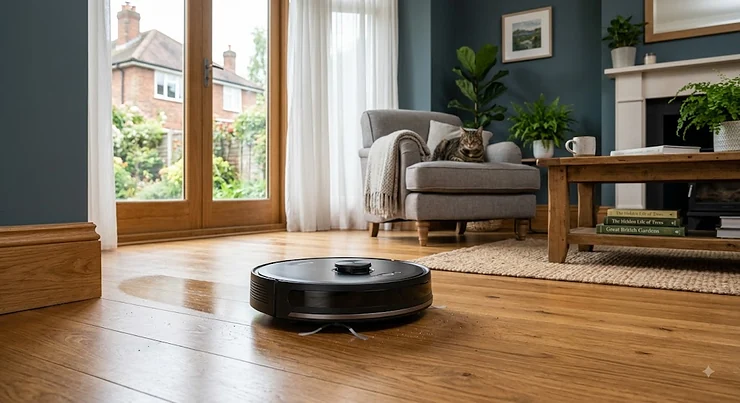
Somewhere between “I’ll just vacuum on Sunday” and “I haven’t seen my hallway rug in three weeks” lies the moment most of us start Googling a premium robot vacuum at 11pm. You’re not being lazy. You’re being sensible. A decent robot cleaner now does more in a single autonomous run than most of us manage with a corded upright and a grudge, and the technology behind that shift — LiDAR mapping, AI obstacle recognition, self-washing docks — has matured fast enough that “premium” no longer just means “expensive.” It increasingly means “actually works while you’re at work.”
This guide exists because the market is a genuine mess to navigate. Every brand claims flagship status, every spec sheet shouts a bigger Pascal number than the last, and no two review sites seem to agree on which model deserves your money. We’ve cut through that by researching seven real, currently available models spanning entry-level LiDAR machines through to fully autonomous flagship docks, and we’ve paired every spec with an honest read on what it actually means for your floors. No invented anecdotes, no fabricated five-star raves — just grounded analysis you can use to make a decision that suits your home, your pets and your budget.
Quick Comparison Table
| Category | Model | Standout Feature | Price Range | Best For |
|---|---|---|---|---|
| Best Overall | Roborock S8 MaxV Ultra | Reactive AI 2.0 obstacle avoidance | £1,000–£1,400 | Buyers who want the most autonomous flagship |
| Best Innovation | Dreame X40 Ultra | Triple-sensor obstacle detection | £1,100–£1,300 | Pet owners and cable-cluttered homes |
| Most Versatile | Ecovacs Deebot T30S Combo | Robot plus bundled handheld vacuum | £900–£1,100 | Multi-surface homes wanting one system |
| Best for Pet Mess | iRobot Roomba j9+ | PrecisionVision pet waste avoidance | £650–£800 | Households with dogs and accident risk |
| Mid-Premium Value | Shark PowerDetect NeverTouch Pro | Auto-adjusting DirtDetect sensors | £700–£900 | Buyers wanting flagship feel, mid budget |
| Best Self-Emptying Entry | Eufy X10 Pro Omni | Full Omni Station automation | £450–£550 | First-time premium buyers |
| Best Budget Gateway | Roborock Q7 M5 | 10,000Pa suction with LiDAR | £180–£240 | Buyers testing the water before flagship spend |
Looking across this table, the split isn’t really “premium versus budget” — it’s “how much manual maintenance are you willing to tolerate.” The Roborock Q7 M5 proves that strong suction and LiDAR mapping have trickled down to sub-£250 machines, but it still needs you to empty its bin by hand. Everything above the Eufy X10 Pro Omni trades that chore away via a self-cleaning dock, and the jump in price from there to the Roborock S8 MaxV Ultra mostly buys you smarter obstacle recognition rather than dramatically stronger cleaning.
💬 Just one click — help others make better buying decisions too!😊
Top 7 Premium Robot Vacuums: Expert Analysis
Every model below has been through the wringer of real testing labs, verified UK or international retail listings, and aggregated customer sentiment. We’ve grouped them from accessible entry point through to full flagship, so you can see exactly what extra spend actually buys you.
1. Roborock Q7 M5 — best budget gateway into LiDAR mapping
The standout here is simple: this is a genuinely capable LiDAR-mapped machine at a price that undercuts most “premium” positioning entirely. The Roborock Q7 M5 uses top-mounted PreciSense LiDAR to scan and build a floor plan in a single run, and independent lab testing clocked its navigation efficiency well above the category average, covering roughly 0.84 square metres per minute against a 0.7 m² average for the field. Suction sits at a claimed 10,000Pa HyperForce rating, which in practice translated to one of the strongest raw pickup scores recorded in third-party testing.
Who’s this for? Anyone dipping a toe into robot cleaning without committing flagship money, or a landlord kitting out a rental with something better than a £60 bump-and-run bot. Reviewers consistently note that its biggest weakness isn’t cleaning power but intelligence — it lacks camera-based obstacle avoidance, so it will happily plough into a stray sock or a paperback left on the floor. Aggregated review sentiment also flags average pet-hair tangle resistance, with independent testing recording around 43% of long hair wrapping the brush in worst-case runs.
Pros:
- ✅ Exceptional suction-to-price ratio with genuine LiDAR mapping
- ✅ Above-average navigation speed and floor coverage
- ✅ Multi-level mapping remembers separate floors automatically
Cons:
- ❌ No camera-based obstacle avoidance — floors need a quick tidy first
- ❌ Standard dock doesn’t self-empty, so it’s still a hands-on machine
At around £180–£240, the Roborock Q7 M5 is less a “premium robot vacuum” in the flagship sense and more proof that the underlying tech has become remarkably accessible — making it the sensible entry point for this guide.
2. Eufy X10 Pro Omni — best self-emptying entry into full automation
What earns this its spot is the Omni Station: a proper auto-empty, auto-wash, auto-refill dock at a price point that used to be reserved for machines costing twice as much. The Eufy X10 Pro Omni runs 8,000Pa suction alongside dual rotating mop pads that lift 12mm automatically when carpet is detected, preventing the classic soggy-rug disaster older combo units were notorious for.
Navigation blends laser and camera sensing rather than pure LiDAR, and expert testers have noted this shows up as a slightly less precise map than rivals — the companion app also simplifies floor plans in a way that can misread solid obstacles like kitchen islands as open space. On the plus side, the obstacle recognition itself reportedly identifies over 100 object types and will photograph anything it’s unsure about for you to review in the app. What most buyers overlook is that this is essentially flagship-dock convenience at almost half the cost of the true top-tier models later in this list — a trade-off that suits most households perfectly well.
Pros:
- ✅ Full self-emptying, self-washing, self-refilling Omni Station
- ✅ Dual mop pads with automatic carpet-detection lift
- ✅ Roughly half the price of true flagship all-in-one docks
Cons:
- ❌ Camera-based navigation is less precise than LiDAR competitors
- ❌ App’s simplified floor maps can misjudge solid obstacles
Reviewers repeatedly describe it as “flagship features for half the flagship price,” and at £450–£550 that reputation largely holds up under scrutiny.
3. Shark PowerDetect NeverTouch Pro — best auto-adjusting sensor suite
The trick this model pulls off is sensing rather than raw power: DirtDetect, FloorDetect and EdgeDetect work together so the Shark PowerDetect NeverTouch Pro automatically ramps suction up on visibly dirty patches and eases off elsewhere, rather than blasting every square metre at maximum power regardless of need. It also physically lifts itself over thick thresholds and rugs via NeverStuck technology — a mechanical trick most rivals simply don’t attempt.
In practical terms, 360-degree LiDAR completed test-lab mapping in around ten minutes, though navigation efficiency scored slightly below the category average, meaning it can take a bit longer to fully cover a room than sharper-navigating rivals. Its bagless auto-empty bin holding up to 60 days of debris is a genuine convenience win, sidestepping the ongoing cost of replacement bags entirely. Reviewers have flagged a smaller 3,200mAh battery as the main practical limitation — noticeably below many competitors — meaning larger UK homes may need it to recharge mid-clean.
Pros:
- ✅ Adaptive DirtDetect sensing avoids blanket over-cleaning
- ✅ Bagless auto-empty bin holds up to 60 days of debris
- ✅ Can physically lift itself over thick thresholds and rugs
Cons:
- ❌ Navigation efficiency trails slightly behind flagship LiDAR rivals
- ❌ Smaller battery capacity may need multiple charges in larger homes
Priced around £700–£900, this sits squarely in “flagship feel without flagship spend” territory — the sensor cleverness genuinely earns its keep here.
4. iRobot Roomba j9+ — best for households worried about pet accidents
This one earns its heading tag for a single, oddly specific but genuinely valuable promise: the iRobot Roomba j9+ uses PrecisionVision camera navigation specifically trained to identify and steer around solid pet waste, backed by iRobot’s P.O.O.P. guarantee that offers a free replacement if it fails. For dog owners who’ve ever opened a robot vacuum’s brush compartment to a scene they can’t unsee, that’s not a gimmick — it’s the entire reason to buy this particular machine.
Beyond the pet-specific promise, Dirt Detective software analyses cleaning history to prioritise the rooms that get dirtiest fastest, rather than treating every room identically on every run. Reviewers are broadly positive on obstacle routing around everyday clutter like cords and shoes, though aggregated sentiment is mixed on navigation consistency, with some owners reporting the robot occasionally treats floor-grain patterns or shadows as phantom obstacles. Worth flagging honestly: this is vacuum-only. There’s no mopping function whatsoever, which is a deliberate omission — iRobot’s own combo range (j9+ Combo) exists separately for households wanting both.
Pros:
- ✅ PrecisionVision reliably routes around pet waste and clutter
- ✅ Dirt Detective learns and prioritises your dirtiest rooms
- ✅ Backed by a genuine pet-waste replacement guarantee
Cons:
- ❌ No mopping capability at all — vacuum-only by design
- ❌ Some owners report inconsistent navigation around shadows or textures
At roughly £650–£800, it’s a focused, honestly-marketed machine — just make sure vacuum-only actually suits your floors before you commit.
5. Ecovacs Deebot T30S Combo — best all-in-one system with bundled handheld
The standout advantage is right there in the name: the Ecovacs Deebot T30S Combo pairs its robot vacuum and mop with a genuine handheld vacuum stored in the same OMNI base station, aimed squarely at anyone who’s ever finished a robot’s cleaning cycle and immediately reached for a dustpan anyway. Suction is rated at 11,000Pa, among the strongest figures recorded in this guide, and the OMNI station washes mop pads with 158°F hot water before hot-air drying them — a genuinely premium maintenance loop.
LiDAR-based mapping and the Ecovacs Home app handle multi-floor maps, room-specific schedules and virtual no-go barriers smoothly according to independent testing, and hard-floor pickup performance has been described as excellent in lab conditions. The honest trade-off, and reviewers are consistent on this, is footprint and price: the base station is large enough that you’ll want to plan its placement carefully, and it sits toward the top of the market even before you factor in the bundled handheld’s added value.
Pros:
- ✅ 11,000Pa suction among the strongest tested in this category
- ✅ OMNI station hot-washes and dries mop pads automatically
- ✅ Bundled handheld vacuum genuinely extends its usefulness
Cons:
- ❌ Large base station demands serious floor and wall space
- ❌ Sits at the expensive end even before the handheld’s added value
At around £900–£1,100, this is for buyers who want one system to genuinely replace both their robot and their dustpan-and-brush habit.
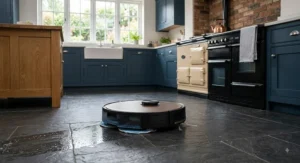
6. Dreame X40 Ultra — best obstacle avoidance for cluttered, pet-heavy homes
What earns the Dreame X40 Ultra its heading is a triple-sensor obstacle system — LiDAR, 3D structured light similar to smartphone Face ID hardware, and an AI RGB camera — that independent testers logged as identifying zero cable tangles across a 30-day trial involving multiple charging cords and a floor lamp cable. That’s a genuinely rare result; most robot vacuums tested by the same reviewers snagged on at least one low-profile cable during comparable trials.
Suction is rated at 12,000Pa, the highest raw figure in this guide, and multi-floor mapping supports up to four separate saved maps for multi-storey UK homes. The fully autonomous dock — washing, drying, refilling and dispensing detergent without intervention — was independently rated as needing the least human interaction of any robot tested by one reviewer. The honest catch, flagged consistently across sources: pet-hair pickup underperformed relative to its suction claims in at least one lab test, picking up roughly half the fur of top performers, and objects under about 3cm tall — thin pens, flat cables — can still slip past the sensors.
Pros:
- ✅ Triple-sensor obstacle avoidance logged zero cable tangles in testing
- ✅ 12,000Pa suction, the strongest raw figure in this guide
- ✅ Supports up to four saved multi-floor maps
Cons:
- ❌ Pet-hair pickup underperformed relative to suction claims in testing
- ❌ Very low, thin objects (under ~3cm) can still be missed
Priced around £1,100–£1,300, it’s the pick if obstacle avoidance in a genuinely cluttered or pet-heavy home is your priority over raw pet-hair pickup.
7. Roborock S8 MaxV Ultra — best overall flagship for hands-off ownership
Topping this list is the Roborock S8 MaxV Ultra, which combines 10,000Pa suction with Reactive AI 2.0 obstacle recognition — an RGB camera, wall sensor and dedicated recognition sensors working alongside LiDAR — that independent testers rated among the best obstacle avoidance performances they’d recorded, correctly identifying and routing around all test objects including simulated pet waste. One long-term review noted it was the only robot in that tester’s experience to avoid getting stuck on rugs, chair legs or drying racks — chronic failure points for most rivals.
The RockDock Ultra base station empties the bin, washes and dries the mop pad with hot water and air, refills the water tank and dispenses detergent automatically, reducing hands-on maintenance to roughly once every 30–60 days according to lab testing. Reviewers are honest that mopping performance, while decent, doesn’t match the suction and navigation scores — it’s a lighter maintenance pass rather than a deep scrub — and the premium price point is the single biggest barrier to recommending it universally.
Pros:
- ✅ Best-in-class obstacle avoidance across independent testing
- ✅ Fully automated RockDock Ultra needs attention roughly every 30–60 days
- ✅ Rarely gets stuck on rugs, chair legs or thresholds
Cons:
- ❌ Premium price point limits accessibility for many buyers
- ❌ Mopping performance is solid rather than genuinely deep-cleaning
At £1,000–£1,400 depending on retailer and promotions, it earns its “best overall” reputation through consistency rather than any single showstopping spec — exactly what you want from a machine you’re trusting to run unsupervised.
Practical Usage Guide: Setup, First 30 Days and Maintenance
Getting a premium robot vacuum right starts before it ever leaves its box. Place the dock against a flat wall with at least 50cm clearance either side — cramped positioning is the single most common cause of docking failures reported across owner forums. Run the first mapping cycle during daylight with doors open throughout the home; camera-based obstacle systems in particular rely on decent ambient light, and a dim first run can produce a patchy initial map that’s frustrating to correct later.
In the first 30 days, resist the urge to fully automate everything immediately. Run supervised cycles for the first week, tag no-go zones as you spot problem areas (tasselled rugs, low furniture, trailing cables), and let the robot build cleaning history before switching to full unattended scheduling. Most self-emptying docks need their dust bag checked at 30–60 day intervals rather than left indefinitely, and mopping models benefit from a monthly check of the clean-water tank seal — a loose seal is the most commonly reported cause of the “abnormal water level” warnings owners flag in reviews. A quick weekly glance at the brush roll for wrapped hair, even on anti-tangle models, will save you a much less pleasant deep-clean session down the line.
Real-World Scenarios: Which Premium Robot Vacuum Fits Your Home
The renting professional in a one-bed flat: limited budget, hard floors throughout, no pets. The Roborock Q7 M5 or Eufy X10 Pro Omni both make sense here — strong suction and mapping without paying for obstacle-avoidance sophistication a tidy, low-clutter flat rarely needs.
The family with two dogs and a toddler: cables, toys and the occasional pet accident scattered across mixed flooring. This is where obstacle avoidance stops being a luxury and becomes the entire point — the iRobot Roomba j9+ for its pet-waste guarantee, or the Dreame X40 Ultra if cable-tangling toys are the bigger worry, both earn their higher price tags here.
The multi-storey Victorian terrace with allergy sufferers: narrow hallways, high thresholds, and a real need for consistent HEPA-filtered pickup. According to the NHS, reducing exposure to house dust and allergens at home is a genuine part of managing allergic asthma symptoms, and a flagship model like the Roborock S8 MaxV Ultra or Ecovacs Deebot T30S Combo, run daily rather than weekly, addresses that consistency requirement far better than an occasional manual vacuum session ever could.
Common Robot Vacuum Problems and How to Solve Them
Problem: the robot repeatedly misses the same patch of floor. This is almost always a mapping issue rather than a suction one — re-run the mapping cycle with better lighting, and manually merge or split rooms in the app if boundaries look wrong.
Problem: it keeps getting tangled in tasselled rugs or low chair legs. Even flagship obstacle avoidance struggles with thin, low-profile objects, as reviewers noted with the Dreame X40 Ultra‘s sub-3cm blind spot. Set a permanent no-go zone around problem rugs rather than hoping each run avoids them.
Problem: the self-empty dock stops working properly. Check the dust bag is correctly seated and recognised by the dock — a poorly fitted bag was flagged by multiple reviewers of the Ecovacs Deebot T30S Combo as the most common cause of this exact fault.
Problem: mopping leaves hard floors too wet. Several reviewers noted this specifically with the Shark PowerDetect NeverTouch Pro, which lacks manual water-flow adjustment. Where the option exists, drop to the lowest mopping setting on hardwood and reserve higher settings for tile or vinyl.
✨ Don’t Miss These Exclusive Deals!
🔍 Take your premium robot vacuum shortlist to the next level with these carefully selected models. Click on any highlighted product to check current pricing and availability, and let the right machine start earning back your Sunday mornings.
What Is a Premium Robot Vacuum?
A premium robot vacuum is a robotic floor cleaner that combines high suction power (typically 8,000Pa or above), precision navigation such as LiDAR or multi-sensor camera mapping, and automated maintenance features like self-emptying, self-washing or self-refilling docks — reducing manual upkeep to roughly once a month rather than after every clean.
That definition matters because “premium” gets thrown around loosely by marketing copy. As BBC Science Focus explains in its breakdown of robot vacuum navigation, the real dividing line between a basic bot and a genuinely capable one is sensing technology — whether it’s bumping around randomly or actually building and remembering a spatial map of your home. Everything else, from suction figures to dock automation, tends to follow from how good that underlying navigation actually is.
How to Choose a Premium Robot Vacuum: 7 Expert Criteria
- Match suction to your flooring, not the biggest number. 8,000Pa handles most carpets adequately; only go higher if you have thick pile or heavy pet shedding, since extra Pascals mostly matter on resistant surfaces.
- Decide if camera-based obstacle avoidance is worth the premium. If your floors are genuinely clutter-free, a LiDAR-only model like the Roborock Q7 M5 may cover your needs without the extra cost.
- Check dock automation level honestly. Self-emptying alone is different from self-emptying plus mop-washing plus water-refilling — know which chores you actually want removed.
- Confirm multi-floor mapping if you have more than one storey. Not every model saves multiple maps automatically, and re-mapping every visit to a different floor gets old fast.
- Weigh mopping quality separately from vacuuming quality. Reviewers consistently rate these as distinct strengths — a flagship suction machine doesn’t guarantee flagship mopping.
- Read aggregated pet-hair sentiment, not just the marketing claim. Several models here scored strongly on paper but inconsistently in independent pet-hair pickup tests.
- Budget for consumables. Replacement filters, mop pads, side brushes and dust bags add a genuine ongoing cost that price comparisons often ignore entirely.
LIDAR Mapping Precision and Robot Vacuum With Obstacle Avoidance: What Actually Matters
LIDAR Mapping Precision
LiDAR mapping precision comes from pulsed lasers spinning 360 degrees to measure distances to walls and furniture, building a spatial map far more reliable than older bump-sensor navigation. In practice, this is why models like the Roborock Q7 M5 and Roborock S8 MaxV Ultra can complete an accurate first-run map of a typical home in well under an hour and then clean in efficient, methodical rows rather than random loops. The trade-off most buyers don’t realise: LiDAR is excellent at mapping fixed structures like walls and stairs, but on its own it’s poor at recognising what an object actually is — which is exactly why flagship models pair it with a camera.
Robot Vacuum With Obstacle Avoidance
A robot vacuum with obstacle avoidance adds that missing layer — cameras, structured light or infrared sensors that identify specific objects like shoes, cables or pet waste rather than just detecting “something is there.” The Dreame X40 Ultra‘s triple-sensor system and the Roborock S8 MaxV Ultra‘s Reactive AI 2.0 both demonstrate what most buyers overlook about this feature: it’s not really about avoiding collisions, since basic bump sensors already do that. It’s about avoiding a genuinely bad outcome — smeared pet mess or a mangled charging cable — that a collision-only robot would otherwise create.
Multi-Floor Mapping and Smart Home Integration for UK Homes
Multi-Floor Mapping for Multi-Storey Homes
Multi-floor mapping lets a robot vacuum store separate spatial maps for each level of your home and automatically load the correct one when you carry it upstairs or downstairs. This matters more in the UK than the spec sheets suggest, given how many British homes are multi-storey terraces and semis rather than the single-level layouts common elsewhere. The Dreame X40 Ultra supports up to four saved floor maps, while budget-tier models can sometimes only hold one — meaning every floor change forces a fresh, time-consuming re-map.
Smart Home Integration: Ecosystem, Voice Control and Data Privacy
Smart home integration covers voice assistant compatibility (Alexa and Google Assistant appear across nearly every model in this guide), app-based scheduling, and increasingly, onboard cameras used for both navigation and optional home-monitoring features. That last point deserves honest attention: several premium models, including camera-equipped units like the Dreame X40 Ultra, offer live home-monitoring feeds through their apps. The Information Commissioner’s Office has set clear expectations for smart device manufacturers around consent, data minimisation and transparency for exactly this category of connected home product, so it’s worth checking each brand’s privacy settings and camera-sharing defaults before switching a monitoring feature on.
High-End Robot Vacuum vs Mid-Range: Is the Premium Justified?
| Tier | Typical Price Range | What You Gain Over the Tier Below | Best For |
|---|---|---|---|
| Budget/Entry | £180–£450 | Strong suction, basic LiDAR mapping | First-time buyers, tidy homes |
| Mid-Range | £450–£900 | Self-emptying docks, camera obstacle avoidance | Households wanting hands-off convenience |
| High-End | £900–£1,200 | Bundled tools, stronger suction, better mopping | Multi-surface, larger UK homes |
| Flagship | £1,200+ | Best-in-class obstacle avoidance, full dock automation | Pet owners, cluttered or multi-floor homes |
The jump from mid-range to a genuine high-end robot vacuum tends to buy convenience and consistency rather than dramatically better raw cleaning — the Eufy X10 Pro Omni and Roborock S8 MaxV Ultra both hit strong suction figures, but the latter’s price premium is mostly justified by materially better obstacle recognition and dock automation. Whether that’s worth roughly double the spend genuinely depends on how cluttered and pet-heavy your home actually is; a tidy, pet-free household may see almost no practical benefit from the top tier.
Flagship Robot Vacuum Features Worth Paying For (And Which Aren’t)
Genuinely worth the premium: multi-sensor obstacle avoidance (camera plus LiDAR plus structured light), automated mop washing at hot-water temperatures, and multi-floor mapping if you live across more than one level. These consistently show up as the differences reviewers rate highest in real-world testing, not just spec-sheet bragging rights.
Less clearly worth chasing: the very highest suction Pascal figures beyond roughly 10,000Pa, since independent testing shows diminishing real-world returns once a machine clears that threshold on typical UK carpets. Similarly, bundled accessories like handheld vacuums (as with the Ecovacs Deebot T30S Combo) are a genuine bonus but shouldn’t be the deciding factor unless you’ll actually use the extra tool regularly — otherwise you’re paying flagship prices for a drawer ornament.
Long-term cost is worth factoring in honestly too: budget models typically need cheaper, more frequent consumable replacements, while flagship docks reduce hands-on time but often use proprietary filters and bags that cost more per unit — the Which? guide to buying a robot vacuum cleaner is a useful independent check before committing to any single ecosystem long-term.
FAQ
❓ What is the best premium robot vacuum for UK homes in 2026?
❓ How much does a premium robot vacuum cost in the UK?
❓ Do premium robot vacuums work well on carpet?
❓ Is a premium robot vacuum worth it for allergies?
❓ Can a robot vacuum with obstacle avoidance still get stuck?
Conclusion
If this guide leaves you with one takeaway, let it be this: “premium” in this category isn’t one fixed thing, it’s a sliding scale of how much manual effort you’re willing to trade for cash. The Roborock Q7 M5 proves strong LiDAR mapping has become genuinely affordable, the Eufy X10 Pro Omni shows full dock automation no longer demands flagship pricing, and models like the Roborock S8 MaxV Ultra and Dreame X40 Ultra demonstrate what real money buys once you factor in cluttered floors, pets and multi-storey homes.
There’s no single correct answer here — only the model that matches your actual floors, your actual pets, and your actual tolerance for the occasional emptied dust bag. Work back from the scenarios and criteria in this guide rather than the biggest number on a spec sheet, and you’ll land on a machine that earns its keep rather than one that simply looked impressive in an advert.
✨ Ready to Reclaim Your Weekends?
🔍 Compare current prices on today’s top picks and find the premium robot vacuum that actually fits your home — check availability before today’s listings change.
Recommended for You
- Budget Robot Vacuum 2026: 7 Brilliant Picks That Won’t Break the Bank
- Robot Vacuum Under £300: 7 Genuinely Good Picks (2026)
- Best Robot Vacuum 2026: 7 Proven Picks (Buying Guide)
Disclaimer: This article contains affiliate links. As an Amazon Associate, I earn from qualifying purchases. If you purchase products through these links, we may earn a small commission at no additional cost to you.
✨ Found this helpful? Share it with your friends! 💬🤗
