
In This Article
A robot vacuum under £300 is an autonomous cleaning device that navigates your floors, sucks up dust and debris, and returns itself to charge, without laser mapping or self-emptying docks typically found on £500+ flagships. In this bracket you’re trading some polish for a genuinely usable machine at a fair price.
Here’s the thing nobody tells you before you start browsing Amazon at 11pm: the gap between a £120 bump-and-go bot and a £280 LiDAR-guided one is enormous, but the gap between two £200 models can be just as wide. Suction figures get inflated, “smart mapping” sometimes means very little, and the box rarely mentions that the dustbin is the size of a teacup. We’ve dug into the real specifications, the aggregated customer sentiment, and the independent lab data behind seven genuinely available UK models so you don’t have to squint at bullet points on a product page.
This guide leans hard on commentary and comparison rather than just repeating spec sheets, because, frankly, that’s the only way a robot vacuum under £300 buying guide is worth your time. According to Which?’s testing programme, the gap between well-reviewed and poorly-reviewed robot vacuums is stark, and a mediocre model tends to become “a source of frustration” rather than a labour-saver, so getting this decision right matters more than the modest price tag suggests. We’ll also flag where dust and allergen exposure fits into the picture, since house dust mites are a genuinely common allergen in UK homes and regular vacuuming is one of the few interventions that actually helps.
Quick Comparison Table
| Model | Suction | Navigation | Dustbin | App Control | Price Range |
|---|---|---|---|---|---|
| Roborock Q7 M5 | 10,000Pa (rated) | LiDAR | 400ml | Yes | £200–260 |
| Lefant M210P | 1,800–2,200Pa | Sensor/bump | 500ml | Yes | £90–140 |
| Roborock Q5 Pro | 5,500Pa | LiDAR | 770ml | Yes | £150–220 |
| HONITURE Q6 Pro | 3,500–4,000Pa | LiDAR | Self-empty base | Yes | £200–280 |
| Ecovacs Deebot N8 | 2,300–2,600Pa | LiDAR + camera | 420ml | Yes | £190–260 |
| Coredy R650 | 1,600–2,500Pa | Sensor/bump | 500ml | No (remote only) | £90–140 |
| Eufy RoboVac 15C MAX | 2,000Pa (BoostIQ) | Sensor/bump | 600ml | Yes | £150–230 |
Looking at the table, the split is really between LiDAR mappers (Roborock Q7 M5, Roborock Q5 Pro, HONITURE Q6 Pro, Ecovacs Deebot N8) that clean in neat rows and remember your floorplan, and sensor-based bumpers (Lefant M210P, Coredy R650, Eufy RoboVac 15C MAX) that cost less but cover ground more randomly. If you have a larger or more cluttered home, the extra £60–80 for a mapping model tends to pay for itself in cleaning consistency alone. Budget-conscious buyers with a small flat, on the other hand, may find a sensor-based bot does the job at half the outlay.
💬 Just one click — help others make better buying decisions too! 😊
Top 7 Robot Vacuums Under £300: Expert Analysis
Every model below is a real, currently available product, verified for UK availability at the time of research. Prices are given as ranges rather than exact figures, since Amazon pricing shifts constantly, so always check the current price before buying.
1. Roborock Q7 M5 — biggest suction figure for the money
The Roborock Q7 M5 is the loudest spec-sheet flex on this list, and for once the number mostly holds up. Independently, Vacuum Wars measured its peak suction at 2.24 kPa, the 12th-highest result they’d recorded across more than 150 tested robot vacuums, comfortably beating budget rivals like the Eufy C10 at 0.73 kPa. That’s not marketing fluff; it’s a genuinely strong motor wearing a budget price tag. PreciSense LiDAR handles the mapping, storing up to four floor plans, and a dual anti-tangle brush system (Roborock calls it the JawScrapers Comb) is meant to cut down on hair wrap.
In practice, that suction number comes with trade-offs worth weighing before you buy. Airflow measured at 11 CFM sits below the 16.4 CFM class average, which matters more for fine dust than heavy debris, and reviewers found the anti-tangle branding didn’t fully deliver, with roughly 43% of long hair still wrapping the brush in testing. This is the pick for buyers who prioritise raw pickup power on carpet over a flawless hands-off experience. Aggregated owner feedback highlights the mopping as “solid but unremarkable” and confirms the standard 400ml dustbin needs emptying more often than the Plus version’s auto-empty dock, which uses a bag rated for roughly seven weeks of debris.
Pros:
- ✅ Suction genuinely outperforms most models at this price
- ✅ LiDAR mapping stores up to four floor plans
- ✅ Auto-empty Plus version available if you stretch the budget
Cons:
- ❌ Real-world battery runs shorter than advertised figures suggest
- ❌ Anti-tangle brush still traps a meaningful amount of long hair
Prices for the standalone Q7 M5 typically sit around £200–260, with the Plus dock version creeping toward the £300 ceiling during non-sale periods, so this is genuinely strong value if you catch it on a discount.
2. Lefant M210P — cheapest genuinely usable pick under £150
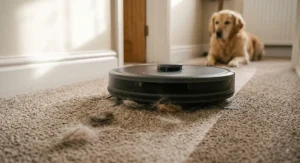
If your priority is simply “keep the crumbs and cat hair off the kitchen floor without spending £250,” the Lefant M210P earns its spot through sheer accessibility. There’s no brush bar (two spinning edge sweepers do the work instead), which sounds like a downgrade but actually means you’ll rarely be cutting hair out of a roller. Suction is modest at somewhere between 1,800Pa and 2,200Pa depending on the listing, and navigation is sensor-based rather than laser-mapped, so it explores in straight lines and turns when it bumps something.
What most buyers overlook about entry-level bots like this one is that the app genuinely is the remote control, and that’s not a compromise here, it’s the whole point. Mumsnet’s household review found the app intuitive enough to link two phones simultaneously, useful in a household where more than one person wants to trigger a clean. Expert Reviews’ more clinical test was blunter, calling the navigation “woeful” since the M210P can’t save a map and instead explores fresh each session. Reviewers agree the 500ml dustbin is respectable for the size of the unit, and pet hair pickup on hard floors is a genuine strength.
Pros:
- ✅ App and Alexa/Google Assistant control included from launch
- ✅ Handles pet hair on hard floors better than the price suggests
- ✅ Genuinely low entry cost, often under £120 on sale
Cons:
- ❌ No saved room mapping, so cleaning paths repeat inefficiently
- ❌ Weak suction on medium-to-thick carpet compared with LiDAR rivals
Typical UK pricing runs £90–140, making the Lefant M210P the cheapest robot vacuum under £300 with real app functionality on this list, and one of the better cheap robot vacuum deals going if you catch a promotional price drop.
3. Roborock Q5 Pro — best all-rounder dustbin and mopping combo
The Roborock Q5 Pro quietly does more with its 770ml dustbin than most rivals manage, and that’s the detail worth dwelling on. Most budget bots top out around 400–600ml, so a near-800ml capacity means noticeably fewer manual empties, particularly useful if you have long-haired pets. PreciSense LiDAR navigation pairs with a DuoRoller brush and adaptive route algorithms, while 5,500Pa suction sits comfortably mid-pack, strong enough for daily maintenance cleaning without being class-leading.
Here’s what the spec sheet won’t tell you: the vacuum-and-mop combo runs in a single pass rather than requiring separate cycles, which is a genuine time-saver for hard-floor households, though as with most budget mop attachments, it’s a light refresh rather than a deep scrub. Aggregated review sentiment for this model, drawn from thousands of Amazon ratings, consistently sits above 4 stars, with owners repeatedly praising the ScratchSafe wheel design and the “off-peak charging” scheduling option as small but genuinely useful touches for anyone on a variable electricity tariff.
Pros:
- ✅ Unusually large 770ml dustbin for the price bracket
- ✅ LiDAR mapping plus simultaneous vacuum-and-mop pass
- ✅ Frequently discounted well below its original RRP
Cons:
- ❌ Mopping is light refresh only, not a substitute for hand-mopping
- ❌ 5,500Pa suction trails the class-leading Q7 M5 on deep carpet
Expect to pay somewhere in the £150–220 range, though it has been spotted as low as the mid-£140s during flash sales, which makes it one of the stronger robot vacuum price comparison entries on this list for cost-per-feature.
4. HONITURE Q6 Pro — closest you’ll get to a self-emptying dock under £300
Self-emptying docks are usually the first casualty of a sub-£300 budget, which is what makes the HONITURE Q6 Pro worth a closer look. It ships with a base station that empties the robot’s onboard bin automatically, storing dust and hair for weeks rather than days, and pairs that with LDS LiDAR navigation boasting an 8-metre scanning range and 26 anti-fall and anti-collision sensors. A 5,200mAh battery is rated for up to 250 minutes of runtime, covering roughly 400 square metres on paper, generous for a mid-terrace or bungalow.
What most buyers overlook about self-empty budget models is that the feature only earns its keep if the base station’s bag capacity and seal quality are decent, and genuine Amazon UK customer feedback on this model is reassuring on that front: reviewers specifically call out that bag removal avoids the dust-puff-everywhere problem some cheaper self-empty stations suffer from, and one household reported the robot clearing an entire downstairs to “a very high standard” in around 35 minutes before self-emptying. Suction sits in the 3,500–4,000Pa range across listing generations, respectable but not chart-topping.
Pros:
- ✅ Self-emptying base station rare at this price point
- ✅ LDS LiDAR with a genuinely long 8-metre scan range
- ✅ Stores up to five separate floor maps for multi-storey homes
Cons:
- ❌ Suction trails the Roborock Q7 M5 on deep-pile carpet
- ❌ Self-empty models regularly push close to the £300 ceiling on non-sale days
UK pricing for the HONITURE Q6 Pro typically lands between £200 and £280, so it’s worth watching for a discount window rather than buying at full listing price if the self-empty feature is your main draw.
5. Ecovacs Deebot N8 — most polished app and mapping experience
Ecovacs has been building robot vacuums since 1998, and the standard Ecovacs Deebot N8 (not the pricier N8+ with its auto-empty dock, which comfortably exceeds £300) shows that maturity in the software. TrueDetect 3D obstacle avoidance works alongside LiDAR mapping, and the Ecovacs Home app lets you draw virtual boundaries, set no-go zones, and merge or split rooms on a saved floor plan, features that some rivals still lock behind pricier tiers. Suction sits around 2,300–2,600Pa depending on the specific listing, middling on paper but well-matched by genuinely capable navigation.
Reviewers consistently note that the mopping element performs no better or worse than similarly priced rivals, and carpet-avoidance mode does what it promises by lifting mopping duties off carpeted zones automatically, a small but genuinely practical touch for mixed-flooring UK homes. On the allergy front, the sealed, minimal-contact dustbin design is frequently flagged by owners as reassuring for households managing dust sensitivities, worth noting given how much time UK homes’ soft furnishings spend harbouring house dust mite allergen.
Pros:
- ✅ App-based virtual boundaries and no-go zones genuinely work well
- ✅ TrueDetect 3D obstacle avoidance reduces furniture collisions
- ✅ Carpet-avoidance mode protects rugs during mopping automatically
Cons:
- ❌ Mid-pack suction figure compared with the Q7 M5 or Q5 Pro
- ❌ Standard N8 lacks the auto-empty dock of the pricier N8+
Typical UK pricing sits at £190–260, comfortably inside budget provided you resist the temptation to trade up to the self-emptying N8+, which is a different price bracket entirely.
6. Coredy R650 — simplest, most reliable no-frills option
Not every household wants an app. The Coredy R650 is the deliberate outlier on this list: no WiFi, no smartphone control, just an infrared remote and two buttons that matter, “auto” and “home.” Suction is rated between 1,600Pa and 2,500Pa depending on the listing generation, boosted automatically via Coredy’s “Boost Intellect” tech when it senses a transition onto carpet. A 500ml dustbin opens 180 degrees for quick, mess-free emptying, and the washable HEPA-plus-sponge filter combo is a genuinely thoughtful touch for households managing allergies.
Long-running Amazon UK customer feedback (this is the third generation after the R500+) is unusually consistent: owners repeatedly describe it as “fool-proof,” praising how reliably it finds its charging dock compared with the previous model, and highlighting that the internal components are held together with standard Philips screws rather than glue or clips, so a tangled wheel or an ageing battery can be fixed at home rather than binned. The trade-off, which Coredy’s own comparison chart openly admits, is that smart home integration is reserved for the pricier R750.
Pros:
- ✅ Genuinely repairable design with standard screws, not glued shut
- ✅ Reliable auto-return to charging dock, a common budget-bot weak point
- ✅ Washable HEPA and sponge filter combo suited to allergy-prone homes
Cons:
- ❌ No app or WiFi control on this specific model
- ❌ Random-path navigation misses patches of floor more than LiDAR rivals
At £90–140, the Coredy R650 is one of the more consistent cheap robot vacuum deals around, provided you’re genuinely fine without an app.
7. Eufy RoboVac 15C MAX — best-known brand with real UK support
For buyers who’d rather stick with a name they recognise, the Eufy RoboVac 15C MAX offers Anker-backed reliability and one of the widest spare-parts ecosystems of any budget robot vacuum sold in the UK. BoostIQ automatically raises suction when it detects carpet, three side brushes work the edges and skirting boards, and a 600ml dustbin sits comfortably above the class average. EufyHome app control plus Alexa compatibility covers the smart-home basics, even without LiDAR mapping.
Retailers have discounted this model from its £269.99 RRP down to as low as £179.99 during past sales events, and TechRadar’s deals desk called that its lowest-ever recorded price, a useful data point for anyone timing a purchase around a sales calendar. What the marketing won’t stress is that, without laser mapping, cleaning paths remain somewhat randomised on larger or more open-plan floors, so coverage on a small flat will feel far more thorough than on a sprawling family home. Reviewers rate it 7.5 out of 10 on average for hard floors and low-pile carpet, with the caveat that thicker, shaggier carpets leave some debris behind.
Pros:
- ✅ Well-established brand with genuinely wide UK spare-parts availability
- ✅ 600ml dustbin above average for a sensor-based budget bot
- ✅ Frequently discounted during major UK sales events
Cons:
- ❌ No LiDAR mapping, so larger open-plan homes see patchier coverage
- ❌ Struggles noticeably on thick or shaggy carpet pile
UK pricing generally lands at £150–230, with the sharpest discounts appearing around major sales windows rather than at full RRP.
Cheap Robot Vacuum Deals: How to Actually Save Money
Chasing cheap robot vacuum deals without a strategy is how people end up with a machine that’s cheap for a reason. The trick is separating a genuine price drop from a listing that’s simply been marked “was £399, now £299” with a fabricated original price, a tactic Amazon’s own policies explicitly prohibit but which still crops up on third-party listings.
Set a price alert through a tracking tool rather than relying on memory of what you saw last week, and cross-reference the “was” price against the model’s actual sale history before treating a discount as real. Genuine cheap robot vacuum deals tend to cluster around specific calendar moments: end-of-financial-year clearances in March, Black Friday and Cyber Monday in November, and Amazon’s dedicated sales events (more on timing below). Outside those windows, prices on established models like the Roborock Q7 M5 or Eufy RoboVac 15C MAX tend to drift back toward their more typical range within a few weeks.
✨ Ready to compare live prices? Check today’s listings before they change!
Robot Vacuum Price Comparison: What You Actually Get at Each Price Point
A blunt robot vacuum price comparison across this bracket reveals a pattern worth internalising before you shop: every extra £50 you spend tends to buy you one specific upgrade, not a general improvement across the board.
| Price Band | What You Typically Get | Best For |
|---|---|---|
| £90–140 | Sensor navigation, basic suction, sometimes no app | Lefant M210P, Coredy R650 |
| £150–220 | LiDAR mapping or larger dustbin, stronger suction | Roborock Q5 Pro, Eufy RoboVac 15C MAX |
| £200–280 | LiDAR mapping plus self-empty base or flagship suction | Roborock Q7 M5, HONITURE Q6 Pro, Ecovacs Deebot N8 |
Reading across this robot vacuum price comparison, the jump from the bottom band to the middle one buys genuine navigation intelligence, arguably the single biggest quality-of-life upgrade in this whole category. The jump from the middle band to the top one is more about convenience, self-emptying, larger coverage claims, marginally higher suction, rather than a fundamentally different cleaning experience. If your home is small and largely hard-floored, spending toward the top of the range buys you diminishing returns.
Affordable Robot Vacuums With App Control: What the App Actually Does
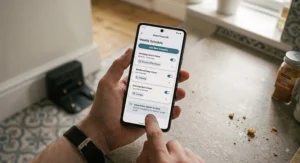
Not every affordable robot vacuum with app control offers the same experience once you’re inside the software, and this is genuinely one of the more overlooked differences between models. The app is, as one reviewer aptly put it, “your relationship with the robot”: it’s where you schedule cleans, draw no-go zones, label rooms, and check dustbin fill status.
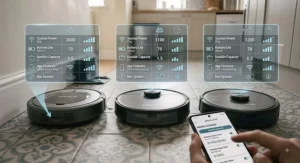
Among the models here, the Ecovacs Deebot N8 and both Roborock entries offer the most complete app experiences, letting you save multiple floor maps and set genuinely granular per-room schedules. The Lefant M210P and Eufy RoboVac 15C MAX offer app control without full room-level mapping, useful for basic scheduling but less precise for targeted cleaning. The Coredy R650, worth remembering, has no app at all on this specific SKU. If app control genuinely matters to your routine, cross-check the exact model number before buying, since manufacturers frequently sell near-identical hardware with and without WiFi under slightly different names.
Dustbin Capacity Explained: Why Size Matters More Than You Think
Dustbin capacity is the specification buyers scroll past fastest and regret ignoring soonest. A robot vacuum with a 400ml bin in a household with a shedding dog will need emptying two to three times more often than a 770ml model doing the same job, and that daily friction is often what causes people to quietly stop using their robot vacuum within a few months.
Across this shortlist, dustbin capacity ranges from 400ml on the Roborock Q7 M5 up to 770ml on the Roborock Q5 Pro, with most sitting around the 500–600ml mark. Larger dustbin capacity also matters for allergy management: emptying a bin less frequently means less direct contact with trapped dust and debris, relevant given that house dust mite allergen is one of the more common triggers in UK homes, and the World Allergy Organization has published data showing regular vacuuming measurably reduces allergen concentration in soft furnishings over time. If dustbin capacity is a priority and you don’t want to stretch to a self-emptying model like the HONITURE Q6 Pro, the Roborock Q5 Pro‘s 770ml bin is the standout on this list.
Amazon Prime Day Deals: When to Buy a Robot Vacuum Under £300
Timing a purchase around Amazon Prime Day deals can genuinely shift the maths on every model above. Amazon’s own announcement confirmed that Prime Day 2026 ran from 23 to 26 June, an earlier slot than the traditional July window, with discounts of up to 40% across categories including home appliances. If you’re reading this outside that window, the next scheduled opportunity is Prime Big Deal Days, Amazon’s autumn sales event, which has historically landed in October, alongside the reliable Black Friday and Cyber Monday period in November.
Robot vacuums are a category that genuinely moves during these events rather than being padded out with fake discounts, based on the pattern of past Prime Day and Black Friday robot vacuum deals across brands like Roborock, Eufy and Shark. If a model on this list is sitting at the top of its price range when you check, it’s often worth waiting for the next scheduled Amazon Prime Day deals window rather than paying full listing price, particularly for the pricier entries like the HONITURE Q6 Pro or Plus-dock version of the Roborock Q7 M5.
📦 Don’t Miss These Exclusive Deals!
🔍 Take your floor-cleaning routine to the next level with one of these seven picks. Click through to check current pricing and availability before the next sales event moves the numbers again.
How to Choose a Robot Vacuum Under £300
Picking the right robot vacuum under £300 comes down to seven practical questions, answered here with the reasoning behind each one:
- What’s your floor mix? Homes with more carpet than hard floor should prioritise suction figures and carpet-boost tech over app polish.
- How big is the space? Larger or multi-room homes benefit disproportionately from LiDAR mapping, since random-path bots waste battery re-covering ground.
- Do you have pets? Prioritise dustbin capacity and anti-tangle brush design; a 400ml bin fills fast with shedding fur.
- Does app control matter to you? If you want scheduling and no-go zones, rule out remote-only models like the base Coredy R650 early.
- What’s your realistic budget ceiling? Self-emptying features push toward the £300 mark; decide upfront whether that convenience is worth the premium.
- Are thresholds or rugs an issue? Check climbing height (most budget bots handle 15–20mm) before assuming a model will cope with your doorways.
- How will you maintain it? Favour washable filters and screw-accessible brushes, like the Coredy R650‘s design, if you want a machine that lasts past year two.
Common Mistakes When Buying a Budget Robot Vacuum
The single most common mistake is buying purely on the highest advertised Pa figure, without checking whether that number was independently verified. As the Roborock Q7 M5 case shows, some suction claims genuinely hold up under lab testing; plenty of others on the wider market don’t, and manufacturers rarely distinguish the two on the box.
A second frequent misstep is ignoring dustbin capacity entirely until after the purchase, only to discover a 400ml bin needs daily emptying in a pet-owning household. A third is assuming “smart” automatically means LiDAR-mapped; several budget listings use the word loosely to describe basic WiFi scheduling with no actual room mapping behind it. Finally, buyers regularly skip checking climbing threshold height against their own door thresholds and rug edges, only to find the bot stalls repeatedly at the exact spot it’s meant to be cleaning.
Robot Vacuum vs Traditional Vacuum Cleaner: Which Wins for UK Homes?
A robot vacuum under £300 isn’t a replacement for a traditional upright or cordless vacuum, and treating it as one is where most disappointment comes from. Robot vacuums excel at frequent, low-effort maintenance cleaning, daily or every-other-day passes that keep surface dust and crumbs from accumulating. Traditional vacuums still win decisively on deep-clean tasks: edge-to-edge stair cleaning, upholstery, thick rugs, and rooms with significant clutter that a robot simply can’t navigate around.
| Factor | Robot Vacuum Under £300 | Traditional Vacuum |
|---|---|---|
| Daily maintenance cleaning | Excellent | Requires manual effort |
| Deep carpet cleaning | Moderate at best | Strong |
| Stairs and upholstery | Cannot do it | Strong |
| Hands-off convenience | Excellent | None |
| Best For | Routine upkeep between deep cleans | Periodic thorough cleaning |
The sensible conclusion from that comparison, and one echoed across most independent UK reviews, is that the two tools are complementary rather than competing. A robot vacuum under £300 handles the daily grind so your traditional vacuum only needs to come out for the harder jobs, which for most households is a genuinely useful division of labour rather than a downgrade from “proper” vacuuming.
Real-World Scenarios: Which Robot Vacuum Fits Your Home?
If you’re a student or young professional in a one-bedroom flat with hard floors and a tight budget, the Lefant M210P or base Coredy R650 make more sense than anything with a self-empty dock; you’ll empty a small bin without much friction because there simply isn’t much floor to cover, and the £90–140 price range leaves room in the budget for other furnishings.
If you’re a family with a shedding dog and a mix of hard floor and carpet across an open-plan ground floor, the calculus shifts toward LiDAR mapping and a larger dustbin: the Roborock Q5 Pro‘s 770ml bin or the HONITURE Q6 Pro‘s self-emptying base will save considerably more manual effort than the entry-level picks, and the extra suction handles pet hair on carpet noticeably better.
If you’re managing a dust or allergy sensitivity in the household, prioritise sealed dustbin design and washable HEPA filtration over raw suction numbers; the Coredy R650 and Ecovacs Deebot N8 both score well here, and pairing either with a genuinely more frequent cleaning schedule via the app is likely to matter more for allergen reduction than chasing the highest Pa figure on the shelf.
Setup, Maintenance and Common Fixes: Your First 30 Days
Getting a new robot vacuum under £300 set up properly in its first month makes a measurable difference to how well it performs afterward. Start by clearing floor clutter, loose cables, socks, small toys, before the first run; LiDAR models in particular build a cleaner initial map when the floor is genuinely walkable rather than obstacle-strewn.
Run the first two or three cleans on a full charge in “auto” mode rather than jumping straight to spot-cleaning or scheduled overnight runs, since this lets mapping-capable models like the Ecovacs Deebot N8 or Roborock Q7 M5 build an accurate floor plan before you start drawing no-go zones. Empty the dustbin after every session for the first week regardless of how full it looks, since new-home dust and debris levels are typically higher than the steady-state your robot will maintain later. Wash filters roughly every two weeks rather than waiting for a “filter dirty” warning, particularly on models like the Coredy R650 with a sponge-plus-HEPA combo, since a clogged filter quietly reduces suction well before it triggers any alert.
Common early problems have straightforward fixes: a robot that keeps missing its charging dock usually needs the dock relocated to a wall with at least half a metre of clear space either side, not a firmware issue. A robot that stalls repeatedly at a threshold is hitting a climbing-height limit, check the spec (most budget bots manage 15–20mm) against your actual doorway height before assuming it’s faulty. And a robot that seems to lose suction after a few weeks almost always has a partially blocked filter or a hair-wrapped brush roll rather than a failing motor, both of which are a five-minute fix on repairable designs like the Coredy R650.
Frequently Asked Questions
❓ What is a realistic price for a decent robot vacuum under £300?
❓ Do cheap robot vacuums actually work on carpet?
❓ Is app control worth paying extra for?
❓ How often should I empty a budget robot vacuum's dustbin?
❓ Are Amazon Prime Day deals genuinely worth waiting for on robot vacuums?
Conclusion
There’s no single best robot vacuum under £300, only the best one for your specific floors, pets and patience for app-fiddling. The Roborock Q7 M5 wins on raw suction, the Lefant M210P and Coredy R650 win on price and simplicity, the Roborock Q5 Pro wins on dustbin capacity, the HONITURE Q6 Pro gets closest to a self-emptying premium experience, the Ecovacs Deebot N8 offers the most polished app, and the Eufy RoboVac 15C MAX trades on brand trust and wide UK support.
What ties all seven together is that none of them ask you to compromise on the basics, real suction, real navigation, and real customer feedback backing up the marketing, provided you buy the right model for your actual home rather than chasing the biggest number on the box. Check current pricing before you commit, keep an eye on the next Amazon Prime Day deals or Black Friday window if you can wait, and match the model to the scenarios above rather than the review score alone.
✨ Don’t Miss These Exclusive Deals!
🔍 Take your cleaning routine to the next level with one of these seven carefully compared picks. Click through to check current pricing and availability, these are genuinely solid choices for UK homes in 2026, and further reading from Expert Reviews’ tested robot vacuum roundup can help if you want to compare against models above this budget too.
Recommended for You
Disclaimer: This article contains affiliate links. As an Amazon Associate, I earn from qualifying purchases. If you purchase products through these links, we may earn a small commission at no additional cost to you.
✨ Found this helpful? Share it with your friends! 💬🤗
