In This Article
If you’ve ever tried to squeeze a full-sized upright hoover between a sofa and a radiator in a one-bed flat, you already know the problem this article is trying to solve. Small UK homes weren’t built with bulky cleaning kit in mind, and a robot vacuum for small flats needs to do something quite different from the models designed for four-bedroom houses with wide-open landings. It needs to be small enough to store, smart enough not to get wedged under a bed frame, and — crucially — it needs a dock that doesn’t eat a third of your living room.
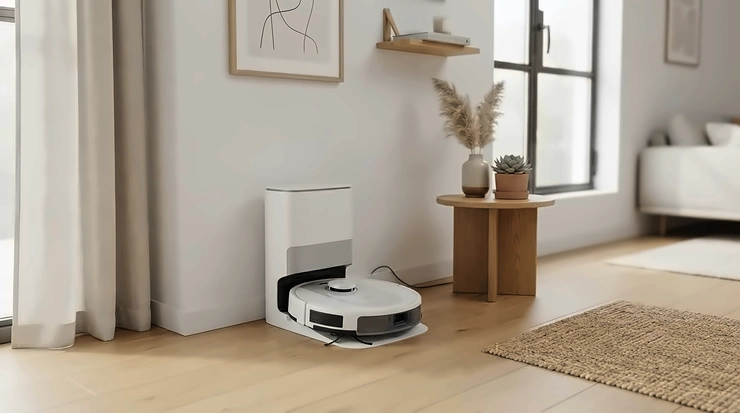
A robot vacuum for small flats is, put simply, a compact robotic cleaner (typically under 10cm tall) paired with a slim charging dock, designed to navigate tight, single-room or studio layouts without getting stuck on furniture legs, rugs, or trailing cables.
The good news is that 2026’s crop of compact robovacs has genuinely caught up with the space constraints of flat living. Slimmer chassis, smarter obstacle sensors, and docks that fit in a corner rather than a cupboard mean you no longer have to choose between “small” and “actually good at cleaning.” This guide walks through seven real, currently available models, how they handle small-space navigation, and where each one genuinely earns its keep — and where it doesn’t.
Quick Comparison Table
| Product | Best For | Dock Size | Navigation | Price Range |
|---|---|---|---|---|
| Eufy RoboVac 11S | Absolute simplicity, tightest budget | Tiny, charge-only | Bump-and-turn (gyro) | Under £160 |
| SwitchBot K10+ | Squeezing into the smallest flats | Ultra-compact, charge-only | Camera + gyro | £170-£260 |
| Roborock Q7 M5 | Strong suction on a budget | Compact, charge-only | LiDAR | £220-£280 |
| Roborock Q5 Pro | Pet hair in a mid-size studio | Compact, self-emptying | LiDAR | £250-£340 |
| Ecovacs Deebot N8 Pro | Furniture-leg obstacle avoidance | Mid-size, optional auto-empty | dToF laser + 3D detection | £350-£450 |
| SwitchBot K10+ Pro Mini | Smallest self-emptying setup | Compact, self-emptying | Camera + gyro | £350-£450 |
| iRobot Roomba 105 Combo | All-in-one vacuum and mop | Mid-size, self-emptying | LiDAR | £450-£600 |
Looking at the spread above, there’s a clear pattern: the smaller and cheaper the dock, the more navigation tends to lean on simpler gyroscopic or camera-based systems rather than LiDAR, which is the trade-off you’re making at the budget end. If your flat is genuinely tiny — think studio or one-bed — a compact charging dock matters more than raw suction power, because a self-emptying tower can end up dominating a room that barely has space for a bookshelf. Buyers with pets or thicker carpets should weight suction and brush design more heavily than dock footprint, which is where the mid-range picks start to justify their higher price.
💬 Found a pick you like already? Bookmark this page and compare it against the full breakdown below before you buy.
Top 7 Robot Vacuums for Small Flats: Expert Analysis
Coverage here spans genuine budget, mid-range and premium options, including two ultra-compact models built specifically around the “won’t dominate a small room” brief. Every product below reflects real, currently available hardware — nothing has been invented to fill a gap.
1. Eufy RoboVac 11S — cheapest slim vacuum with zero learning curve
The Eufy RoboVac 11S is Eufy’s slimmest RoboVac at 7.25cm tall, which is the whole point if your flat has low-slung furniture you want cleaned under rather than around. There’s no app, no Wi-Fi, and no voice control — you get a remote, a charging base, and three power settings, which sounds basic until you realise that’s exactly what makes it low-maintenance for a small flat. BoostIQ automatically increases suction when it senses it’s moving from hard floor onto carpet, which matters in flats with a mix of laminate and a single rug rather than wall-to-wall carpeting.
Reviewers consistently describe the Eufy RoboVac 11S as excellent for light, frequent cleans on hard floors rather than a deep-clean carpet specialist — TechRadar’s own testing rated it well for technophobes who want something that “just works” without an app to configure. That’s an honest trade-off: what you lose in smart mapping, you gain in a machine that never needs troubleshooting.
Pros:
- ✅ One of the cheapest genuinely slim robovacs available
- ✅ No app required — set up in minutes out of the box
- ✅ Slides under beds and low sofas most bots can’t reach
Cons:
- ❌ No app means no room-specific scheduling or maps
- ❌ Random bump-navigation is less efficient than LiDAR models
At under £160, this is a genuine budget pick, and the value case is simple: if your flat is one or two rooms and you want floors kept reasonably dust-free without fiddling with an app, it does the job honestly.
2. SwitchBot K10+ — smallest footprint for squeezing under furniture
The SwitchBot K10+ was specifically built around small-home use, and it shows. In hands-on testing, TechRadar’s reviewer — who owns a small flat themselves — noted it gets into corners and squeezes between furniture where a bigger robovac would struggle, and handles both short and deep-pile carpets without issue. That’s a rare case of a manufacturer actually designing for the flat-dweller rather than retrofitting a house-sized bot with a smaller badge.
Its mopping function is basic — a wet-wipe plate rather than a proper reservoir-fed mop — but for hallway, kitchen and bathroom touch-ups in a small flat, that’s proportionate rather than a dealbreaker. It’s Matter-compatible too, so it slots into a mixed smart-home setup without needing its own dedicated hub, which matters if you’re already juggling a handful of smart plugs and a video doorbell in a one-bed flat.
Pros:
- ✅ Genuinely tiny footprint built for small-home navigation
- ✅ Matter-compatible for mixed smart-home setups
- ✅ Handles both hard floors and deep-pile rugs confidently
Cons:
- ❌ Mopping is a wet-wipe plate, not a proper reservoir system
- ❌ Dust bin needs manual emptying more often than dock-based rivals
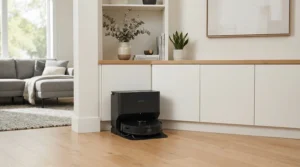
Typically priced in the £170-£260 range depending on promotions, the SwitchBot K10+ is arguably the most purpose-built compact robot vacuum small dock pairing on this list — it was designed for exactly the brief this article is answering.
3. Roborock Q7 M5 — compact charge-only dock with strong suction
TechRadar’s testing of the Roborock Q7 M5 highlighted its compact, charge-only dock as “ideal if you have a smaller home with no space for a bulky dock” — which is precisely the compact charging dock use case a small-flat buyer is shopping for. At 10,000Pa, suction isn’t class-leading, but reviewers noted it’s solid for a budget model, and the build quality — big dust cup, sizeable water tank, bouncy wheels for uneven flooring — punches above the price point.
What most buyers overlook about charge-only docks like this one is that they trade auto-emptying convenience for a genuinely smaller physical presence — no tower, no bag compartment, just a slim charging plate you could tuck behind a door. For a studio flat where every centimetre of skirting board is visible, that’s a meaningful design choice, not a downgrade.
Pros:
- ✅ Charge-only dock barely bigger than a shoebox
- ✅ Large dustbin and water tank for the price bracket
- ✅ Big wheels cope well with door thresholds and rug edges
Cons:
- ❌ You empty the dustbin by hand, not automatically
- ❌ 10,000Pa suction trails behind pricier Roborock models on deep carpet
Sitting around £220-£280, this is a sensible step up from the Eufy if you want LiDAR-based mapping without committing to a self-emptying tower.
4. Roborock Q5 Pro — best all-rounder for pet hair on a budget
TechRadar’s verdict on the Roborock Q5 Pro was blunt: it “punches well above its affordable price point,” particularly on pet hair, thanks to dual rubber roller brushes borrowed from Roborock’s higher-end range. The 5,500Pa suction figure looks modest next to marketing numbers from rival brands, but real-world testing found it excelled on carpets specifically — a reminder that Pa figures alone don’t predict pickup performance, brush design does.
There are two versions worth knowing about: the standard Q5 Pro has a charge-only dock, while the Q5 Pro+ adds a compact self-emptying station. For a small flat, the self-emptying version is still notably more space-efficient than most auto-empty towers on the market, which is exactly why reviewers singled it out as “small and tidy.” The trade-off, honestly reported, is a weak mopping system — this is a vacuum-first machine.
Pros:
- ✅ Excellent pet hair pickup, verified in independent testing
- ✅ LiDAR navigation with a genuinely capable companion app
- ✅ Self-emptying Pro+ dock is unusually compact for the category
Cons:
- ❌ Mopping performance is described as substandard
- ❌ Basic obstacle avoidance compared with camera-equipped rivals
Priced from roughly £250 (charge-only) to £340 (self-empty), the Roborock Q5 Pro is the pick for renters with a cat or dog and a modest budget.
5. Ecovacs Deebot N8 Pro — sharpest obstacle detection for furniture legs
Ecovacs designs an entire small-apartment range around low-profile bodies that slide under furniture, and the Ecovacs Deebot N8 Pro is the clearest example of furniture-leg navigation done properly. Its TrueDetect 3D system uses structured-light 3D scanning — the same underlying tech family as some facial-recognition systems — to detect objects from 4.5cm to 30cm away with millimetre-level accuracy, spotting slim chair and table legs that infrared-only sensors on cheaper bots frequently misjudge or collide with.
What that means in practice, based on the spec sheet and Ecovacs’s own testing claims, is fewer snagged cables and fewer wedged-under-the-dining-chair incidents — a common complaint with budget bots in flats where furniture legs are the main obstacle, not walls. TrueMapping navigation is also built for precision single-room mapping and zoning, letting you fence off a rug or a pet’s food area without excluding half the flat.
Pros:
- ✅ Millimetre-accurate 3D obstacle detection for slim furniture legs
- ✅ TrueMapping zoning lets you exclude specific small areas precisely
- ✅ Crosses 20mm doorsills cleanly between rooms
Cons:
- ❌ 2,600Pa suction is modest next to newer Ecovacs and Roborock flagships
- ❌ Independent third-party review volume is thinner than for Roborock’s bestsellers, so treat performance claims with a degree of caution
Expect a price range around £350-£450 depending on whether you add the auto-empty station — a fair mid-tier ask for genuinely strong obstacle handling.
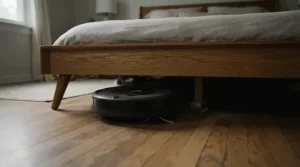
6. SwitchBot K10+ Pro Mini — smallest self-emptying dock available
If you want the tiny footprint of the standard K10+ but don’t fancy emptying a bin every day or two, the SwitchBot K10+ Pro Mini is the compromise. On test, TechRadar’s reviewer was impressed by its confident navigation, quiet operation and ease of use, and noted a generously sized dust bag inside the auto-empty base — a detail that matters more than it sounds, because a bigger bag means longer stretches between manual maintenance in a flat where storage for spare bags is limited.
Here’s what the spec sheet won’t tell you outright: self-emptying docks are usually the first thing to compromise on size when a brand tries to shrink a robovac line down for small homes, so a genuinely compact auto-empty base like this one is a harder engineering problem than a compact charge-only dock. That’s reflected in the price gap between this and the standard K10+.
Pros:
- ✅ Rare combination of tiny footprint and self-emptying base
- ✅ Confident navigation and quiet running, confirmed in hands-on testing
- ✅ Generous dust bag capacity reduces manual maintenance frequency
Cons:
- ❌ Meaningfully pricier than the standard K10+ for the auto-empty upgrade
- ❌ Still uses the same basic wet-wipe mopping plate, not a full mop system
At around £350-£450 (watch for regular promotional pricing, which has historically dropped it closer to £200), it’s worth checking current price before assuming it’s out of budget.
7. iRobot Roomba 105 Combo — most capable all-in-one for studio living
The iRobot Roomba 105 Combo brings LiDAR-based ClearView mapping, room-by-room scheduling, and a genuine vacuum-and-mop combo run in one pass — useful in a studio where the “kitchen” and “living room” are really the same open-plan space needing different settings for tile versus carpet. Independent testing found it copes well with dust, pet hair and everyday dirt across multiple surfaces, with a self-emptying dock rated for up to 75 days between manual bin changes.
One honesty note worth flagging clearly: iRobot completed a Chapter 11 bankruptcy restructuring in January 2026, with ownership transferring to Shenzhen Picea Robotics. As of the most recent reporting, the app and customer support remain active, but this is a relevant trustworthiness consideration for a purchase you’re expecting to support for several years — it’s worth checking current warranty terms before buying rather than assuming continuity with the old iRobot. Reviewers also noted it can struggle in cluttered, tight corners compared with camera-based obstacle avoidance systems, and that pet-hair pickup specifically underperforms the category average in independent testing without the self-cleaning brushroll found on pricier Roomba models.
Pros:
- ✅ LiDAR mapping with genuine room-by-room scheduling
- ✅ Vacuum and mop run simultaneously in one pass
- ✅ Self-emptying dock rated for up to 75 days hands-off
Cons:
- ❌ Ownership change to Shenzhen Picea Robotics adds long-term uncertainty
- ❌ Weaker pet-hair pickup than category average without the premium brushroll
Priced roughly £450-£600, this is the most feature-complete option here, but it’s the one where doing your own current research before buying matters most.
Full Spec Comparison: Top 7 at a Glance
| Product | Navigation | Suction | Dock Type | Best For |
|---|---|---|---|---|
| Eufy RoboVac 11S | Gyro (no app) | Moderate | Charge-only | Tightest budgets |
| SwitchBot K10+ | Camera + gyro | Good | Charge-only, tiny | Smallest flats |
| Roborock Q7 M5 | LiDAR | 10,000Pa | Charge-only | Budget LiDAR mapping |
| Roborock Q5 Pro(+) | LiDAR | 5,500Pa | Charge-only or self-empty | Pet hair on hard floors and rugs |
| Ecovacs Deebot N8 Pro | dToF laser + 3D | 2,600Pa | Charge or auto-empty | Furniture-leg avoidance |
| SwitchBot K10+ Pro Mini | Camera + gyro | Good | Compact self-empty | Small self-emptying setups |
| iRobot Roomba 105 Combo | LiDAR | 7,000Pa | Self-empty | Studio vacuum + mop combo |
Read across this table and a genuine trade-off emerges: no single product tops every column, which is exactly why “best” depends on your flat’s specific pain point rather than a single spec. If furniture legs are your main obstacle, the Ecovacs Deebot N8 Pro‘s 3D detection outranks the Pa figure on the spec sheet; if it’s pet hair on a budget, the Roborock Q5 Pro is hard to beat regardless of its unimpressive mopping.
✨ Don’t Miss These Small-Flat Deals!
🔍 Take your floor cleaning to the next level with a compact robovac built for your space. Click on any highlighted pick above to check current pricing and availability.
How to Choose a Robot Vacuum for Small Flats
Choosing between compact robovacs isn’t just about picking the cheapest one that fits under the sofa. Here’s the reasoning worth working through before you buy, drawn from how these seven models actually differ in practice.
- Measure your dock space first, not the robot. A robot vacuum for small flats lives or dies by where the dock sits — measure the corner you’d realistically dedicate before comparing suction figures.
- Match navigation to your furniture layout. LiDAR suits open-plan studios with fewer obstacles; camera and 3D-detection systems (like the Ecovacs Deebot N8 Pro) earn their keep in flats with lots of chair and table legs.
- Decide if self-emptying is worth the footprint trade-off. Auto-empty docks reduce maintenance but take up more space — in genuinely tiny flats, a charge-only dock like the Roborock Q7 M5 may be the smarter compromise.
- Prioritise brush design over Pa numbers for pet hair. As independent testing on the Roborock Q5 Pro shows, dual rubber rollers outperform higher Pa ratings from less carefully engineered brush systems.
- Check app requirements against your comfort level. If you want zero setup friction, the app-free Eufy RoboVac 11S removes an entire layer of complexity that trips up less tech-confident buyers.
- Factor in mopping honestly. Wet-wipe systems (SwitchBot’s K10 range) suit occasional touch-ups; if you want a genuine mop-and-vacuum combo pass, only the iRobot Roomba 105 Combo on this list delivers it.
- Read current, independent reviews before buying — not just the retailer listing. Retailer copy won’t tell you about ownership changes, review volume, or real-world obstacle performance; Which?’s independent testing is a useful cross-check against manufacturer claims.
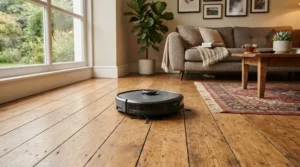
Compact Robot Vacuum Small Dock: Why Size Matters
The phrase “compact robot vacuum small dock” isn’t just a spec-sheet buzzword — it’s arguably the single biggest differentiator between a robovac that suits a small flat and one that was designed for a house and merely fits, awkwardly, into a smaller room. A standard self-emptying tower can measure 40cm tall and 35cm wide at the base; in a studio flat, that’s a visible, permanent piece of furniture, not a discreet appliance.
Here’s what most buying guides skip: a small dock isn’t just about floor space, it’s about sightlines. In an open-plan studio where the kitchen, living and sleeping areas share one visual field, a bulky auto-empty tower sits in your eyeline all day, whereas a slim charge-only dock like the one on the SwitchBot K10+ or Roborock Q7 M5 can be tucked into a genuinely unobtrusive corner. The trade-off, honestly, is manual bin emptying — typically every few days rather than every 30-75 days with a self-emptying tower — so the right choice depends on whether you’d rather spend thirty seconds a week emptying a bin or permanently host a taller dock.
Buyers who specifically want a small dock but aren’t willing to sacrifice auto-emptying entirely should look at the SwitchBot K10+ Pro Mini, which is one of the only models on the market that manages a genuinely compact self-emptying base — TechRadar’s own testing flagged its dock as noticeably smaller than typical auto-empty towers while still holding a decent-sized dust bag.
Robot Vacuum vs Traditional Vacuum: Benefits Analysis
| Factor | Robot Vacuum for Small Flats | Traditional Upright/Stick Vacuum |
|---|---|---|
| Storage footprint | Dock sits in a corner, out of the way | Needs a cupboard or wall-mount bracket |
| Daily maintenance | Runs on a schedule, unattended | Requires you to physically vacuum each time |
| Under-furniture access | Slides under most beds and sofas | Often needs furniture moved first |
| Deep-clean power | Generally lower peak suction | Higher peak suction, better for spills |
| Upfront cost | Wide range, £130-£600+ | Often cheaper for equivalent build quality |
| Best For | Frequent light-to-medium cleans, hands-off maintenance | Occasional deep cleans, spills, stairs |
The honest read here is that a robot vacuum doesn’t replace a traditional vacuum outright so much as it changes how often you need one. For someone in a small flat, running a compact robovac like the Roborock Q5 Pro on a daily or every-other-day schedule dramatically cuts down on visible dust and pet hair between the occasional deeper clean with a stick vacuum for spills, stairs, or a proper carpet refresh. If your flat is entirely hard flooring, the case for going robot-only is stronger; if you’ve got thick carpet throughout, keeping a lightweight stick vacuum as backup is the more realistic setup.
How Robot Vacuum Small Space Navigation Actually Works
Small space navigation is where the real engineering differences between budget and mid-range robovacs show up, and it’s worth understanding before you assume a higher price automatically means better navigation for your specific flat.
Budget models like the Eufy RoboVac 11S rely on what’s essentially bump-and-turn navigation with a gyroscope — the robot moves in a pattern, changes direction when it hits something, and doesn’t build a persistent map. In a small, simple flat with few obstacles, this is honestly less of a handicap than it sounds, because there’s less floor area to cover inefficiently. In a cluttered flat, though, it means more time spent working around chair legs and more repeat passes over the same patch of floor.
Mid-range and premium models — the Roborock Q7 M5, Roborock Q5 Pro, and iRobot Roomba 105 Combo — use LiDAR, which spins a laser to build a persistent map of the room in one pass, then plans efficient, methodical cleaning routes rather than random bouncing. According to TechRadar’s ongoing robot vacuum testing, LiDAR-equipped bots consistently cover a given floor area faster and more evenly than gyro-only models, which matters more than it sounds in a small flat because inefficient coverage means longer, noisier cleaning cycles in a space you can’t simply leave and forget about.
Camera-and-3D-detection systems, as used by the SwitchBot K10+ range and the Ecovacs Deebot N8 Pro, add a layer LiDAR alone doesn’t cover: recognising the shape and depth of specific obstacles like chair legs, shoes, or cables, rather than just their presence. This is the technology that most directly solves the “got stuck under the dining table again” problem that’s disproportionately common in small flats, where furniture is often positioned closer together out of necessity.
Furniture-Leg Navigation: What Actually Stops Robots Getting Stuck
Furniture-leg navigation deserves its own section because it’s genuinely the most common real-world failure point for robot vacuums in small flats — not open floor space, which most bots handle fine, but the forest of chair, table and sofa legs that a compact flat inevitably packs into a smaller footprint.
The Ecovacs Deebot N8 Pro‘s TrueDetect 3D system is the clearest example of a purpose-built solution: structured-light scanning detects objects as small as one millimetre from a distance of 4.5cm to 30cm, which is roughly ten times more accurate than the infrared sensors found on cheaper bots. In practical terms, that’s the difference between a robot that slows down and steers cleanly around a thin metal chair leg versus one that clips it, changes direction abruptly, or worse, tangles a side brush in it.
Budget models without this level of detection aren’t necessarily bad — the Eufy RoboVac 11S and standard Roborock Q7 M5 both rely on simpler bump sensors — but the trade-off is honest: expect occasional light contact with furniture legs rather than confident avoidance. For most small flats with a handful of chairs and a coffee table, that’s a manageable compromise. For flats with lots of spindly-legged furniture, cables, or a dining set in constant use, paying up for 3D detection genuinely reduces the “why has it got stuck again” frustration that’s the single most common complaint in user reviews of budget robovacs.
Single-Room Mapping vs Whole-Flat Mapping
For a studio or one-bed flat, the mapping debate looks different than it does for a four-bedroom house, and it’s worth being specific about what single-room mapping actually buys you.
Whole-flat mapping — building one persistent map covering every room — is the standard approach on LiDAR models like the Roborock Q5 Pro and iRobot Roomba 105 Combo, and it’s genuinely useful even in a small flat because it enables no-go zones (fencing off a pet’s food bowl, a delicate rug, or a cluster of cables) and room-specific scheduling.
Single-room mapping, by contrast, is what you get by default on simpler models, or when a multi-room map hasn’t been built yet — the robot cleans what it can reach in one session without persistent room boundaries. In a genuine studio flat where there’s arguably only one “room” to map anyway, this distinction matters less than manufacturers’ marketing suggests; the practical benefit of full mapping shows up more in one-bed flats with a separate bedroom, hallway and kitchen area, where you might want the bedroom cleaned on a different schedule to the living space.
The honest takeaway: if you live in a genuine open-plan studio, don’t overpay purely for advanced multi-floor mapping features you won’t use — put that budget into suction power or obstacle detection instead. If your flat has multiple distinct rooms, persistent whole-flat mapping on something like the Roborock Q7 M5 earns its place.
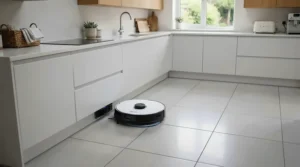
Practical Usage Guide: Setting Up Your Robot Vacuum in a Small Flat
Getting a compact robovac working well in a small flat takes about twenty minutes of setup, plus a few first-month habits that make a real difference to performance.
Day one: Place the dock against a flat wall with at least 50cm clear on either side, even for compact charge-only docks — cramped positioning is the single most common cause of a robot failing to redock reliably. Do a full first clean with doors open so the robot (if LiDAR-equipped) can build an accurate initial map; interrupting this run gives you a patchy, less efficient map for weeks afterwards.
First week: Walk the flat and lift trailing cables, phone chargers and loose rug edges — even 3D-detection models like the Ecovacs Deebot N8 Pro struggle more with thin cables than solid obstacles. Set a no-go zone around anything genuinely fragile rather than trusting sensor avoidance alone.
First month: Establish a realistic schedule. In a small flat, running a robovac daily on a lower power setting typically produces less noticeable dust build-up than running it twice a week on maximum suction — smaller floor areas mean shorter cycles, so daily runs aren’t the battery or time drain they’d be in a larger house.
Common early mistakes: overfilling the water tank on mop-equipped models (causing streaking on hard floors), forgetting to empty a charge-only dock’s bin for over a week (leading to reduced suction), and scheduling cleans during video calls or work-from-home hours, which — as Ecovacs’s own product testing notes — even “quiet” robovacs can be distracting on a hard floor in a small, echo-prone room.
Regular robot-vacuum use also has a genuine secondary benefit worth flagging honestly: Asthma + Lung UK notes that vacuuming regularly with a HEPA-filtered machine can help reduce house dust mite allergens, which matters disproportionately in small flats where dust has less floor area to settle across and can feel more concentrated.
Robot Vacuum for Studio Apartment Living: Real-World Scenarios
Three brief, realistic profiles help translate specs into decisions for the studio-apartment reader specifically.
The graduate on a tight budget, one hard-floor studio, no pets. Suction needs are modest, and app complexity isn’t a priority. The Eufy RoboVac 11S covers this brief almost exactly — cheap, slim enough to slide under a bed-in-a-box frame, and simple enough to hand over instructions to a flatmate without a tutorial.
The remote worker in a one-bed conversion flat with a cat. Pet hair on a mix of hardwood and one bedroom carpet is the priority, alongside quiet operation during video calls. The Roborock Q5 Pro, scheduled to run mid-morning rather than during core working hours, handles the carpet-and-hair combination well according to independent testing, while its compact self-empty dock avoids becoming a visible distraction on camera.
The couple sharing a genuine studio with a dining set and several plants (read: furniture legs everywhere). This is the scenario where furniture-leg navigation stops being a nice-to-have. The Ecovacs Deebot N8 Pro‘s 3D obstacle detection is worth the higher price here specifically because the flat’s layout is the constraint, not the floor area — fewer stuck incidents means fewer manual interventions in a home where both occupants are often out during the day.
Matching the product to the specific pain point — budget, pets, or furniture density — consistently beats picking whichever model has the highest star rating on a general retailer listing.
Buyer’s Decision Framework for Small-Space Robot Vacuums
A simple priority checklist, worth running through in order:
- If your flat is under 40 square metres with minimal furniture, choose a charge-only-dock model — the Eufy RoboVac 11S or SwitchBot K10+ — because dock footprint outweighs every other consideration at this scale.
- If you have a pet and hard floors plus one carpeted room, choose a LiDAR model with strong brush design like the Roborock Q5 Pro, because suction and hair-tangle resistance matter more than mapping sophistication.
- If your flat has dense, close-together furniture with lots of legs, choose 3D-detection navigation — the Ecovacs Deebot N8 Pro — because obstacle avoidance failures, not suction shortfalls, will be your main frustration.
- If you want zero manual bin-emptying but can’t fit a full tower, choose the SwitchBot K10+ Pro Mini, the rare genuinely compact self-emptying option.
- If you want one machine to vacuum and mop a genuinely open-plan studio in a single pass, choose the iRobot Roomba 105 Combo, while checking current warranty terms given the 2026 ownership change.
Price Range & Value Snapshot
| Budget Band | Recommended Pick | What You’re Paying For |
|---|---|---|
| Under £200 | Eufy RoboVac 11S / SwitchBot K10+ | Compact footprint, basic navigation |
| £200-£350 | Roborock Q7 M5 / Roborock Q5 Pro | LiDAR mapping, stronger suction |
| £350-£600 | Ecovacs Deebot N8 Pro / SwitchBot K10+ Pro Mini / iRobot Roomba 105 Combo | Advanced obstacle detection, self-emptying, mop-and-vac combos |
Reading this against the decision framework above, the jump from the sub-£200 band to £200-£350 buys genuinely better mapping efficiency, while the jump beyond £350 buys specific problem-solving — furniture avoidance, compact auto-emptying, or combined mopping — rather than a blanket “better” machine. Spend based on your flat’s actual pain point, not the highest number you can afford.
Common Mistakes When Buying a Robot Vacuum for Small Flats
Even careful buyers repeat a handful of avoidable mistakes when shopping specifically for small-space use.
Buying based on Pa suction figures alone is the most common one — as independent testers have pointed out, a 2,000Pa robot with well-designed brushes can outperform a 4,000Pa model on pet hair, so treat Pa as one input among several, not the deciding factor. A close second is measuring the robot but not the dock — plenty of buyers check that a robovac itself is slim enough to fit under furniture, then discover the charging tower is a foot taller than expected and dominates the one wall it needed to hide against.
Assuming every “compact” model has weak suction is also a mistake — the Roborock Q7 M5‘s compact charge-only dock houses a genuinely capable 10,000Pa machine, proving small and powerful aren’t mutually exclusive. Finally, skipping current, independent reviews in favour of retailer star ratings alone means missing details that matter for long-term ownership, such as review volume, real-world obstacle performance, or — as with the iRobot Roomba 105 Combo — ownership changes that could affect future support.
FAQ
❓ What is the best robot vacuum for a small flat?
❓ Do robot vacuums work well in studio apartments?
❓ How big does a robot vacuum charging dock need to be?
❓ Can a robot vacuum get stuck on furniture legs in a small flat?
❓ Is a self-emptying dock worth it for a small flat?
Conclusion
Choosing a robot vacuum for small flats really comes down to matching the machine to your specific constraint — dock space, furniture density, pets, or how much manual maintenance you’re willing to accept — rather than chasing the highest suction figure on the box. The Eufy RoboVac 11S and SwitchBot K10+ cover the tightest budgets and smallest layouts; the Roborock Q7 M5 and Roborock Q5 Pro step up to LiDAR mapping and stronger pet-hair performance without demanding much extra floor space; and the Ecovacs Deebot N8 Pro, SwitchBot K10+ Pro Mini and iRobot Roomba 105 Combo handle the specific problems — furniture legs, compact auto-emptying, and combined mop-and-vac passes — that justify their higher price tags.
None of these seven is objectively “the best” in isolation; each earns its place by solving a particular small-flat problem well. Whichever you lean towards, do check current prices and read a recent independent review before buying, since availability, pricing, and even company ownership (as with iRobot’s 2026 restructuring) can shift faster than a static buying guide can track. And when the time comes to retire an old vacuum, Recycle Your Electricals makes it straightforward to dispose of it responsibly rather than letting it sit in a cupboard in an already-small flat.
✨ Ready to reclaim your floor space? Compare today’s prices on the pick that matches your flat above, and let the robot handle the rest. 🧹
Recommended for You
- Quietest Robot Vacuum 2026: 7 Whisper-Quiet Picks Tested
- Robot Vacuum for Hard Floors: 7 Best Picks Tested for 2026
- Robot Vacuum for Carpets: 7 Powerful Picks for 2026
Disclaimer: This article contains affiliate links. As an Amazon Associate, I earn from qualifying purchases. If you purchase products through these links, we may earn a small commission at no additional cost to you.
✨ Found this helpful? Share it with your friends! 💬🤗
