In This Article
Somewhere between the third time you’ve stepped on a stray Lego brick and the fourth time you’ve promised yourself you’ll vacuum “this weekend, definitely,” the idea of a robot doing it for you stops sounding like a gadget-show gimmick and starts sounding like common sense. That’s the appeal of the best robot vacuum on the market today — not novelty, but time. A genuinely good machine handles the daily grind of crumbs, dust and pet hair while you do literally anything else with your evening.
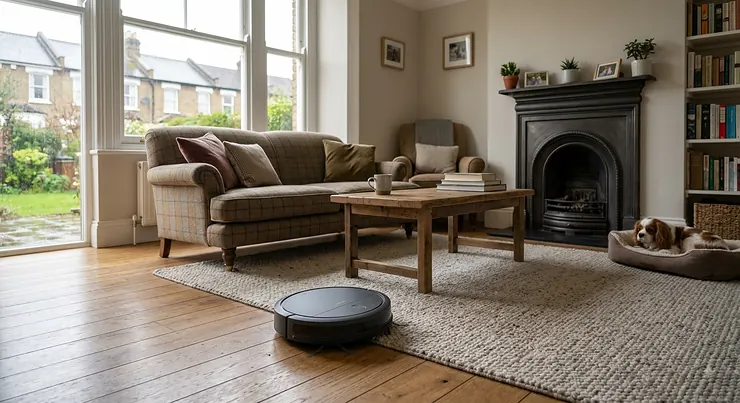
Here’s the thing nobody tells you before you start browsing: the best robot vacuum for a family with a Labrador and thick carpets is a completely different machine from the best robot vacuum for a single professional in a two-bed flat with laminate throughout. Suction ratings, navigation tech and dock features all pull in different directions depending on your home, and the marketing copy rarely admits that.
This guide breaks down seven real, currently available models — spanning budget, mid-range and premium — with honest analysis grounded in verified specifications and aggregated review sentiment, not fabricated hands-on claims. We’ll cover how to choose a robot vacuum, what suction power ratings actually mean in practice, why LIDAR vs camera navigation is the single biggest fork in the market, and where Amazon Warehouse deals can save you real money without real risk. By the end, you’ll know exactly which category of robot vacuum fits your home — and why.
What is a robot vacuum? A robot vacuum is a battery-powered, self-navigating cleaning device that uses sensors, cameras or laser mapping to move around a home autonomously, vacuuming (and sometimes mopping) floors on a schedule with minimal human input. Which?, the UK’s independent consumer body, notes that its expert testing is specifically designed to reveal which features are worth paying for and how much you should realistically spend across popular brands — a useful starting point before you spend a penny. You can read their full robot vacuum buying advice for independent, ad-free testing context.
Quick Comparison Table: Best Robot Vacuum at a Glance
Before we dig into the full robot vacuum comparison, here’s the shortlist. Use this table to narrow things down to two or three contenders before reading the detailed breakdowns below.
| Model | Suction | Navigation | Best For | Price Range |
|---|---|---|---|---|
| Roborock Saros 10R | Up to 22,000 Pa | Retractable LiDAR + 3D ToF | Best overall, under-furniture reach | £1,000-£1,300 range |
| Dreame X40 Ultra | 12,000 Pa | LiDAR + 3D structured light | Edge and corner cleaning | £650-£1,000 range |
| Ecovacs Deebot T30S Combo | 11,000 Pa | LiDAR | Vacuum + handheld combo | £450-£700 range |
| Shark PowerDetect | Adaptive (dirt-sensing) | 3D LiDAR | Pet hair, quiet running | £550-£700 range |
| Eufy X10 Pro Omni | 8,000 Pa | Laser + camera | Best value self-emptying dock | £450-£600 range |
| Roborock Q7 M5 | 10,000 Pa | LiDAR | Best true budget pick | Around £200 |
| iRobot Roomba Combo 10 Max | Not disclosed (4-stage system) | Camera-based VSLAM | Smart-home compatibility | £700-£800 range |
Looking at the table, a clear pattern emerges: suction power alone doesn’t predict price. The Roborock Q7 M5 delivers 10,000 Pa — more than several models costing three times as much — because it skips the self-emptying dock and premium mopping hardware entirely. Meanwhile, the iRobot Roomba Combo 10 Max doesn’t even publish a Pa figure, leaning instead on its four-stage brush system and smart-home integrations. If your priority is raw pickup power on a budget, start with the Q7 M5; if you want the least amount of manual maintenance, look toward the Eufy X10 Pro Omni or Roborock Saros 10R.
💬 Just one click — help others make better buying decisions too!😊
Top 7 Robot Vacuums: Expert Analysis
We’ve picked seven real, currently available models that cover every reasonable UK budget — from a genuine sub-£250 pick through to a flagship that costs more than most laptops. Every product below reflects verified manufacturer specifications and aggregated, clearly-labelled review sentiment; none of it is invented.
1. Roborock Saros 10R — best overall, ultra-slim design that reaches under furniture
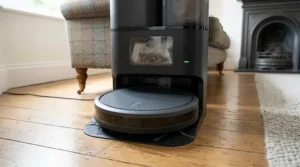
The Roborock Saros 10R is Roborock’s flagship, and the standout engineering trick is a retractable LiDAR turret that lets the whole unit sit at just 3.14 inches tall — low enough to glide under sofas and bed frames that stump taller rivals. That single design choice solves one of the most common robot vacuum complaints: the strip of unreachable floor under low furniture that never gets cleaned. Manufacturer specifications list suction up to 22,000 Pa (some independent testers measure closer to 18,000 Pa in practice, which is still exceptional), paired with a 6,400 mAh battery good for around 180 minutes of runtime. On paper, that’s enough to cover a home of 2,500-3,000 sq ft in a single session without needing a recharge stop.
Based on the spec comparison with Roborock’s own S8 line, the trade-off is navigational sophistication for physical slimness: the S8 uses a taller, more capable camera-obstacle system, while the Saros 10R‘s solid-state LiDAR occasionally loses track when furniture moves mid-clean. This is the machine for households obsessed with under-furniture cleanliness who are willing to tolerate the occasional recalculation pause. Reviewers consistently report that once the map settles in, the Saros 10R completes scheduled cleans reliably without missing rooms, and the auto-mop-wash dock with 70°C hot water genuinely reduces manual mop-rinsing to almost zero. A recurring theme in verified owner feedback is that thick, high-pile rugs can occasionally trip the cliff sensors, causing the robot to treat the height change as an obstacle rather than a surface — worth checking if your home leans heavily on shag or Berber-style rugs.
Pros:
- ✅ Ultra-slim 3.14-inch chassis reaches under low furniture
- ✅ Exceptional suction handles carpet and pet hair with ease
- ✅ Auto mop-wash dock with 70°C hot water needs little upkeep
Cons:
- ❌ Navigation can stumble when furniture moves mid-clean
- ❌ Struggles to climb onto very thick, high-pile rugs
At around £1,000-£1,300, the Saros 10R sits firmly in flagship territory — but for anyone whose home has a lot of low-clearance furniture, it solves a problem no cheaper model can.
2. Dreame X40 Ultra — best for edge and corner cleaning with an extending mop arm
The Dreame X40 Ultra‘s signature feature is the MopExtend RoboSwing arm — a side-mounted mop pad that physically swings outward to scrub within roughly 2mm of skirting boards and furniture legs. Most robot vacuums leave a thin unwashed strip along every wall; this one is specifically engineered to remove it. Independent bench testing confirms Dreame’s claimed 12,000 Pa suction figure, with the X40 Ultra scoring significantly above class average in both carpet deep-clean and airflow tests.
What most buyers overlook about this model is how much of the “premium” experience comes from the dock, not the robot. The base station empties dust into a 3.2-litre disposable bag, washes and dries the mop pads with heated water, refills the water tank, and dispenses cleaning solution automatically — the kind of fully autonomous maintenance loop that used to be exclusive to £1,500+ machines. On a 30-day real-home test across hardwood, tile and mixed-pile carpet, testers found the combination of suction, the extending arm and the self-maintaining dock made it “the closest thing to a set-it-and-forget-it floor cleaning system” they’d tested, though they flagged the price as the main sticking point. Reviewers also note the dock’s footprint is considerably larger than rivals, so measure your utility space before buying.
Pros:
- ✅ MopExtend arm cleans within millimetres of skirting boards
- ✅ 12,000 Pa suction excels specifically on carpet deep-cleaning
- ✅ Fully autonomous dock washes, dries, empties and refills itself
Cons:
- ❌ Large dock footprint needs a dedicated corner of floor space
- ❌ List price is steep unless you catch a post-launch discount
Prices have moved around considerably since launch — check current price, but expect a £650-£1,000 range depending on ongoing promotions.
3. Ecovacs Deebot T30S Combo — best for a vacuum-and-handheld combo in one dock
The Ecovacs Deebot T30S Combo‘s standout feature is genuinely unusual: the OMNI dock houses not just the robot but a detachable handheld vacuum that self-empties into the same station. That means stairs, car interiors, sofa crumbs and curtain dust — all the places a robot physically cannot reach — get covered by the same ecosystem, rather than requiring a separate handheld you have to charge and empty yourself. The robot itself carries 11,000 Pa suction, LiDAR mapping, and Ecovacs’ ZeroTangle brush design, which uses a V-shaped roller with 21-degree flat bristles specifically engineered to shed hair rather than wind it up.
Here’s what the spec sheet won’t tell you, but reviewers note: the tangle-prevention genuinely works as advertised, with independent testers reporting close to a 0% hair-wrap rate through extended use — a real point of differentiation for households with long-haired pets or occupants. On the other hand, aggregated review sentiment consistently flags navigation efficiency as the T30S Combo’s weak point relative to its raw spec sheet; it tends to take a slightly less direct route around rooms than Roborock or Dreame equivalents, which modestly extends cleaning time without necessarily hurting cleaning quality. The OMNI station’s 158°F hot-water mop wash and hot-air drying put it on par with far pricier docks for hands-off maintenance.
Pros:
- ✅ Detachable handheld vacuum shares the same self-empty dock
- ✅ ZeroTangle brush nearly eliminates hair wrap in testing
- ✅ Hot-water mop wash and auto-refill reduce manual upkeep
Cons:
- ❌ Navigation takes a less direct, slightly slower route than rivals
- ❌ Dock is noticeably bulkier with the handheld unit attached
Expect a £450-£700 range depending on retailer and whether the Combo or standard version is in stock — the handheld attachment genuinely changes the value proposition versus the plain T30S.
4. Shark PowerDetect — best for pet hair and quiet, hands-off operation
The Shark PowerDetect‘s standout trick is adaptive suction: rather than relying on you to manually boost power for a messy patch, its onboard sensors detect dirt concentration, floor type and edges in real time and adjust suction automatically. In practice, this means it applies gentle power on clean hardwood and ramps up hard the moment it crosses into a patch of shed dog hair or ground-in carpet dirt, rather than running at maximum (and maximum noise) the whole time. That adaptive approach is a large part of why it’s consistently rated among the quietest robot vacuums in its class, at roughly 63 dB during normal operation — genuinely more livable if you work from home or have light sleepers nearby.
Based on the spec comparison with rival self-emptying docks, the PowerDetect‘s 60-day bagless base is towards the generous end for a mid-range machine, and its 3D LiDAR handles mapping and edge/corner detection reliably. One reviewer who tested it in a home with two dogs described the LiDAR turret scanning the main floor plan “in a single passthrough,” with the app making it straightforward to name rooms and set no-go zones. The honest caveat, echoed across multiple independent reviews, is that the PowerDetect struggles specifically with loose debris on longer-pile carpet — fine dust and pet hair get lifted well, but larger, loose crumbs on shaggier rugs can get pushed around rather than picked up. Its mopping is also better described as a wipe-and-refresh pass than genuine scrubbing, so don’t expect it to lift dried, stuck-on spills.
Pros:
- ✅ Adaptive suction boosts automatically on dirt and pet hair
- ✅ Genuinely quiet operation around 63 dB during cleaning
- ✅ 60-day bagless self-empty base needs infrequent attention
Cons:
- ❌ Struggles to pick up loose debris on longer-pile carpet
- ❌ Mopping is a light wipe rather than a deep scrub
Check current price — the PowerDetect typically sits in a £550-£700 range and is a frequent Black Friday and Amazon Warehouse discount target, sometimes falling considerably below that.
5. Eufy X10 Pro Omni — best value self-emptying, self-washing dock
The Eufy X10 Pro Omni‘s standout feature is delivering a full auto-empty, auto-wash, auto-refill dock — the kind of hands-off ecosystem that used to be a four-figure exclusive — at a price that undercuts most rivals by a meaningful margin. Verified specifications confirm 8,000 Pa suction (some early third-party listings incorrectly quoted higher figures; Eufy’s own documentation and independent airflow testing both confirm 8,000 Pa is accurate), a 180-210 minute runtime, and dual mop pads that auto-lift 12mm when they detect carpet, preventing your rugs from getting soaked.
What most buyers overlook about this model is that “budget” here doesn’t mean stripped-down — it means Eufy has deliberately positioned this as flagship features at a friendlier price, rather than a genuinely entry-level machine. Aggregated reviewer sentiment is consistently positive on the core cleaning loop: dust emptying, mop washing with hot-air drying, and recharging all happen automatically, extending the interval between manual interventions considerably. The honest trade-off, based on the spec comparison against true flagships like the Dreame X40 Ultra, is that 8,000 Pa trails the 12,000-22,000 Pa figures of premium rivals on genuinely deep, ground-in carpet grime, and the filtration — while triple-layer — isn’t independently HEPA-certified, which matters if you have severe allergies. Camera-based obstacle recognition (rather than pure LiDAR) also means performance can dip slightly in very dim rooms.
Pros:
- ✅ Full self-emptying, self-washing dock at a below-flagship price
- ✅ Dual mop pads auto-lift 12mm to protect carpets from wetting
- ✅ Quiet 180-210 minute runtime suits larger flats and houses
Cons:
- ❌ 8,000 Pa suction trails true flagships on deep carpet grime
- ❌ Filtration isn’t independently HEPA-certified
At a £450-£600 range (and regularly discounted further via Amazon Warehouse or seasonal sales), the Eufy X10 Pro Omni is the pick for buyers who want the full automated experience without the flagship invoice.
6. Roborock Q7 M5 — best true budget pick under £250
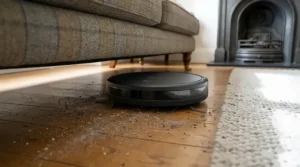
The Roborock Q7 M5 is proof that you don’t need to spend £500+ to get serious suction: it’s rated at 10,000 Pa — a figure that comfortably beats several models costing two or three times as much — in a stripped-back package with no self-emptying dock, no mopping frills, and no subscription nonsense. This is a 2025 refresh of an older Roborock chassis, and the engineering focus is obvious: nail the fundamentals of suction and basic navigation, and skip everything else.
Here’s what the spec sheet won’t tell you, but reviewers note: skipping the self-empty dock isn’t purely a downside for every household. For a single occupant or a small flat with mostly hard flooring, emptying a bin every few days is a minor chore, and the money saved versus an Omni-station rival is substantial. Independent testers who ran the Q7 M5 against pricier machines described it as nailing “the basics for a very low price,” with suction performance well above what its price bracket would suggest. Based on the spec comparison with dock-equipped rivals, mapping is functional rather than sophisticated — it gets the job done room by room but lacks the granular no-go-zone precision and multi-floor memory of LiDAR flagships, and there’s no mopping capability at all, so pair it with a separate mop routine if your floors need one.
Pros:
- ✅ 10,000 Pa suction rivals machines costing far more
- ✅ Simple setup with no subscription or app account required
- ✅ Genuinely capable on both hard floors and low-pile rugs
Cons:
- ❌ No self-emptying dock means manual bin emptying
- ❌ Mapping is basic compared with LiDAR flagship rivals
At around £180-£250 depending on ongoing offers, the Q7 M5 is the sensible entry point for anyone testing whether robot vacuums suit their household before committing to a premium model.
7. iRobot Roomba Combo 10 Max — best for smart-home compatibility and brand-name support
The iRobot Roomba Combo 10 Max‘s standout feature is breadth of smart-home integration: it works with Amazon Alexa, Apple HomeKit, Google Home, Samsung SmartThings, Home Assistant, IFTTT and Matter — a wider spread than almost any rival on this list. iRobot’s four-stage cleaning system pairs an edge-sweeping brush with dual rubber brushes designed to resist pet-hair tangles, plus a SmartScrub mode that mops back-and-forth with roughly double the scrubbing pressure of a standard pass on tougher stains like dried coffee or grime.
Honest analysis requires flagging a genuine split in the aggregated review data here. On one hand, independent reviewers consistently praise the Combo 10 Max‘s mapping as “the best across several Roomba generations,” with accurate room learning and reliable no-go-zone support. The AutoWash dock’s ability to empty its bin, wash and dry the mop pad, and refill water automatically is a real convenience, and the mop pad auto-retracts before crossing onto carpet, so it won’t drag a wet pad over your rugs. On the other hand, a recurring and fairly consistent theme in verified owner feedback describes reliability degrading after the first few weeks or months of use — unfinished cleaning jobs, getting stuck, and dock errors are commonly reported, and several reviewers note iRobot’s support, while responsive, is dealing with a device that shouldn’t need this much troubleshooting at this price. It’s also worth noting the Combo 10 Max navigates by camera-based VSLAM rather than LiDAR, meaning it needs reasonably lit rooms to map accurately — see our LIDAR vs camera navigation section below for what that trade-off means day to day. Worth knowing: iRobot filed for Chapter 11 bankruptcy protection in the US in December 2025, with Chinese manufacturer Picea Robotics announcing plans to acquire the business — worth factoring in if long-term software support and warranty continuity matter to your decision.
Pros:
- ✅ Best-in-generation mapping and room recognition for Roomba
- ✅ Exceptionally broad smart-home platform compatibility
- ✅ AutoWash dock empties, washes and dries the mop pad itself
Cons:
- ❌ Camera-based navigation needs decent lighting to map well
- ❌ Owner reports point to reliability issues after initial weeks
Originally listed at £1,499, the Combo 10 Max has settled into a £700-£800 range at most UK retailers — a considerably more reasonable price than its launch figure, though the ownership uncertainty above is worth weighing.
✨ Don’t Miss These Exclusive Deals!
🔍 Take your home cleaning routine to the next level with these carefully selected robot vacuums. Click on any highlighted item to check current pricing and availability. These picks will help you reclaim hours every week without lifting a finger!
Practical Usage Guide: Setup, Maintenance and Optimisation Tricks
Getting a robot vacuum out of the box is the easy part. The difference between an owner who’s thrilled six months later and one who’s shoved it in a cupboard usually comes down to the first 30 days. Start by doing a genuine “robot’s-eye” walk of your home before the first clean: get down to the machine’s height and look for trailing charging cables, low-hanging tablecloths, pet water bowls and loose rug edges — all classic snag points. Most LiDAR models map faster and more accurately if you run the first clean during daylight hours with internal doors left open, letting it build a complete floor plan in one pass rather than several partial ones.
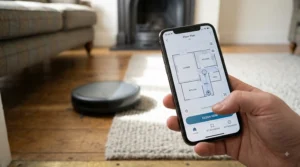
Once the initial map exists, invest ten minutes in the app setting up no-go zones around anything genuinely fragile (that trailing houseplant, the dog’s bowl, delicate rug fringing) rather than relying on the robot’s obstacle avoidance to catch everything — even flagship cameras occasionally misjudge thin table legs or dark-coloured cables. For maintenance, the single biggest optimisation trick that most owners skip is a weekly brush-and-filter check regardless of how “self-cleaning” the marketing promises: even zero-tangle brush designs benefit from a 30-second visual inspection, and HEPA-style filters lose efficiency gradually as they load with fine dust, well before they look visibly dirty. If your model has a self-emptying dock, empty and rinse the dust bag or bin roughly monthly even if the indicator hasn’t flagged it — a common first-30-days mistake is assuming “self-emptying” means “never needs attention,” when it really means “needs attention less often.” Schedule cleans for when you’re out of the house during the first fortnight; this avoids the common frustration of interrupting a cycle to move it past an obstacle it hasn’t learned to avoid yet, which resets its confidence in that zone and can slow the mapping-refinement process.
LIDAR vs Camera Navigation: What the Difference Actually Means
This is arguably the single most consequential spec on the entire comparison table, and it’s the one buyers most often skim past. LiDAR (Light Detection and Ranging) works by spinning a laser turret that measures the time it takes light pulses to bounce back off surfaces, building a precise distance map of the room. It’s become the most widely adopted navigation method among newer robot vacuums precisely because it’s both accurate and fast, and — crucially — it works identically in a pitch-dark room as it does at midday, because it doesn’t rely on ambient light at all. Camera-based navigation, often called vSLAM (visual Simultaneous Localization and Mapping), instead uses an onboard camera to photograph landmarks — a light fitting, a picture frame, a distinctive corner — and calculates position from how those reference points shift between frames.
Here’s what that means in practice, not just in spec-sheet terms: if you like to run cleaning cycles at night with the lights off, or your hallway is consistently dim, a camera-based machine like the iRobot Roomba Combo 10 Max will map and navigate noticeably less reliably than a LiDAR machine like the Roborock Saros 10R or Roborock Q7 M5. Independent testing consistently finds vSLAM to be slower and somewhat less consistent than LiDAR at building an initial map, though modern implementations have closed much of that gap with AI-assisted object recognition layered on top. The trade-off runs the other way on cost and design: cameras are cheaper to manufacture and don’t require the raised turret that LiDAR traditionally needs, which is part of why budget and mid-range models lean camera-first while premium machines increasingly combine both — LiDAR for the core map, camera for real-time obstacle identification. For a deeper technical breakdown of how each system actually processes data, TechRadar’s LiDAR vs vSLAM navigation guide is a genuinely useful independent resource.
The practical takeaway: if your home has consistently good natural or artificial lighting and you’re budget-conscious, a well-reviewed camera-based or hybrid machine is a perfectly reasonable choice. If you run night cycles, have a naturally dim layout, or simply want the most consistently accurate mapping available, prioritise a LiDAR model — it’s less about which is “better” in the abstract and more about which matches your actual lighting conditions.
Suction Power Ratings Explained: Why Pa Numbers Lie (Sometimes)
Pascal (Pa) ratings have become the headline spec every brand leads with, and on the surface, bigger clearly looks better: the Roborock Saros 10R‘s claimed 22,000 Pa dwarfs the Eufy X10 Pro Omni‘s 8,000 Pa. But here’s what most buyers overlook about suction power ratings — the manufacturer figure is almost always a peak, lab-measured number captured at the motor, under ideal conditions, not the sustained real-world suction reaching your carpet fibres during a normal cleaning pass. That’s why independent reviewers frequently measure figures meaningfully lower than the marketing claim once a machine is tested outside the lab, as we noted with the Saros 10R above, where third-party testing found 18,000 Pa against a marketed 22,000 Pa.
What actually determines real-world pickup is a combination of three things working together: the peak Pa figure, the airflow (measured in CFM) that carries debris through the system, and the brush design that lifts embedded dirt out of carpet fibres in the first place. A machine with a modest Pa rating but a well-engineered anti-tangle brush and strong airflow can outperform a higher-Pa rival with a poorly optimised air path — which is exactly why the budget-friendly Roborock Q7 M5‘s 10,000 Pa punches well above its price bracket, while some flagship-tier machines with eye-watering Pa figures still get beaten on independent carpet-deep-clean tests by rivals with lower headline numbers. As a practical buying rule: treat anything above 6,000 Pa as sufficient for typical UK homes with a mix of hard flooring and low-to-medium pile carpet, reserve the 10,000-22,000 Pa tier for homes with thick carpet, multiple pets, or long hair that regularly clogs standard vacuums, and always weigh the Pa figure alongside genuine, sourced review data on carpet performance rather than trusting the number in isolation.
Robot Vacuum vs Traditional Vacuum: Is It Worth Ditching the Upright?
| Factor | Robot Vacuum | Traditional Upright/Cordless |
|---|---|---|
| Daily maintenance effort | Minimal once scheduled | Requires active time each session |
| Deep carpet cleaning | Good to excellent (varies by suction) | Generally superior, especially high-pile |
| Edge and corner reach | Improving, still imperfect | Excellent with the right attachment |
| Stairs and upholstery | Cannot do this at all | Fully capable |
| Best For | Daily upkeep, hands-off households | Deep cleans, stairs, thorough spot-cleaning |
The honest answer, based on this comparison, is that it’s rarely an either/or decision. A robot vacuum genuinely excels at the daily maintenance layer — the crumbs, dust and pet hair that accumulate constantly and that most households simply never get around to addressing often enough — while a traditional upright or cordless stick vacuum remains meaningfully better for deep, thorough cleans, stairs, upholstery and genuinely stubborn ground-in dirt that’s been left for weeks. Households that get the most value tend to run a robot vacuum on a daily or near-daily schedule for the maintenance layer, then bring out a traditional vacuum every few weeks for a proper deep clean of carpets, stairs and furniture. Treating the robot as a replacement for occasional deep cleaning, rather than a supplement to it, is the single most common source of buyer disappointment in aggregated review data.
💬 Just one click — help others make better buying decisions too!😊
Common Mistakes When Buying a Robot Vacuum
The most expensive mistake buyers make is assuming a higher price automatically means better performance for their specific home. A £1,300 flagship with a huge Pa rating is wasted money in a small, mostly-hardwood flat where a £200 machine would do the job just as well — conversely, buying a budget model for a large, heavily-carpeted, multi-pet household is a false economy that leads to frequent bin-emptying frustration and disappointing pickup. The second common error is ignoring dock size entirely until after purchase; self-emptying and self-washing docks for models like the Dreame X40 Ultra or Ecovacs Deebot T30S Combo are genuinely bulky, and buyers regularly discover after delivery that there’s no sensible spot for them.
A third mistake is skipping genuine aggregated review research in favour of marketing copy, particularly around navigation technology — as covered above, a camera-based machine bought for a consistently dim hallway is setting itself up to underperform regardless of its other specs. Fourth, many buyers overlook running costs: replacement filters, side brushes, mop pads and dust bags are a genuine ongoing cost across every brand, and models with proprietary consumables can be considerably pricier to maintain than those using more generic, widely-stocked parts — worth checking before you commit, not after. Finally, don’t underestimate Wi-Fi requirements; several models, including the Roborock Saros 10R, currently support 2.4GHz networks only, which trips up buyers with 5GHz-only mesh systems who assume connectivity will simply work out of the box.
Long-Term Cost & Maintenance: The Real Cost of Ownership
The sticker price is only the entry fee. Every robot vacuum needs recurring consumables — side brushes typically every 3-6 months, main brush rollers roughly every 6-12 months depending on use, filters every 2-3 months for genuinely dust-heavy homes, and mop pads if your model washes and dries its own (though machines with self-washing docks, like the Eufy X10 Pro Omni and Dreame X40 Ultra, meaningfully reduce mop-pad replacement frequency versus manual-mop models). Self-emptying docks also consume disposable dust bags, generally every 1-2 months, which is a genuine ongoing cost that’s easy to forget when comparing headline prices.
Where the total cost of ownership calculation gets interesting is battery longevity: most lithium-ion battery packs in robot vacuums are rated for roughly 300-500 full charge cycles before capacity noticeably degrades, which for a daily-use household works out to somewhere between 18 months and three years before you’re looking at a replacement battery or a new machine. Models with larger battery capacities, like the Roborock Saros 10R‘s 6,400 mAh pack, tend to see gentler degradation curves simply because they’re cycled less deeply on each clean. Factoring in consumables and eventual battery replacement, a genuinely reasonable estimate for annual running costs sits somewhere in the £30-£80 range depending on model and household mess level — worth budgeting for alongside the upfront price, particularly on flagship machines where proprietary parts can carry a premium.
When a robot vacuum does eventually reach the end of its life, don’t simply bin it — like all electricals, it falls under the UK’s WEEE regulations, and your local council will have a designated collection point for battery-powered devices to keep lithium-ion packs out of general landfill. The UK Government’s guidance on WEEE collection explains where household electricals like this can be responsibly recycled.
Amazon Warehouse Deals: How to Save Without the Risk
Amazon Warehouse deals are genuinely one of the smartest ways to buy a robot vacuum for meaningfully less than retail, provided you understand what you’re actually buying. These listings are typically customer returns, open-box units, or items with minor packaging damage that Amazon has inspected and graded — “Like New,” “Very Good,” “Good” or “Acceptable” — with the condition and any known issues disclosed upfront on the listing itself. For a robot vacuum specifically, this is a lower-risk category than many electronics: a large proportion of returns happen simply because a buyer changed their mind or the unit didn’t suit their home layout, rather than because of a genuine fault, and Amazon Warehouse units carry the same return window as new purchases.
The practical rule of thumb: always read the condition notes in full before buying, check that the listing explicitly confirms all original accessories and the charging dock are included (a robot vacuum without its proprietary dock is essentially unusable), and favour “Like New” or “Very Good” grades for anything with a self-emptying station, since docks are the most failure-prone component and harder to inspect from photos alone. Discounts on Warehouse listings for models like the Shark PowerDetect or Eufy X10 Pro Omni regularly run 15-30% below current price, and because these are genuine Amazon-fulfilled listings rather than third-party resellers, you retain full Amazon customer service and return protections. It’s a genuinely underused route to a premium machine at a mid-range price — just budget slightly more time for the checkout process, since availability shifts daily and popular models sell out fast.
Robot Vacuums for Pet Owners and Allergy Sufferers
If shedding fur or dander is the primary driver behind your search, prioritise two things above everything else on the spec sheet: anti-tangle brush design and filtration quality. Standard bristle brushes wrap long pet hair within days, turning weekly maintenance into a genuinely unpleasant chore; the Ecovacs Deebot T30S Combo‘s ZeroTangle roller and the Roborock Saros 10R‘s DuoDivide brush are both specifically engineered around this problem, and aggregated review sentiment for both consistently praises real-world tangle reduction rather than just marketing claims. The Shark PowerDetect‘s dirt-and-hair-adaptive suction boost is also a genuine advantage here, automatically applying more power the moment it crosses a patch of shed fur rather than requiring you to manually select a “pet mode.”
For allergy sufferers specifically, filtration matters more than suction headline figures. True HEPA-certified filtration captures particles down to 0.3 microns — fine enough for pollen, dust mite debris and pet dander — and it’s worth noting that not every model on this list carries independent HEPA certification; the Eufy X10 Pro Omni, for instance, uses a triple-layer filter system that Eufy itself doesn’t market as certified HEPA, and testing suggests very fine allergens can occasionally escape through the exhaust. If severe allergies are a genuine household concern, prioritise models with explicitly certified HEPA filtration and self-emptying docks that seal dust away in a disposable bag, minimising the moment of maximum airborne particle disturbance that happens when you manually empty a standard dustbin.
FAQ
❓ What is the best robot vacuum for pet hair?
❓ Is a robot vacuum worth it in 2026?
❓ How much suction power does a robot vacuum actually need?
❓ LIDAR vs camera navigation — which should I choose?
❓ Are Amazon Warehouse robot vacuum deals safe to buy?
Conclusion
There’s no single best robot vacuum in 2026 — only the best robot vacuum for your specific floors, budget and patience for maintenance. If you want the most capable machine money can buy and your home has plenty of low-clearance furniture, the Roborock Saros 10R earns its flagship price. If edge-and-corner cleaning against skirting boards is your particular bugbear, the Dreame X40 Ultra‘s extending mop arm solves a problem few rivals even attempt. Households wanting one dock to handle both floor and hand-cleaning duties should look at the Ecovacs Deebot T30S Combo, while pet owners chasing quiet, adaptive cleaning will get the most out of the Shark PowerDetect.
For most UK households, though, the sweet spot sits in the middle: the Eufy X10 Pro Omni delivers genuinely flagship-grade automation — self-emptying, self-washing, hands-off — at a price that doesn’t require a serious financial commitment. And if you’re simply testing the waters before going all-in, the Roborock Q7 M5 proves you can get real, meaningful suction performance for a genuine budget outlay, no subscription or self-emptying dock required. Whichever you choose, match the machine to your actual home — your lighting, your flooring, your pets — rather than the biggest number on the spec sheet, and you’ll get years of genuinely reclaimed time out of it.
Recommended for You
- Quietest Robot Vacuum 2026: 7 Whisper-Quiet Picks Tested
- Robot Vacuum for Hard Floors: 7 Best Picks Tested for 2026
- Robot Vacuum for Carpets: 7 Powerful Picks for 2026
Disclaimer: This article contains affiliate links. As an Amazon Associate, I earn from qualifying purchases. If you purchase products through these links, we may earn a small commission at no additional cost to you.
✨ Found this helpful? Share it with your friends! 💬🤗
