In This Article
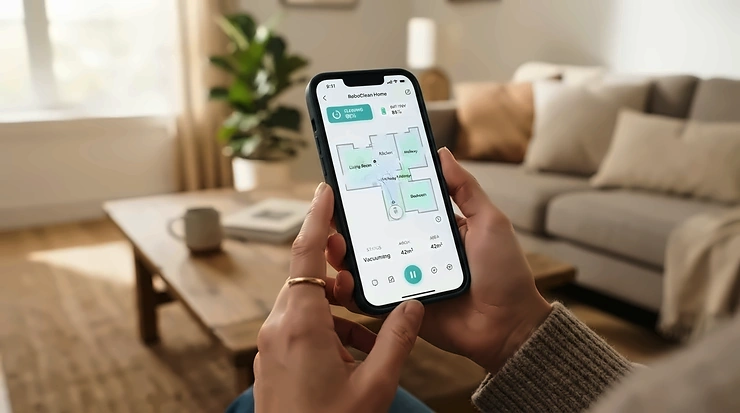
Somewhere in your house right now, there’s a build-up of crumbs, dog hair, or mystery fluff quietly plotting against you. The question is what you send in to deal with it. The robot vacuum vs upright vacuum debate isn’t really about which machine is “better” in some abstract sense — it’s about which one matches how you actually live, clean, and tolerate mess.
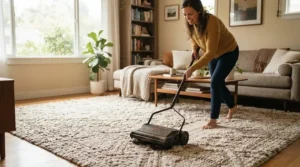
The vacuum cleaner itself has barely changed in basic principle for over a century, even as the machines built around that principle have diverged wildly. Uprights have been the default British cleaning tool since your nan’s Hoover Junior. They’re brute-force machines: point them at a carpet, push, and dirt disappears. Robot vacuums flip that logic entirely — they trade raw suction for autonomy, quietly patrolling your floors while you get on with your life. Neither approach is wrong, but picking the wrong one for your home means either an expensive dust-collecting gadget in the cupboard or a knackered back from lugging a 9kg machine up the stairs every week.
This guide leans on real, currently-available models from Roborock, Eufy, Shark, iRobot, Numatic and Gtech, with honest analysis of where each one earns its keep and where it quietly disappoints. We’ll cover suction power in plain English, what “deep clean” actually means versus daily maintenance, where cordless stick vacuums fit into all this, and — because nobody talks about it enough — what these machines really cost once you’ve bought filters, bags and replacement batteries for five years running. By the end you should know exactly which side of the robot vacuum vs upright vacuum split your household belongs on, and probably which specific model too.
Quick Comparison Table
| Vacuum | Type | Suction / Power | Best For | Price Range |
|---|---|---|---|---|
| Roborock Q7 M5 | Robot (vacuum + mop) | 10,000Pa | Budget-conscious first-time robot buyers | Under £200 |
| Eufy X10 Pro Omni | Robot (self-empty, mop wash/dry) | 8,000Pa | Hands-off maintenance cleaning | £750-£850 range |
| Shark Matrix Plus | Robot (self-emptying) | Mid-tier | Pet hair on carpet and hard floor | £450-£550 range |
| iRobot Roomba Combo 10 Max | Robot (premium vacuum + mop) | Premium-tier | Buyers who want the full ecosystem | £1,300-£1,400 range |
| Numatic Henry HVR200 | Cylinder (bagged, corded) | 620W | Reliable, no-nonsense deep cleaning | Around £100-£140 |
| Shark Stratos XL | Upright (corded, bagless) | 1400W-class | Heavy carpet and pet-hair households | £350-£450 range |
| Gtech AirRAM 3 | Cordless stick / upright | 140W, 20V battery | Quick daily touch-ups, small flats | £280-£400 range |
Looking at this table, the split is stark: the four robots trade motor power for automation and app control, while the Numatic Henry HVR200 and Shark Stratos XL trade convenience for the kind of raw suction only a mains-powered motor can deliver. The Gtech AirRAM 3 sits in the middle as a cordless stick option — genuinely upright in form, but built for speed rather than depth. If your floors see daily traffic from kids or pets, that suction gap matters more than any spec sheet number suggests, which is exactly what we unpack next.
Found this comparison useful so far? Save it or share it with anyone else stuck choosing between a robot and an upright — it might save them an expensive mistake.
Top 7 Vacuum Cleaners: Expert Analysis
We’ve deliberately mixed robot, cylinder, upright and cordless stick models here rather than picking seven robots or seven uprights, because the honest answer to “robot vacuum vs upright vacuum” usually involves owning one of each. Budget, mid-range and premium options are represented across both camps, so whichever way you’re leaning, there’s a real UK-available model to check against your own floors.
1. Roborock Q7 M5 — best budget robot with serious suction
The standout here is that a sub-£200 robot vacuum manages 10,000Pa of suction, a figure that used to be reserved for £600+ flagships just a couple of years ago. That number alone doesn’t tell the whole story, though — what matters is how it translates on the floor. Testing from Vacuum Wars ranked the Roborock Q7 M5‘s suction among the highest ever recorded for a robot in its price bracket, and it performed particularly well pulling fine debris out of carpet fibres, not just skating over hard floors like cheaper bump-and-run bots. Navigation is handled by spinning LiDAR rather than cheap infrared guesswork, so it builds an accurate room-by-room map on its first run and rarely gets stuck under sofas.
Who should buy this: first-time robot owners with a small-to-medium flat, mostly hard floors or low-pile carpet, and no strong feelings about mopping. Reviewers consistently note that the mopping function is the weak link — the fixed pad drags along the floor with no lift on carpet transitions, so your rugs can end up damp if you’re not careful with the app settings. On the plus side, the dock is compact enough to tuck into a corner without dominating the room, unlike the fridge-sized towers some flagship robots ship with.
Pros:
- ✅ Genuinely strong suction for the price bracket
- ✅ Accurate LiDAR mapping, rarely gets lost
- ✅ Compact dock that doesn’t dominate a room
Cons:
- ❌ Mopping can leave hard floors too wet
- ❌ No mop-lift, so carpets get damp mid-clean
At under £200, the Roborock Q7 M5 is one of the strongest value arguments in the entire robot vacuum vs upright vacuum debate — check the current price before deciding, since robot vacuum pricing shifts constantly around sales events.
2. Eufy X10 Pro Omni — best for hands-off maintenance cleaning
What most buyers overlook about self-emptying robots is that the headline feature isn’t the vacuum — it’s the dock. The Eufy X10 Pro Omni empties its own dustbin into a 2.5-litre bag good for roughly 30-60 days depending on pets, washes its own mop pads with clean water, and dries them with warm air afterwards so they don’t turn into a mildew smell factory. That’s the entire point of “maintenance cleaning” as a category: you interact with the machine once every month or two instead of daily.
At 8,000Pa, its raw suction sits a notch below the Roborock on paper, but Expert Reviews found it handled everyday debris, pet hair and even cupboard-overhang obstacles impressively well in real UK home testing, while flagging that it can struggle with tougher, more demanding test scenarios than the true £1,000+ flagships. Based on the spec comparison with pricier rivals like the Ecovacs Deebot T20 Omni, the X10 Pro Omni delivers roughly 80% of the flagship feature set for around half the price — a genuinely rare bit of value in this category.
Pros:
- ✅ Fully self-emptying, self-washing, self-drying dock
- ✅ AI obstacle avoidance handles cables and pet mess
- ✅ Strong value against £1,000+ flagship rivals
Cons:
- ❌ No spare parts included in the box
- ❌ Corners and edges can be missed while mopping
If daily maintenance cleaning is your priority over occasional deep cleans, the Eufy X10 Pro Omni is arguably the smartest single purchase on this list — prices fluctuate, so check current availability at the time of research.
3. Shark Matrix Plus — best for pet hair without the tangle drama
The dual anti-tangle brushroll is the standout feature here, and it’s not just marketing fluff. Long human hair and pet fur are the number one reason robot vacuums end up abandoned in a cupboard after six months, because standard brushrolls turn into hairballs that need scissors to untangle. The Shark Matrix Plus (model RV2620WAUK) pairs an anti-tangle roller with LiDAR-based navigation and a self-emptying dock, putting it squarely between the budget and premium tiers.
Independent testing from Expert Reviews rated it 3 out of 5, noting it performed competently but wasn’t a class leader against the very best in its price bracket. That honest middling score is actually useful information: this isn’t a machine that will dazzle you, but reviewers consistently flag its pet-hair handling as a genuine strength, which matters more than headline suction numbers if you share your home with a shedding animal.
Pros:
- ✅ Anti-tangle brushroll genuinely reduces hair wrap
- ✅ Self-emptying dock cuts down on manual maintenance
- ✅ LiDAR navigation avoids random bump-and-run cleaning
Cons:
- ❌ Not a class-leader on raw cleaning performance
- ❌ Mopping is a secondary feature, not a strength
For households with cats or dogs, the Shark Matrix Plus solves a specific, common annoyance rather than chasing every spec — around £500 at the time of research, though it’s worth checking current pricing before buying.
4. iRobot Roomba Combo 10 Max — best for buyers who want the full premium package
This is the vacuum for people who’ve decided robot cleaning is a permanent part of their routine and want the least fussy option available, whatever it costs. The iRobot Roomba Combo 10 Max combines vacuuming and mopping in one premium unit, rated 4 out of 5 by Expert Reviews’ testing programme, with a dock that handles emptying and cleaning duties with minimal owner intervention.
Here’s what the spec sheet won’t tell you, but user reports suggest: iRobot’s app and room-recognition software remain some of the most mature in the category, a legacy of being first to market with mapping robots over a decade ago. That maturity shows up in smaller, unglamorous ways — accurate no-go zone drawing, sensible scheduling, and fewer software update headaches than some newer Chinese brands still ironing out bugs. It’s worth noting iRobot’s manufacturer, iRobot Corporation, filed for Chapter 11 bankruptcy proceedings in the US in December 2025, with Chinese manufacturer Picea Robotics reportedly lined up to acquire the business — worth being aware of for warranty and long-term support peace of mind, even though existing UK stock and support channels remain active.
Pros:
- ✅ Mature, reliable app and mapping software
- ✅ Combined vacuum-and-mop in one premium unit
- ✅ Recommended rating in independent UK testing
Cons:
- ❌ Premium price puts it well above rival flagships
- ❌ Ownership uncertainty following iRobot’s 2025 bankruptcy filing
If budget isn’t the deciding factor, the iRobot Roomba Combo 10 Max remains one of the most polished robots you can currently buy — around £1,300-£1,400 at the time of writing, so do check the current price given how quickly this segment moves.
5. Numatic Henry HVR200 — best no-nonsense deep-clean workhorse
Britain’s favourite smiley-faced vacuum earns its spot here on reliability alone. The Numatic Henry HVR200 is a bagged cylinder vacuum with a 620W motor, 9-litre capacity, and a 10-metre power cord with rewind — numbers that sound modest next to Dyson marketing claims, but reviewers consistently note that Henry’s actual cleaning performance on carpets, hard floors and stairs punches well above its unglamorous spec sheet. TrustedReviews rated an equivalent Henry model highly specifically for value, reliability and all-surface performance, while flagging it’s less strong on pet hair pickup and heavier to carry up stairs than modern cordless alternatives.
Based on the spec comparison, Henry’s HEPA-standard filtration and bagged design matter more than people assume: bagged systems seal dust away when you change the bag, rather than releasing a cloud of allergens into the room the way emptying a bagless bin often does. For allergy sufferers or anyone who’s had enough of bagless dust clouds, that’s a genuine practical advantage rather than a nostalgia purchase.
Pros:
- ✅ Genuinely reliable, professional-grade build quality
- ✅ Bagged design contains dust and allergens on emptying
- ✅ Long cord and cleaning range reduce plug-swapping
Cons:
- ❌ Heavier and less nimble than cordless alternatives
- ❌ Weaker specifically on pet hair pickup
At around £100-£140, the Numatic Henry HVR200 remains one of the best value-for-money deep-clean machines on the UK market — check current stock and pricing, as availability varies by retailer.
6. Shark Stratos XL — best upright for heavy carpet and pet households
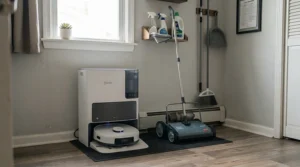
If cleaning power is your priority in the robot vacuum vs upright vacuum decision, this is where uprights still win outright. The Shark Stratos XL (model AZ3000UKT) combines DuoClean dual brush-rolls with Anti Hair Wrap Plus technology, meaning it tackles both carpet fibres and hard floors in the same pass without needing an attachment swap. Its extra-large dust cup — double the capacity of Shark’s standard models — means fewer empties during a big weekend clean.
Independent testing of the equivalent Shark Stratos Upright found it removed 98.9% of debris across all floor types tested, with only minor issues on sugar-fine particles on high-pile carpet. Mumsnet’s own testers compared it directly against a lightweight cordless model and confirmed what the spec sheet suggests: at 9.1kg it’s noticeably heavier and less manoeuvrable, but that weight buys genuinely superior deep-clean performance on carpets that no robot on this list can currently match.
Pros:
- ✅ Near-total debris removal across carpet and hard floor
- ✅ Anti Hair Wrap Plus handles long and pet hair well
- ✅ Extra-large dust cup means fewer mid-clean empties
Cons:
- ❌ Noticeably heavy and tiring on stairs
- ❌ Bulkier to store than cordless or robot alternatives
For anyone whose floors see serious daily wear from kids, pets or high-pile carpet, the Shark Stratos XL delivers deep-clean power robots simply can’t replicate yet — around £350-£450 range, so it’s worth comparing current prices across retailers.
7. Gtech AirRAM 3 — best British-designed cordless stick vacuum
Rounding out the list with a genuine cordless stick vacuum, the Gtech AirRAM 3 is designed, engineered and tested in the UK by a small British company that’s built a loyal following specifically because it isn’t Dyson. Its standout feature is the auto-cleaning filter, which removes the single most annoying maintenance task on most cordless vacuums — no more pulling out a filter to bash dust off it every few uses.
At 3.8kg with a 30-minute runtime and 0.8-litre bin, it’s genuinely lightweight enough to grab for a two-minute clean-up without the commitment an upright demands. TechRadar’s hands-on review scored it 4 out of 5 for value, noting its build quality and high-end materials justify the price “to some degree,” while being upfront that it lacks tool attachments and won’t out-muscle a corded upright on genuinely heavy carpet cleaning. What most buyers overlook is that the AirRAM’s design — weight concentrated low in the base — lets it stand upright unsupported, unlike most stick vacuums that topple over or need a wall-mounted dock.
Pros:
- ✅ Auto-cleaning filter removes a common maintenance chore
- ✅ Genuinely lightweight for quick daily touch-ups
- ✅ Stands upright unsupported, no dock needed
Cons:
- ❌ No tool attachments included in the box
- ❌ 30-minute runtime limits use in larger homes
For quick maintenance cleaning between deeper sessions, the Gtech AirRAM 3 is a strong, distinctly British alternative to the usual cordless suspects — around £280-£400 depending on retailer and current promotions.
Robot Vacuum Pros and Cons: The Honest Breakdown
Before you commit to either side of this comparison, it’s worth laying the robot vacuum pros and cons out plainly, without the marketing gloss. On the plus side: robots clean automatically on a schedule, meaning floors get attention daily rather than whenever you find the energy for a proper hoover. They’re genuinely good at maintenance cleaning — catching crumbs, light dust and loose pet hair before it accumulates into a bigger job. Self-emptying models like the Eufy X10 Pro Omni and iRobot Roomba Combo 10 Max cut manual intervention down to roughly once a month.
On the downside, no current robot vacuum matches a corded upright’s raw suction on deep-pile carpet, and every model on this list still struggles with cables, loose socks, and steps. Reviewers across the board flag mopping as the weakest feature category — robot mops smear rather than scrub, so ground-in stains still need a human with a bucket. Battery life caps single-session coverage, meaning larger homes may need multiple charging cycles to finish one full clean. There’s also the ongoing cost of replacement filters, brushes and dust bags for self-emptying stations, which we’ll return to in the total cost of ownership section below.
✨ Weighing up robot vacuum pros and cons for your own home? Compare the models above and check today’s prices before you decide.
Upright Vacuum vs Robot Cleaning Power: What the Suction Numbers Actually Mean
Suction figures get thrown around constantly, but a Pascal rating on its own tells you almost nothing useful. Robot vacuum manufacturers advertise Pa (pascals, a measure of vacuum pressure), while upright and cylinder manufacturers often quote watts (electrical power draw) or Air Watts (a combined measure of suction and airflow) — and these units aren’t directly comparable to each other.
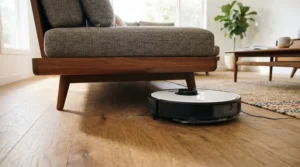
What actually determines upright vacuum vs robot cleaning power in practice is airflow combined with brush-roll agitation. A corded upright like the Shark Stratos XL uses a mains-powered motor that never needs to ration its energy, paired with an aggressive motorised brush-roll that physically beats dirt out of carpet fibres. A robot vacuum, by contrast, runs on battery power and typically uses a passive or lightly motorised roller, prioritising battery life over aggressive agitation. That’s precisely why independent testing consistently shows even a 10,000Pa robot like the Roborock Q7 M5 pulling less embedded debris out of thick carpet than a corded upright, despite the robot’s suction number looking more impressive on a spec sheet.
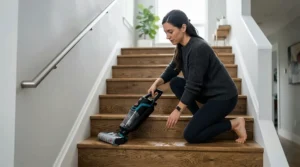
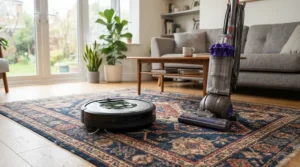
The practical takeaway: robots excel at surface-level maintenance on hard floors and low-pile carpet, while uprights and cylinders remain the tool of choice for genuine deep-clean jobs on thicker carpets, stairs and upholstery. If your home is mostly laminate and rugs, a robot alone might genuinely suffice. If you’ve got deep-pile carpet throughout, pairing a robot for daily maintenance with an occasional upright deep clean tends to be the honest answer.
Is a Robot Vacuum Worth It in 2026?
A robot vacuum is worth it if your main frustration is daily dust and light debris building up faster than you can be bothered to hoover — not if you’re hoping to replace deep carpet cleaning entirely. According to industry data, the UK robot vacuum market reached roughly £285 million in 2025, growing 23% year-on-year, and a Which? survey found 67% of robot vacuum owners now use their device daily, up sharply from 41% just a couple of years earlier.
That growth reflects genuine satisfaction rather than novelty spending: daily automated cleaning measurably reduces visible dust build-up between deeper cleans, which matters for busy households, pet owners and anyone with mobility concerns about pushing a heavy upright around. Where it isn’t worth it is as a sole cleaning solution in a home with thick carpets, multiple floors requiring stair-carrying, or serious pet-hair shedding that overwhelms a robot’s smaller dustbin within days. The honest answer for most UK households sitting on the fence: budget models like the Roborock Q7 M5 offer low-risk entry into daily automated cleaning without the four-figure commitment of a flagship, making the “is it worth it” question far easier to answer at under £200 than at £1,300.
Deep-Clean vs Maintenance Cleaning: Building a System That Works
Here’s a problem most buying guides skip entirely: deep-clean vs maintenance cleaning aren’t competing approaches, they’re two different jobs that need two different tools. Maintenance cleaning is the daily or every-other-day pass that stops mess accumulating — crumbs after dinner, a dusting of pollen by the door, cat hair drifting across the hallway. Deep cleaning is the occasional, more thorough session that lifts ground-in dirt, refreshes carpet pile, and tackles areas maintenance cleaning simply can’t reach with the same intensity.
Problem: Dust and pet hair build up daily, but a full hoover every day isn’t realistic for most households. Solution: Run a robot vacuum like the Shark Matrix Plus or Roborock Q7 M5 on a daily schedule for maintenance, freeing you from that constant low-level chore.
Problem: Ground-in dirt and deep carpet grime don’t respond to light daily passes. Solution: Schedule a weekly or fortnightly deep clean with a corded machine such as the Shark Stratos XL or Numatic Henry HVR200, which apply the agitation and suction robots can’t match.
Problem: Stairs remain a blind spot for every robot vacuum currently on the market. Solution: A lightweight cordless option like the Gtech AirRAM 3 bridges this gap without the bulk of a full upright.
Problem: Allergy sufferers need consistent removal, not occasional deep cleans months apart. Solution: Combine daily robot maintenance with weekly bagged-vacuum deep cleans — a system Allergy UK and the NHS’s own guidance on house dust mites both recommend as more effective than either approach alone.
Treating these as complementary rather than competing tools is the single biggest mindset shift that makes either purchase actually pay off.
Real-World Scenarios: Matching the Vacuum to Your Household
The busy family with two kids and a Labrador: Daily mess, constant pet hair, and genuinely no time for a full hoover most evenings. Best fit: a self-emptying robot such as the Eufy X10 Pro Omni for daily maintenance, backed by a weekly deep clean with the Shark Stratos XL to handle the pet hair and ground-in mud a robot’s smaller motor can’t fully lift.
The student in a small rented flat: Limited storage, budget-conscious, mostly hard floors and a couple of rugs. Best fit: the Gtech AirRAM 3 covers quick daily touch-ups without needing a dedicated cupboard, and it’s light enough to carry up narrow rented-flat staircases without complaint.
The retired couple prioritising convenience over cost: Less physical capacity for lugging a heavy upright, happy to invest upfront for genuine hands-off cleaning. Best fit: the iRobot Roomba Combo 10 Max or Roborock Q7 M5 depending on budget, since both minimise the physical effort involved in day-to-day floor care while still delivering respectable results.
Cordless Stick Vacuums: Where They Fit Between Robot and Upright
Cordless stick vacuums like the Gtech AirRAM 3 occupy a genuinely useful middle ground that often gets ignored in a straight robot-versus-upright framing. They’re manually operated, so you get more control and immediate agitation than a robot, but they’re lighter and quicker to deploy than a corded upright — no cord to find a socket for, no bag or bin the size of a small dustbin to lug around.
The trade-off is runtime and capacity: most cordless sticks, the AirRAM 3 included, cap out around 30 minutes on a single charge with a sub-litre bin, meaning they’re built for quick jobs rather than whole-house deep cleans. AO floorcare expert Katie Lilywhite’s advice, echoed across independent UK testing, is that cordless models are best positioned as the “quick clean” tool in a household’s arsenal rather than a sole replacement for either a robot’s daily automation or an upright’s deep-clean power. If you’re weighing up a third option beyond robot vacuum vs upright vacuum, a cordless stick genuinely earns its place as backup rather than headline act.
Total Cost of Ownership: Robot vs Upright vs Stick Over Five Years
Purchase price is only the opening bid. Total cost of ownership is where the robot vacuum vs upright vacuum decision often flips, because ongoing costs vary wildly between categories.
| Cost Factor | Robot (e.g. Eufy X10 Pro Omni) | Corded Upright (e.g. Shark Stratos XL) | Cordless Stick (e.g. Gtech AirRAM 3) |
|---|---|---|---|
| Upfront price | £750-£850 range | £350-£450 range | £280-£400 range |
| Consumables (annual) | Dust bags, filters, mop pads | Bags (if bagged) or filters | Replacement battery every 2-3 years |
| Repair/part availability | Brand-dependent, app updates needed | Widely available parts | Battery cost can be significant |
| Typical lifespan | 4-6 years | 8-12 years+ | 4-6 years |
Looking at this comparison, corded uprights and bagged cylinders like the Numatic Henry HVR200 tend to win on total cost of ownership simply because they last longer and their consumables are cheap and universally stocked. Robot vacuums carry a higher ongoing cost through proprietary dust bags, replacement brushes, and eventual battery degradation, while cordless sticks face a similar battery-replacement bill on a shorter overall lifespan. None of this means robots are a bad investment — the time saved has genuine value — but anyone budgeting strictly by pounds-per-year should weigh a £1,300 robot’s five-year running costs against a £120 Henry’s near-negligible ones before assuming the robot is automatically the smarter long-term buy.
How to Choose Between a Robot Vacuum and an Upright Vacuum
Which?’s independent buying guide is a useful cross-check against any single review, since it pools test results across dozens of models rather than relying on one brand’s marketing claims. With that in mind, here’s a practical framework for the decision itself:
- Assess your flooring first. Mostly hard floors and low-pile rugs favour robots; thick or high-pile carpet throughout favours a corded upright or cylinder.
- Be honest about your available time. If daily hoovering genuinely won’t happen, a scheduled robot solves that specific problem better than any upright ever will.
- Factor in pets realistically. Heavy shedding breeds benefit from anti-tangle robot brushrolls for daily upkeep, but still need a proper upright pass weekly.
- Check your storage space. Robots need permanent dock real estate; uprights need a cupboard; cordless sticks need almost nothing.
- Set a total budget, not just a purchase price. Use the total cost of ownership figures above rather than comparing sticker prices alone.
- Consider your stairs. No robot currently climbs stairs, so multi-storey homes need at least one manual option regardless of robot ownership.
- Decide if you need both. Many UK households increasingly own a robot for maintenance and a corded machine for deep cleans — this guide’s whole comparison table exists because that combination is often the honest answer.
Common Mistakes When Buying a Robot or Upright Vacuum
The most common mistake is buying purely on suction figures without checking whether they’re even comparable — Pa and watts measure different things, as covered earlier, so a “10,000Pa” robot isn’t automatically stronger than a “1400W” upright. A close second: assuming a cheap robot vacuum will handle thick carpet and heavy pet shedding as well as premium models, then feeling let down when it doesn’t — cheaper models genuinely do less, and reviewers are consistent about this across brands.
Buyers also frequently underestimate maintenance requirements, particularly with self-emptying robot docks that still need dust bags, filter washing, and occasional brush-roll untangling despite the marketing implying total hands-off operation. On the upright side, a common oversight is ignoring weight and manoeuvrability entirely — a machine that performs brilliantly in a lab test but is genuinely painful to carry upstairs weekly will end up gathering dust in a cupboard just as fast as an underpowered robot would.
Safety, Allergies and Regulations: What UK Buyers Should Know
For allergy sufferers, filtration matters more than almost any other spec on this list. NHS-published guidance on house dust mites recommends regular vacuuming with a high-filtration machine as one of the most effective ways to reduce allergen exposure in the home, alongside damp-dusting and washing bedding at high temperatures. Bagged systems like the Numatic Henry HVR200 contain dust more effectively at emptying time than bagless bins, which can release a visible dust cloud back into the room.
On the regulatory side, all UK-sold vacuum cleaners must carry UKCA (or CE, during the current transition period) marking confirming electrical safety compliance, and end-of-life disposal falls under the Waste Electrical and Electronic Equipment (WEEE) regulations. Under official WEEE regulations guidance, retailers selling a new vacuum are required to offer a free take-back scheme for your old one, so there’s no excuse for binning a broken Shark Stratos XL or worn-out robot vacuum with general household waste — most councils and retailers will recycle it responsibly instead.
Practical Usage Guide: Getting the Most from Day One
Whichever side of the robot vacuum vs upright vacuum decision you land on, the first month sets the tone for the machine’s whole lifespan. For robot vacuums: run the initial mapping pass with doors open and cables tidied away, since a messy first scan means permanently confused navigation afterwards. Set a genuine daily or every-other-day schedule immediately rather than running it ad hoc — reviewers consistently note that robots left on manual triggering get used less and less over time. Empty and wash the dustbin or self-empty bag on the recommended cycle even if it looks fine, since odour and bacterial build-up happens invisibly.
For corded uprights and cylinders, the single biggest first-month mistake is ignoring the filter until suction visibly drops — by then, performance has already been quietly declining for weeks. Wash or replace filters on schedule (check the manual for HEPA-specific washing instructions), and empty bagless bins before they’re completely full, since suction drops sharply well before a bin looks “full” to the eye. For any vacuum, keeping the brush-roll free of wrapped hair is the cheapest, most effective maintenance habit going — a pair of scissors and two minutes weekly saves genuine money on motor strain over the machine’s lifetime.
Frequently Asked Questions
❓ Can a robot vacuum fully replace an upright vacuum?
❓ How often should I deep clean if I already own a robot vacuum?
❓ Is a cordless stick vacuum powerful enough as a main vacuum?
❓ Do robot vacuums work well on stairs?
❓ What's cheaper long-term, a robot or an upright vacuum?
Conclusion
The robot vacuum vs upright vacuum question rarely has a single winner, and honestly, that’s good news — it means you’re not locked into one imperfect compromise. If your home leans hard floors and light carpet with a busy schedule, a robot like the Roborock Q7 M5 or Eufy X10 Pro Omni solves the daily maintenance problem better than any human habit ever will. If you’re dealing with thick carpet, serious pet shedding, or need genuine deep-clean power on demand, the Shark Stratos XL or the endearingly indestructible Numatic Henry HVR200 remain hard to beat. And if you just need something fast for quick touch-ups between proper cleans, the Gtech AirRAM 3 covers that gap neatly.
Increasingly, the smartest UK households aren’t choosing sides at all — they’re running a budget robot for daily upkeep and keeping a reliable corded machine in the cupboard for the deep cleans robots simply can’t do yet. Whichever combination suits your floors, your pets and your patience, check current prices before buying, since availability and promotions on all seven of these models shift regularly.
✨ Ready to stop debating and start cleaning?
Browse today’s prices on any of the seven picks above and pick the one that actually matches how you live — not just how the spec sheet reads! 🧹
Recommended for You
- Robot Vacuum for Small Flats: 7 Best Picks for UK Homes (2026)
- Quietest Robot Vacuum 2026: 7 Whisper-Quiet Picks Tested
- Robot Vacuum for Hard Floors: 7 Best Picks Tested for 2026
Disclaimer: This article contains affiliate links. As an Amazon Associate, I earn from qualifying purchases. If you purchase products through these links, we may earn a small commission at no additional cost to you.
✨ Found this helpful? Share it with your friends! 💬🤗
