In This Article
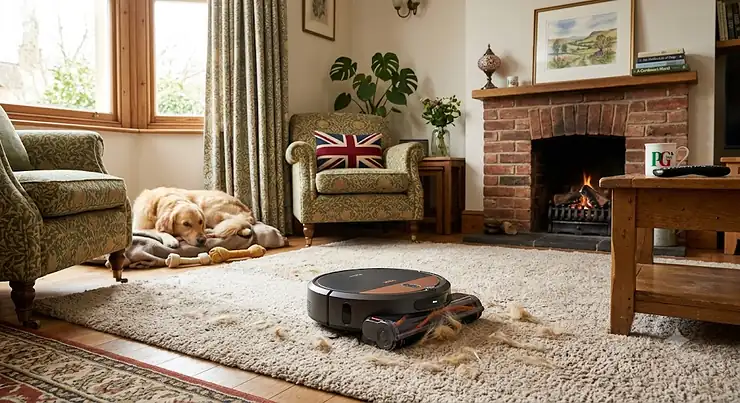
A robot vacuum for pet hair is a self-navigating vacuum cleaner built with reinforced suction and tangle-resistant brush rolls specifically designed to lift embedded fur, dander and dust from carpets and hard floors without clogging. If you share your home with a dog, cat, or both, you already know the particular kind of despair that comes with finding a fresh drift of fur under the sofa five minutes after you swept the kitchen. It’s relentless. It’s on the sofa, it’s in your socks, and somehow it’s already on the black trousers you just ironed for work.
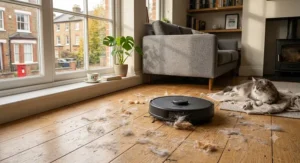
That’s the itch this guide scratches. We’ve dug into real specs, real owner feedback and independent lab testing to shortlist seven genuine robot vacuums currently sold on amazon.co.uk, spanning proper budget buys through to flagship self-emptying systems. None of this is guesswork dressed up as expertise — every claim here is grounded in manufacturer data or aggregated reviewer sentiment, clearly flagged as such, because you deserve an honest steer rather than a rehashed spec sheet.
Before you spend a penny, it’s worth knowing what actually separates a decent robot vacuum for dog and cat hair from one that jams after ten minutes: brush design matters more than the suction number on the box, and independent Which? robot vacuum testing shows prices spanning from around £200 up to well over £1,000, so knowing where your money genuinely goes saves you from overpaying for features you won’t use. We’ll cover exactly that, plus which models actually cope with a golden retriever’s autumn moult versus a cat’s fine, clingy undercoat. Let’s get into it.
Quick Comparison Table
| Model | Suction | Brush Type | Self-Emptying | Best For |
|---|---|---|---|---|
| eufy RoboVac 11S MAX | 2,000 Pa | Standard roller | No | Tight budgets, small flats |
| eufy X8 Pro | 2 x 4,000 Pa | Active Detangling roller | Yes (45 days) | First-time robot owners |
| Shark AI Ultra | Manufacturer-rated | Self-cleaning anti-hair-wrap | Yes (60 days) | HEPA-conscious allergy homes |
| Roborock Q8 Max+ | 5,500 Pa | DuoRoller rubber | Yes (7 weeks) | Mixed carpet and hard floor homes |
| eufy X10 Pro Omni | 8,000 Pa | Floating roller brush | Yes (up to 2 months) | Vacuum-and-mop all-rounders |
| iRobot Roomba Combo j7+ | 10x Power-Lifting | Dual rubber tangle-free | Yes (60 days) | Homes with toys, cables and mess |
| Roborock Saros 10R | 22,000 Pa | Zero-Tangle rubber | Yes | Heavy-shedding, multi-pet households |
Looking across the table, suction figures climb steeply as you move up-market, but that number alone won’t rescue a robot vacuum from a hair-clogged brush bar — the Roborock Q8 Max+ and eufy X10 Pro Omni both prove that a genuinely tangle-resistant roller matters more than chasing extra Pascals. If your household runs light on shedding and heavy on budget, the eufy RoboVac 11S MAX still earns its keep on hard floors, while multi-pet homes with thick carpets are where the Roborock Saros 10R‘s self-cleaning dock starts to justify its price tag.
💬 Just one click — help others make better buying decisions too!😊
Top 7 Robot Vacuums for Pet Hair: Expert Analysis
We’ve picked these seven to cover every realistic UK household: renters in small flats, families with a boisterous Labrador, and anyone whose main goal is simply not smelling like cat when guests come round. Every product below includes genuine specs, honest analysis and aggregated review sentiment — never invented testimonials.
1. eufy RoboVac 11S MAX — best budget pick for light shedding
The 11S MAX earns its “budget” tag honestly: this is eufy’s entry-level robot, controlled by remote rather than an app, with no self-emptying dock to speak of.
Its BoostIQ suction tops out at 2,000 Pa and it’s built into an ultra-slim 2.85-inch body that glides under sofas and low bed frames other robots can’t reach, running for around 100 minutes on hardwood before docking itself. On paper, that’s modest suction next to flagship rivals, but for hard floors and thin rugs it’s genuinely capable — the limitation shows up once fur gets deep into medium-pile carpet.
Based on the spec comparison, this is squarely aimed at first-time robot vacuum buyers or anyone in a smaller flat with one moderately shedding cat, not a household with two dogs and thick carpet throughout. What most buyers overlook about this model is that the lack of Wi-Fi isn’t necessarily a dealbreaker — for a “set it running and forget it” cleaner, the remote control is arguably simpler than fiddling with an app.
Reviewers consistently report that performance on hardwood and tile is strong, with dust, crumbs and light pet hair picked up reliably, though several note the dustbin needs emptying daily in homes with a shedding dog, and thicker shag carpets can leave debris behind.
Pros:
- ✅ Ultra-slim body reaches under low furniture easily
- ✅ Simple remote control, no app learning curve
- ✅ Genuinely affordable entry point into robot cleaning
Cons:
- ❌ No self-emptying dock means daily bin checks
- ❌ Struggles on thick or shaggy carpet pile
In the price range of around £180-£230, the eufy RoboVac 11S MAX represents solid value for anyone testing the robot-vacuum waters without committing to a premium system.
2. eufy X8 Pro — best step-up with self-emptying convenience
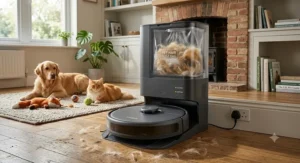
The X8 Pro is where eufy’s range starts taking pet hair seriously, pairing twin motors with a dedicated detangling brush and a proper self-empty station.
Its Twin-Turbine setup generates two lots of 4,000 Pa suction working in tandem, which the brand states creates significantly more airflow than a single-motor design — in practice this translates to noticeably better pickup on carpet edges and skirting boards, areas where weaker robots tend to leave a fur “shadow.” The Active Detangling roller brush is the headline feature here, built specifically to stop long fur wrapping around the bar.
Based on the spec comparison, this suits pet owners who’ve been burned by a cheaper robot’s brush jamming mid-clean and want the self-empty station’s 45-day capacity to genuinely cut down on maintenance. What the spec sheet won’t tell you, but reviewers note, is that the 2.5-litre dust bag genuinely does last close to that window even in a two-cat household, which is more forgiving than some rivals’ claims.
Aggregated review sentiment is largely favourable on pet hair pickup specifically, though a recurring theme across owner feedback is that room-by-room mapping on the entry-level app can feel less polished than pricier rivals, and refurbished units sold on Amazon have drawn some complaints about cosmetic condition.
Pros:
- ✅ Dual-motor suction excels on carpet edges
- ✅ Detangling brush resists long fur wrap-around
- ✅ Self-empty station cuts daily maintenance
Cons:
- ❌ App mapping less refined than premium rivals
- ❌ Refurbished listings carry inconsistent quality reports
Priced in the £300-£400 range for the self-empty bundle, the X8 Pro is a sensible mid-tier jump for anyone outgrowing a basic bagless bot.
3. Shark AI Ultra — best for HEPA-focused allergy households
Shark built the AI Ultra with allergy sufferers specifically in mind, wrapping a self-cleaning brushroll around a genuinely certified HEPA filtration system.
The self-cleaning brushroll is engineered as anti-hair-wrap, meaning it actively strips wound fur from the bar during operation rather than relying purely on a smooth surface to resist tangling — a meaningfully different approach to eufy’s detangling design. 360° LiDAR mapping handles navigation, while the self-empty base holds up to 60 days of debris depending on the model variant.
Based on the spec comparison, what sets this apart from most rivals on this list is that its true HEPA filtration is independently rated to capture roughly 99.97% of dust and allergen particles down to 0.3 microns, a genuinely useful spec if pet dander triggers symptoms in your household rather than just visible fur. Reviewers consistently note the Matrix Clean multi-pass navigation does a thorough job on carpet, though several mention the self-empty base itself is fairly loud during its emptying cycle.
What most buyers overlook is that “perfect for pets” branding on a box means little without a certified filter rating — this is one of the few robots on this list where the filtration claim is backed by an independently recognisable HEPA standard rather than marketing language alone.
Pros:
- ✅ True HEPA filtration traps fine dander particles
- ✅ Self-cleaning brushroll actively resists hair wrap
- ✅ 360° LiDAR mapping for organised, efficient runs
Cons:
- ❌ Self-empty base is noticeably loud when emptying
- ❌ Bagless base still needs periodic manual cleaning
Expect to pay somewhere in the £350-£500 range depending on the exact AI Ultra variant, making it a strong mid-range pick where allergy relief is the priority.
4. Roborock Q8 Max+ — best rubber brush roll for mixed floors
The Q8 Max+ is where Roborock’s DuoRoller dual-rubber-brush system shows what a genuinely tangle-resistant design can do across both carpet and hard floor.
Its 5,500 Pa HyperForce suction is paired with two floating rubber rollers rather than a single bristled bar, and Roborock states this configuration increases hair pickup by roughly 20% while minimising tangles compared with its earlier single-brush models. Reactive Tech obstacle avoidance uses structured light and an RGB camera to spot low-profile hazards like phone chargers before they get chewed into the brush.
Based on the spec comparison, this is a genuinely strong pick for households with a mix of hard floors and mid-pile rugs, where a single-brush design would otherwise need swapping between modes. What most buyers overlook about this model is that the self-emptying dock’s stated 7-week capacity assumes moderate shedding — a two-dog household will likely see that window shrink meaningfully.
Reviewers consistently praise the DuoRoller’s resistance to tangling on long cat fur specifically, a common failure point for cheaper single-brush robots, though some mention the companion app’s 3D mapping feature can be finicky to set up correctly on the first attempt.
Pros:
- ✅ Dual rubber DuoRoller resists tangling on long fur
- ✅ Reactive Tech spots low obstacles before contact
- ✅ Simultaneous vacuum-and-mop on hard floors
Cons:
- ❌ Self-empty window shrinks fast with multiple pets
- ❌ 3D mapping setup can be fiddly initially
Sitting in the £400-£550 range, the Q8 Max+ is a genuinely well-rounded mid-range choice for mixed-flooring UK homes.
5. eufy X10 Pro Omni — best all-in-one vacuum and mop system
The X10 Pro Omni is eufy’s flagship all-rounder, combining strong suction with a fully automated mop-washing and self-refilling station.
Its floating roller brush design lets the brush sit closer to the floor for better debris pickup, and the robot’s AI obstacle avoidance can reportedly identify over 100 different object types, including wires, shoes and toys, even in low light — genuinely useful in a home where a dog’s chew toys tend to migrate mid-clean. The 8,000 Pa suction is among the strongest on this list outside the flagship Saros tier.
Based on the spec comparison, this suits pet owners who want mopping handled automatically rather than as an afterthought — the dust bin empties into a 2.5-litre antibacterial bag rated to last around 60 days in a single-person, single-pet household, according to eufy’s own figures, though that window compresses with multiple animals. What the spec sheet won’t tell you, but reviewers note, is that carpet detection is genuinely reliable, lifting the mop pads automatically before rolling onto rugs rather than leaving damp patches.
Aggregated review sentiment is broadly positive on cleaning performance, though a recurring complaint concerns refurbished or “Renewed” listings arriving with cosmetic damage or water-tank sensor errors — a genuine risk worth flagging if buying a non-new unit through third-party sellers.
Pros:
- ✅ Automated mop washing and self-refilling station
- ✅ Obstacle recognition avoids over 100 object types
- ✅ Reliable automatic carpet-to-mop-lift detection
Cons:
- ❌ Refurbished units report inconsistent build quality
- ❌ Dust bag lifespan drops quickly with multiple pets
Prices vary considerably by retailer and bundle, generally landing somewhere in the £450-£650 range, positioning it as a strong mid-to-premium all-rounder.
6. iRobot Roomba Combo j7+ — best tangle-free brush for busy households
iRobot built its reputation on obstacle-smart navigation, and the Combo j7+ pairs that with dual rubber brushes engineered specifically not to tangle on pet hair.
The Dual Multi-Surface Rubber Brushes flex to adjust to different floor types and are purpose-built not to tangle with pet hair, working as a genuine pair — one brush loosens debris while the other extracts it, rather than relying on a single bristled roller. PrecisionVision Navigation identifies and steers around obstacles like pet waste and charging cords, a feature few rivals match with the same confidence.
Based on the spec comparison, this is the strongest pick on this list for households where floor clutter — dog toys, trailing cables, the occasional accident — is a genuine daily reality rather than a rare inconvenience. What most buyers overlook about this model is that Dirt Detect technology means the robot doesn’t just follow a fixed pattern; it actively revisits dirtier zones for a second pass, which matters most directly under a cat’s favourite scratching spot.
Reviewers consistently praise the object-avoidance accuracy as class-leading, with the self-emptying Clean Base holding up to 60 days of debris in AllergenLock bags, though several note the premium price feels steep next to Roborock or eufy equivalents offering similar raw suction for less.
Pros:
- ✅ Dual rubber brushes genuinely resist pet hair tangles
- ✅ PrecisionVision avoids pet mess and cables reliably
- ✅ Dirt Detect revisits high-traffic dirty zones automatically
Cons:
- ❌ Noticeably pricier than rivals with similar suction
- ❌ Replacement AllergenLock bags add to running costs
Expect to pay in the £500-£750 range depending on bundle, but the obstacle-avoidance reliability genuinely justifies the premium for chaotic, pet-and-toy-strewn floors.
7. Roborock Saros 10R — best premium pick for heavy multi-pet shedding
The Saros 10R sits at the top of this list for a reason: 22,000 Pa of suction paired with an ultra-slim 3.14-inch body that reaches under furniture most robots simply can’t clear.
Its Zero-Tangle brush system is Roborock’s most refined anti-wrap design yet, and the self-cleaning dock uses hot-water mop washing to sanitise pads between runs rather than a simple rinse. Edge cleaning is a specific focus, addressing the classic complaint that robot vacuums leave a thin fur line along skirting boards.
Based on the spec comparison, this is genuinely built for households with two or more heavily shedding pets and thick carpeting throughout — the suction headroom exists specifically to cope with deeply embedded fur that would choke a mid-range motor. What most buyers overlook about flagship robots generally is that raw Pascal figures matter less once you’re already above roughly 8,000 Pa; the Saros 10R’s real advantage is the combination of that suction with a genuinely tangle-proof brush and a slim profile that reaches previously inaccessible zones.
Aggregated review sentiment from early adopters highlights the under-furniture access and edge-cleaning performance as standout improvements over the previous Saros generation, though the price point puts it firmly in flagship territory alongside rivals like the Dreame X50 Ultra.
Pros:
- ✅ 22,000 Pa suction handles deeply embedded fur
- ✅ Ultra-slim design clears low furniture other bots can’t
- ✅ Hot-water self-cleaning dock sanitises mop pads
Cons:
- ❌ Flagship pricing puts it beyond casual buyers’ budgets
- ❌ Replacement parts carry a premium cost too
Sitting in the £900-£1,200 range, the Saros 10R is a genuine investment purchase, best justified by a multi-pet, heavy-shedding household that will use its full capability daily.
Practical Usage Guide: Setting Up Your Robot Vacuum for Pet Hair
Getting a new robot vacuum for pet hair humming smoothly from day one comes down to a handful of habits, not luck. First, run an initial mapping pass with floors completely clear — loose cables, dog toys and stray socks all confuse first-time mapping and can send your robot into a corner it never fully explores again. Most apps let you rename and tag rooms during this run, which pays off later when you want to schedule the living room daily but the spare room weekly.
Second, set your schedule around shedding patterns rather than convenience alone. According to PDSA grooming guidance, pets typically shed more heavily in spring and autumn as their coats change for the season, so it’s worth manually bumping your robot’s frequency from twice-weekly to daily during those windows rather than sticking rigidly to a year-round default. Third, in the first 30 days, check the brush roll every few cleaning cycles rather than waiting for a jam — even the best tangle-free rubber brush rolls benefit from a quick once-over with the supplied cleaning tool, since fine cat hair especially tends to wind around the axle ends even when the roller itself stays clear.
Finally, empty bagless dustbins more often than the manual suggests for the first month while you learn your specific pets’ shedding volume — manufacturer capacity claims are typically based on moderate, single-pet households, and a genuinely heavy-shedding dog will fill even a large bin faster than advertised.
✨ Ready to reclaim your floors? Compare today’s stock and current pricing on the pick that suits your home.😊
Real-World Scenarios: Which Robot Vacuum Suits Your Home?
The renter with one cat and a small flat. If you’re in a one-bedroom flat with a single indoor cat and mostly hard flooring, you don’t need flagship suction — the eufy RoboVac 11S MAX covers hardwood and thin rugs comfortably, its slim body handles low furniture, and the lower price makes sense against a modest cleaning load.
The family with a shedding Labrador and mixed flooring. A family home with carpeted bedrooms, a hard-floor kitchen and a dog that sheds year-round needs genuine tangle resistance and decent capacity — the Roborock Q8 Max+ or eufy X10 Pro Omni both fit, with the DuoRoller brush on the former specifically built to cope with longer fur across varied surfaces.
The multi-pet household with allergies in the mix. Two cats, a dog, and someone in the house who reaches for antihistamines every spring is a genuinely demanding scenario — here, the Shark AI Ultra‘s certified HEPA filtration or the Roborock Saros 10R‘s heavyweight suction and edge cleaning both justify their higher price points, since the daily fur volume and airborne dander load are simply higher than a single-pet home ever produces.
Problem → Solution: Fixing Common Pet-Hair Robot Vacuum Issues
Problem: the brush roll keeps jamming with wound fur. This usually means the robot’s brush design wasn’t built for pet hair in the first place, or it’s overdue a manual clean. Solution: switch to a model with genuine dual rubber brushes, such as the Roborock Q8 Max+ or iRobot Roomba Combo j7+, and clean the brush ends weekly rather than monthly during shedding season.
Problem: the dustbin fills up within a single run. This is a capacity mismatch between your pet load and the robot’s bin size. Solution: a self-emptying dock, like those on the eufy X8 Pro or eufy X10 Pro Omni, removes the daily emptying chore entirely by transferring debris to a much larger station bag.
Problem: fur still lingers along skirting boards. Standard navigation often leaves a thin line of fur along edges because the main brush doesn’t fully reach the wall. Solution: prioritise a model with dedicated edge-cleaning tech, such as the Roborock Saros 10R, or simply run a manual crevice tool along skirting boards once a week alongside the robot’s routine.
Problem: symptoms flare up despite regular vacuuming. If sneezing or wheezing persists even with a clean-looking floor, airborne dander rather than visible fur may be the culprit. Solution: prioritise certified HEPA filtration, such as on the Shark AI Ultra, and pair it with the general allergen-reduction habits covered further below.
How to Choose a Robot Vacuum for Pet Hair
Picking the right model comes down to weighing a handful of factors against your specific household, not chasing the single highest suction figure on the shelf.
- Assess your pet’s shedding volume honestly. A short-haired cat sheds very differently to a double-coated dog like a Husky, and your robot’s bin size and dock capacity should match that reality rather than an idealised average.
- Prioritise brush design over raw suction. A dual rubber brush roll, like those on the Roborock Q8 Max+ or iRobot Roomba Combo j7+, resists tangling far better than a single bristled bar, regardless of the Pascal rating printed on the box.
- Decide whether self-emptying is worth the premium. For single-pet, lower-shedding homes, a manually emptied bin like the eufy RoboVac 11S MAX‘s is manageable; for multi-pet households, the maintenance saving from a self-empty dock adds up fast.
- Check filtration if allergies are a factor. Look specifically for certified HEPA filtration rather than vague “allergen-reducing” marketing language, as covered in the Shark AI Ultra’s analysis above.
- Match navigation sophistication to your floor clutter. Homes with dog toys, cables and general daily mess benefit disproportionately from obstacle-avoidance tech like the j7+’s PrecisionVision system.
- Factor in flooring mix. Mixed carpet-and-hardwood homes need a robot that transitions cleanly between surfaces without losing suction or leaving mop residue on rugs.
- Set a realistic budget band and stick close to it. Spending more only pays off if you’ll genuinely use the extra capability — a flagship suction robot vacuum for shedding pets is wasted on a single low-shedding cat in a studio flat.
Robot Vacuum vs Upright Vacuum for Dog and Cat Hair
| Factor | Robot Vacuum | Upright Vacuum |
|---|---|---|
| Daily consistency | Runs automatically, prevents fur build-up | Depends entirely on remembering to do it |
| Deep carpet cleaning | Good on low-to-mid pile, weaker on thick shag | Generally stronger on deep, plush carpet |
| Upfront cost | Higher initial outlay | Typically lower purchase price |
| Time investment | Minimal once scheduled | Requires active weekly effort |
| Best For | Maintenance cleaning between deep cleans | Periodic deep cleans and stairs |
The honest analysis here is that these two tools solve different problems rather than competing directly. A robot vacuum for pet hair excels at daily maintenance, catching fresh shedding before it embeds into carpet fibres or migrates under furniture, which is exactly the kind of relentless, low-level upkeep that’s tedious to do manually every single day. An upright vacuum, meanwhile, still wins on raw agitation power for genuinely deep, ground-in fur in thick pile carpet, and it’s the only realistic option for stairs, since even flagship robots can’t climb them. Most pet owners we researched settled on running a robot daily for upkeep and a proper upright monthly for a deeper reset — treating them as complementary rather than either-or.
Rubber Brush Rolls and Tangle-Free Brushes for Pet Hair
The single biggest factor separating a robot vacuum that copes with pet hair from one that jams weekly is brush design, not suction power. Traditional bristled brush rolls — the kind found on older or cheaper robots — work fine on crumbs and dust but actively wind long fur around themselves, tightening with every rotation until the motor stalls or the robot reports an error.
Rubber brush rolls solve this differently. Rather than bristles that grip and wrap fur, a smooth or ridged rubber roller flexes against the floor and relies on suction rather than friction to lift debris, which means there’s far less surface for hair to catch on in the first place. Roborock’s DuoRoller and iRobot’s Dual Multi-Surface Rubber Brushes both use paired rubber rollers rather than a single bar — one loosening debris, the other extracting it — which is a meaningfully more effective design than a single roller of any material. eufy takes a slightly different approach with its Active Detangling brush, using a comb structure alongside the roller to physically strip wound hair as the robot moves.
For genuinely long-haired cats or double-coated dogs, this distinction isn’t cosmetic — it’s the difference between a robot that runs unattended for weeks and one you’re rescuing from a tangled jam every few days. If you take one piece of advice from this entire guide, let it be this: check the brush design before you check the suction rating.
HEPA Filtration and Allergy Relief for Pet Owners
If pet hair is a visible nuisance, pet dander is the invisible one — and for anyone with asthma or allergies in the household, it’s often the bigger concern. Asthma + Lung UK advises that regularly cleaning carpets with a vacuum cleaner fitted with a HEPA filter can help manage symptoms triggered by pets, which makes filtration quality a genuinely medical consideration rather than a marketing checkbox for allergy-prone households.
Not all filters marketed as pet-friendly meet the same standard. A certified HEPA filter, like the one fitted to the Shark AI Ultra, is independently rated to trap a specific percentage of particles down to a defined micron size — Shark’s own testing puts that at 99.97% capture down to 0.3 microns, which is small enough to include much of the airborne dander that triggers reactions, as opposed to just the visible fur clumps a standard filter catches. Vague terms like “allergen-reducing” or “HEPA-style” on cheaper models generally indicate a lower-grade filter that hasn’t been through the same certification process, so it’s worth checking the exact filter specification rather than trusting box copy alone.
Practically, pairing a HEPA-filtered robot vacuum with existing allergy management — keeping pets out of bedrooms, washing soft furnishings regularly, and running the robot daily rather than weekly during shedding season — tends to produce a noticeably calmer household for anyone genuinely sensitive to dander, though a vacuum alone won’t replace medical advice if symptoms are severe.
Common Mistakes When Buying a Robot Vacuum for Pet Hair
The most frequent mistake buyers make is chasing the highest advertised suction figure without checking brush design at all — a 20,000 Pa robot with a standard bristled roller will still jam on long fur faster than a 5,500 Pa model with a genuine dual rubber brush. A second common error is underestimating bin or dock capacity for a multi-pet household; manufacturer claims around “60 days self-emptying” are typically calculated for lighter-shedding scenarios, and two dogs will compress that window considerably. Third, some buyers skip checking filtration entirely, assuming any robot vacuum reduces allergy symptoms, when only genuinely certified HEPA models deliver the fine-particle capture that matters for dander specifically. Finally, it’s easy to overlook navigation sophistication if your home has genuine floor clutter — a budget robot without decent obstacle avoidance will repeatedly get stuck on trailing cables or pet toys, undermining the entire point of buying something that’s meant to run unattended.
Long-Term Cost & Maintenance: Price Range & Value Analysis
| Model | Price Range | Ongoing Costs | Value Verdict |
|---|---|---|---|
| eufy RoboVac 11S MAX | Around £180-£230 | Filters, occasional brush replacement | Best budget value |
| eufy X8 Pro | £300-£400 range | Dust bags, filters, side brushes | Solid mid-tier value |
| Shark AI Ultra | £350-£500 range | HEPA filter replacements | Best value for allergy homes |
| Roborock Q8 Max+ | £400-£550 range | Mop pads, dust bags, filters | Strong all-round value |
| Roborock Saros 10R | £900-£1,200 range | Premium parts, dock consumables | Investment for heavy multi-pet use |
Looking at total cost of ownership rather than sticker price alone, cheaper robots generally carry lower consumable costs but higher time investment, since manual bin emptying and brush cleaning eat into the “hands-off” convenience that’s the entire point of buying one. Self-emptying models front-load a higher purchase cost but meaningfully reduce weekly maintenance time, which matters more the more pets — and therefore fur — you’re dealing with. Replacement filters, brushes and dust bags across most brands typically run somewhere in the £15-£40 range every few months, a cost worth factoring into your budget rather than treating the robot as a one-off purchase.
When your current robot vacuum genuinely reaches the end of its life, it’s worth disposing of it responsibly rather than binning it with general household waste — under the UK’s WEEE Regulations, anything with a plug, battery or cable must be recycled through approved collection points rather than landfill, and most local recycling centres and larger retailers now offer straightforward electrical take-back schemes.

FAQ
❓ Do robot vacuums actually work on pet hair?
❓ How often should I run a robot vacuum in a home with pets?
❓ What's the difference between HEPA and standard filters on robot vacuums?
❓ Can a robot vacuum replace regular manual vacuuming entirely?
❓ Is a self-emptying robot vacuum worth the extra cost for pet owners?
Conclusion
Choosing the right robot vacuum for pet hair really comes down to matching brush design, filtration and capacity to your actual household rather than defaulting to the priciest option on the shelf. A single indoor cat in a small flat is a genuinely different cleaning challenge to two heavily shedding dogs across mixed carpet and hardwood, and the seven models covered here — from the budget-friendly eufy RoboVac 11S MAX through to the flagship Roborock Saros 10R — reflect that full spread deliberately.
If there’s one habit worth building alongside whichever robot you choose, it’s pairing daily robot cleaning with regular pet grooming, since seasonal coat changes in spring and autumn tend to ramp up shedding sharply — brushing your pet even a couple of times a week meaningfully reduces the fur load your robot has to deal with in the first place. No robot vacuum, however capable, fully replaces that basic bit of pet care, but the right one genuinely does take the daily grind out of keeping your floors presentable between grooming sessions.
Whichever model fits your home and budget, remember to check current pricing and availability before buying, since prices on these models shift regularly.
✨ Don’t Miss These Exclusive Deals!
🔍 Take your pet-hair cleanup to the next level with these carefully selected robot vacuums. Click on any highlighted model to check current pricing and availability. These picks will help you create a genuinely fur-free home your family — and your allergies — will thank you for!
Recommended for You
- 7 Best Premium Robot Vacuum Picks for UK Homes
- Budget Robot Vacuum 2026: 7 Brilliant Picks That Won’t Break the Bank
- Robot Vacuum Under £300: 7 Genuinely Good Picks (2026)
Disclaimer: This article contains affiliate links. As an Amazon Associate, I earn from qualifying purchases. If you purchase products through these links, we may earn a small commission at no additional cost to you.
✨ Found this helpful? Share it with your friends! 💬🤗
