In This Article
Here’s a confession most cleaning blogs won’t make: hard floors are deceptively hard to keep clean. Carpet hides its sins. Wood, tile and laminate broadcast every crumb, dog hair and coffee splash under a downlight like it’s auditioning for a crime scene photo. That’s precisely why a robot vacuum for hard floors has become less of a gadget-shelf novelty and more of a genuine household fixture for British homes with wooden hallways, tiled kitchens and laminate-floored flats.
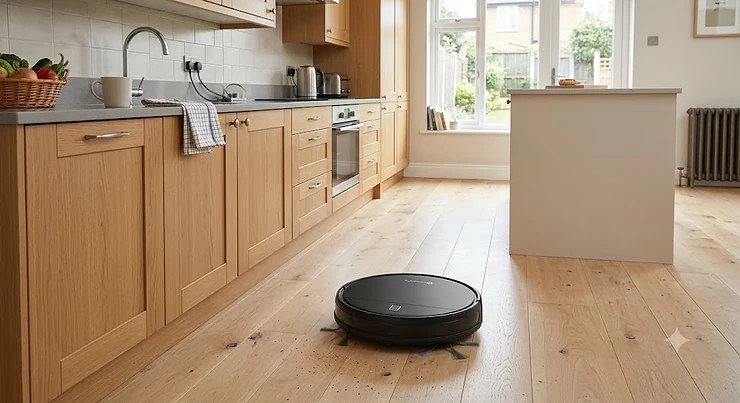
A robot vacuum for hard floors is a self-navigating cleaning robot built (or specifically tuned) to lift fine dust, hair and debris from wood, tile, vinyl and laminate, often pairing suction with a mopping function to wipe away marks in the same pass. Unlike a general carpet-focused model, the better hard-floor units prioritise edge reach, gentle wheels that won’t mark delicate finishes, and filtration fine enough to trap the dust that settles into skirting-board corners and floorboard gaps.
We’ve spent time digging through real specifications, aggregated review sentiment and independent lab testing — the category itself has an interesting backstory, covered in this overview of robotic vacuum cleaners — to shortlist seven genuine products across budget, mid-range and premium price bands, all available through amazon.co.uk. This isn’t a rewritten spec sheet. Every product below comes with honest commentary on who it actually suits, where it falls short, and what the marketing copy conveniently leaves out.
If you’ve got a Victorian terrace with awkward door thresholds, a new-build flat with wall-to-wall laminate, or a kitchen where the dog’s water bowl seems to generate its own weather system, there’s a sensible pick here for you. Let’s get into it.
Quick Comparison Table
| Model | Suction | Mop System | Best For |
|---|---|---|---|
| Eufy RoboVac 11S (Slim) | 2,000Pa | None (vacuum only) | Tightest budgets, low-clearance furniture |
| Lefant M210 Pro | Mid-range | None (vacuum only) | Small flats, quietest daily runs |
| Shark Matrix Plus | Strong | Sonic vibrating pad | HEPA-conscious households |
| Ecovacs Deebot T20 Omni | High | Hot-water spinning mop | Mixed hard floor + occasional rugs |
| iRobot Roomba Plus 405 Combo | High | Dual spinning pads | Brand-loyal buyers, pet hair |
| Dreame L10s Ultra Gen 2 | Very high | MopExtend edge mop | Skirting boards and tight corners |
| Roborock Qrevo Curv | Flagship-level | Hot-water spinning mop | Whole-home mixed flooring |
Looking at the spread above, the gap between the Eufy RoboVac 11S and the Roborock Qrevo Curv isn’t just price — it’s what each robot is actually built to solve. The budget end trades self-emptying docks and mopping for simplicity and a low profile that slides under sofas. The premium end automates almost everything except deciding when to switch the thing on in the first place, but you’re paying handsomely for that hands-off convenience.
💬 Found a pick that fits your floors already? Jump straight to it below — your future self, free of Sunday-morning mopping, will thank you.
Top 7 Robot Vacuums for Hard Floors: Expert Analysis
1. Eufy RoboVac 11S (Slim) — best lightweight budget pick
At just 7.2cm tall, the standout feature of the Eufy RoboVac 11S is how easily it slides under low furniture that stops bulkier robots dead in their tracks. It runs a straightforward 2,000Pa suction motor with Eufy’s BoostIQ system, which automatically ramps up power the moment it senses it’s moved from hard floor onto a rug edge — a small but genuinely useful trick at this price point. There’s no mopping function and no companion self-empty dock, so this is a pure vacuuming robot rather than an all-in-one system.
Based on the spec comparison, this is squarely a first-robot buy: ideal for renters, studio flats, or anyone testing whether robot vacuuming actually suits their routine before committing to a flagship. Reviewers consistently report it handles fine dust and everyday debris on hard floors well, but struggles once it hits medium or thick-pile carpet, which tracks with its modest suction rating. What most buyers overlook is the maintenance side — long hair reportedly tangles in the brush roll fairly easily, though Eufy ships a cutting tool specifically for this.
Pros:
- ✅ Ultra-slim body reaches under sofas and low units
- ✅ BoostIQ auto-adjusts suction on carpet edges
- ✅ Quiet operation, reportedly around 55 decibels
Cons:
- ❌ No mopping function at all
- ❌ Hair tangles in the brush roll over time
At the time of research, the Eufy RoboVac 11S typically sits in the £130-£190 range, and pricing swings hard around sales events, so it’s worth checking the current price before buying. For a no-frills hard-floor cleaner that won’t scuff furniture legs, it’s solid value.
2. Lefant M210 Pro — quietest option for small flats
The Lefant M210 Pro‘s standout trait is how unobtrusively it runs — genuinely low noise for its class, which matters more than people expect when you’re working from a home office fifteen feet away. It offers six cleaning modes and around 120 minutes of runtime, which comfortably covers a one or two-bedroom flat before it needs to return to its dock.
Here’s what the spec sheet won’t tell you, but user reports suggest: this is a vacuum-only robot without navigation-grade LiDAR, so it cleans in a more randomised bounce-and-turn pattern rather than mapping the room methodically. That’s not a dealbreaker in a small, largely open-plan flat, but it becomes noticeably less efficient in larger or more partitioned homes. This is a lesser-known but genuinely capable alternative to the bigger brands for anyone who mainly needs light daily upkeep rather than a deep weekly clean.
Pros:
- ✅ Notably quiet for a budget robot vacuum
- ✅ Six cleaning modes for different mess levels
- ✅ Slim, low profile for under-furniture access
Cons:
- ❌ No LiDAR mapping, so coverage is less methodical
- ❌ No mop function included
Price-wise, expect somewhere around the £120-£160 range at the time of research. Given the quiet running and decent runtime, it’s a reasonable value pick for smaller hard-floor homes rather than sprawling houses.
3. Shark Matrix Plus — best sonic mopping under mid-range money
The Shark Matrix Plus (model AV2610WA) leads with its sonic vibrating mop pad, which oscillates rapidly rather than just dragging a damp cloth around — the standout feature that separates it from cheaper mop-bolt-on robots. It pairs this with 360° LiDAR home mapping, a CleanEdge mode aimed specifically at skirting boards and room edges, and a HEPA-filtered 60-day self-empty base.
Based on the spec comparison, sonic mopping tends to lift dried-on marks (think spilled juice, muddy paw prints) more effectively than simple back-and-forth pad dragging, because the vibration works like a mini scrubbing brush rather than a wipe. Reviewers consistently note the self-cleaning brushroll as a genuine time-saver for pet owners, since it’s one of the more common complaints about rival robots at this price. What most buyers overlook is that CleanEdge mode, while effective, does add noticeably to total cleaning time when run on every cycle.
Pros:
- ✅ Sonic mopping tackles dried marks better than pad-drag mops
- ✅ HEPA filtration in the 60-day self-empty base
- ✅ Dedicated CleanEdge mode for skirting boards
Cons:
- ❌ CleanEdge mode extends total cleaning time
- ❌ Mop pad needs manual washing between uses on tougher jobs
At the time of research, the Shark Matrix Plus typically sits in the £300-£400 range. For households wanting proper edge and allergen-conscious cleaning without flagship pricing, it earns its place in the mid-tier.
4. Ecovacs Deebot T20 Omni — best hot-water mop washing dock
The Ecovacs Deebot T20 Omni‘s standout feature is genuinely hygienic maintenance: its dock washes the spinning mop pads in hot water rather than cold, which matters more than it sounds. On paper this means less lingering bacterial odour building up in the mop pads between cleans — a common complaint with cold-water or no-wash rival docks. It also lifts the mop pads automatically when it senses carpet or rugs, avoiding the soggy-carpet problem that plagued earlier generations of mopping robots.
This model has been rated as a strong hard-floor performer by independent UK tech press, and reviewers consistently praise the trustworthy room mapping and the combined vacuum-and-mop pass, which suits households with a genuine mix of tile, wood and the odd hallway rug. What the spec sheet won’t tell you, but user reports suggest, is that the app experience can feel a touch fiddly when first setting no-go zones — budget half an hour for initial setup rather than five minutes.
Pros:
- ✅ Hot-water mop pad washing reduces lingering odour
- ✅ Auto mop-lift when carpet or rugs are detected
- ✅ Strong, independently reviewed hard-floor performance
Cons:
- ❌ App setup and zone-mapping can feel fiddly at first
- ❌ Dock is bulkier than vacuum-only alternatives
Prices for the Ecovacs Deebot T20 Omni have been seen anywhere from the mid-£400s up toward £600, so it’s genuinely worth comparing the current price against recent promotional pricing before buying — this is one of the models that tends to see meaningful seasonal discounts.
5. iRobot Roomba Plus 405 Combo — best-known brand with an AutoWash dock
For sheer brand recognition, the iRobot Roomba Plus 405 Combo is probably the name your parents already know. Its standout feature is the AutoWash dock with dual spinning mop pads, which self-empties the dustbin for up to roughly 75 days and handles pad washing and drying without user intervention. Smart and fast mapping is aimed squarely at pet hair pickup and everyday debris on hard floors and low-pile rugs alike.
Here’s the honest bit the marketing won’t lead with: iRobot filed for Chapter 11 bankruptcy protection in the US in December 2025, with reported plans for Chinese manufacturer Picea Robotics to acquire the business. That doesn’t mean existing stock stops working, but based on the spec comparison alone, buyers weighing long-term app support, firmware updates and warranty servicing should factor in this ownership transition before committing, particularly compared with financially stable rivals in this list. Reviewers consistently rate the cleaning performance itself as competent rather than category-leading at this price band.
Pros:
- ✅ AutoWash dock handles pad washing and drying automatically
- ✅ Recognisable brand with widely available accessories
- ✅ Strong pet hair pickup on hard floors
Cons:
- ❌ Ongoing company ownership transition adds long-term support uncertainty
- ❌ Not class-leading on obstacle avoidance versus newer rivals
Expect a price somewhere in the £400-£550 range at the time of research. It’s a sensible pick if brand familiarity and parts availability matter more to you than bleeding-edge navigation tech.
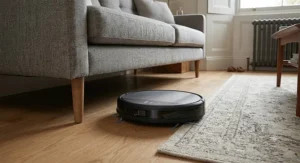
6. Dreame L10s Ultra Gen 2 — best edge-reaching MopExtend system
The Dreame L10s Ultra Gen 2 stands out for its MopExtend technology, which physically pushes the mop pad outward toward skirting boards and furniture legs — Dreame claims meaningfully wider edge coverage than a fixed mop position, and independent testers have specifically called out its edge and corner performance as a strength. It runs 10,000Pa Vormax suction, a floating rubber main brush designed to resist hair wrap, and a self-emptying, self-refilling base rated for up to roughly 75 days between manual top-ups.
Based on the spec comparison, that combination of higher suction and an extending mop head genuinely does address one of the most common hard-floor gripes: the strip of grime that collects exactly where the floor meets the wall, which fixed-mop robots routinely miss. Reviewers consistently note strong value for the feature set relative to some flagship-priced rivals, though a small volume of feedback flags the dock as slightly noisy during self-cleaning cycles — worth running scheduled cleans outside of quiet hours if that would bother you.
Pros:
- ✅ MopExtend pushes the mop toward skirting boards and edges
- ✅ 10,000Pa Vormax suction with anti-tangle rubber brush
- ✅ Self-empty and self-refill base up to ~75 days
Cons:
- ❌ Dock can be noisy during self-cleaning cycles
- ❌ Consumables (solution, dust bags) add to running costs
At the time of research, pricing has been seen roughly in the £400-£500 range, though as with most Dreame models it’s worth checking current pricing directly, since regional and promotional pricing shifts fairly often.
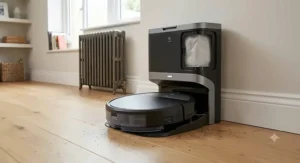
7. Roborock Qrevo Curv — best all-round flagship for mixed flooring
The Roborock Qrevo Curv‘s standout feature is its AdaptiLift Chassis — an industry-first design that can independently raise the whole robot by 10mm or lift individual corners, letting it glide over door thresholds and transition smoothly between hard floor and rugs without getting stuck or dragging weight unevenly across delicate finishes. Suction sits at 18,500Pa HyperForce, paired with a DuoDivide main brush and a FlexiArm arc-shaped side brush that physically extends to sweep along skirting boards and into corners.
On paper this means Roborock is targeting the two biggest hard-floor pain points at once: awkward thresholds between rooms, and the edges that ordinary round robots simply glide past. What most buyers overlook is the anti-tangle engineering behind that side brush — it’s SGS and TÜV certified specifically for reducing hair entanglement, which reviewers consistently flag as a genuine improvement over older Roborock generations rather than just marketing language. The dock washes mop pads in hot water at up to 75°C and dries them automatically, addressing the same lingering-odour issue mopping robots have historically struggled with.
Pros:
- ✅ AdaptiLift Chassis smooths transitions across mixed flooring
- ✅ FlexiArm side brush extends for genuine edge cleaning
- ✅ Hot-water (75°C) mop washing and auto-drying dock
Cons:
- ❌ Premium price puts it out of reach for casual buyers
- ❌ Dock footprint needs a reasonably clear utility space
At the time of research, the Roborock Qrevo Curv has typically sat somewhere in the £650-£850 range, though flagship Roborock pricing moves noticeably around Black Friday and Prime Day, so it’s genuinely worth timing a purchase around one of those windows if you can.
Practical Usage Guide: Setup, First 30 Days & Maintenance
Getting a robot vacuum for hard floors properly dialled in takes more than unboxing it and pressing go. In the first week, run the mapping pass during daylight with as few obstacles as possible — cables, loose rugs and pet toys all confuse early scans, and a messy first map means messy no-go zones for weeks afterward. Set virtual walls around stairs, cat litter trays and anything trailing (phone chargers are the classic culprit) before your first unattended run.
For maintenance, treat the brush roll and side brushes as weekly, not monthly, tasks — hair and thread wrap far faster on hard floors than most owners expect, since there’s no carpet pile to comb debris loose along the way. Wash mop pads after every couple of uses if your model doesn’t self-clean, and empty dustbins before they’re genuinely full rather than waiting for the app to nag you, since suction noticeably drops once a bin is around 80% full. A common first-month mistake is leaving furniture legs and low shelving unmapped, which leads to repeated bumping and, over months, small scuffs on delicate wood finishes — a five-minute walk-through with the app’s no-go zone tool solves this permanently.
Filters deserve their own note. Rinse or replace HEPA filters roughly every four to six weeks depending on usage and any pets in the home; a clogged filter doesn’t just reduce suction, it can push fine dust straight back into the air rather than trapping it — precisely the opposite of what you bought a filtered robot vacuum to do.
Real-World Scenarios: Who Actually Needs This
The new-build flat owner with wall-to-wall laminate: if your entire floor plan is one continuous laminate run with minimal furniture clutter, a robot vacuum for wood floors with strong mapping (like the Roborock Qrevo Curv or Dreame L10s Ultra Gen 2) will run near-flawlessly, since there’s little for it to get stuck on. Budget models like the Eufy RoboVac 11S genuinely suffice here too, since navigation complexity is low.
The Victorian terrace with tile-to-carpet transitions: older UK homes often mix a tiled hallway, wood-floored reception rooms and carpeted stairs, with high door thresholds between them. Here, chassis flexibility matters more than raw suction — the Roborock Qrevo Curv‘s AdaptiLift design or the Dreame L10s Ultra Gen 2‘s edge-focused mopping earn their higher price tags by handling these transitions without getting stuck or leaving mop-shaped avoidance gaps near the threshold strips.
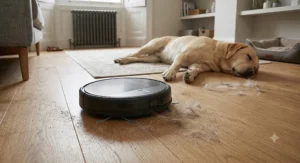
The pet-owning family in a mid-size semi: shedding fur on tile and laminate is a daily, not weekly, problem. The iRobot Roomba Plus 405 Combo and Shark Matrix Plus both lean into self-cleaning brushrolls specifically to reduce the hair-wrap maintenance burden, and their longer self-empty cycles (up to roughly 60-75 days) mean less manual bin-emptying during busy weeks.
How to Choose a Robot Vacuum for Hard Floors
- Check suction rating against your actual mess, not the marketing number. Fine dust and pet hair on hard floors don’t need 20,000Pa — most genuine hard-floor performance differences show up in brush design and edge reach, not raw Pascal figures.
- Prioritise wheel and chassis design over headline suction. A gentle wheel robot vacuum hardwood owners can trust won’t drag its full weight unevenly across a finish when turning; look for soft, wide wheels or an adaptive chassis rather than small hard casters.
- Confirm genuine edge-cleaning brushes, not just a side brush. Extending or arm-style side brushes that physically reach toward skirting boards outperform fixed brushes by a noticeable margin on real-world edge debris.
- Look for HEPA-grade fine dust filtration if anyone in the household has allergies. Standard filters miss the smallest particles that trigger dust-related symptoms — filtration quality is covered in more depth further down.
- Decide honestly whether you want mopping at all. A mop adds cost, consumables and maintenance; if your hard floors rarely see wet mess, a vacuum-only model like the Eufy RoboVac 11S may be the more sensible spend.
- Factor in dock footprint and noise. Self-emptying and mop-washing docks are genuinely convenient but take up real utility space and can be audible during cleaning cycles — check where you’d realistically put one before buying.
- Weigh brand stability alongside features. As the iRobot Roomba Plus 405 Combo entry above shows, ownership changes can affect long-term firmware support, so it’s worth a quick search on a brand’s current standing before a premium purchase.
Robot Vacuum for Wood Floors vs Tile and Laminate: What Actually Changes
It’s tempting to assume any robot vacuum for hard floors performs identically across wood, tile and laminate, but the honest analysis is more nuanced. On wood floors — particularly older, softer or oiled finishes — the wheel and brush material genuinely matters: overly firm plastic wheels or aggressive rotating brush bristles can, over months of daily use, leave faint scuff marks, which is why gentle wheel and scratch-safe wheel design gets called out specifically for hardwood-focused models rather than tile-focused ones.
Tile and laminate are more forgiving of wheel hardness but introduce a different problem: grout lines and laminate seams trap fine dust and crumbs that a robot’s suction alone can miss on a single pass, especially on textured or embossed laminate finishes. This is where sonic or hot-water mopping systems, like those on the Shark Matrix Plus and Roborock Qrevo Curv, earn their keep — the scrubbing action lifts debris settled into seams that a dry pass alone leaves behind. Reviewers consistently note that mop-equipped robots noticeably outperform vacuum-only models specifically on tiled kitchen floors, where cooking splatter dries into a stubborn film rather than loose dust.
The practical takeaway: if your home is predominantly original or engineered wood, weight softer wheels and gentler brush design more heavily in your decision. If it’s mostly tile or laminate, prioritise mopping quality and edge reach instead. For a broader sense of how these systems are independently ranked, TechRadar’s ongoing robot vacuum testing is a useful reference point alongside the analysis here.
Gentle Wheels and Scratch-Safe Design for Hardwood Floors
This is the feature category most buyers skip past on a spec sheet, and it’s arguably the one that matters most for anyone protecting an expensive engineered or solid wood floor. A genuinely gentle wheel robot vacuum hardwood owners can trust typically uses wider, softer rubber-compound wheels rather than narrow hard plastic ones, distributing the robot’s weight across a larger contact area and reducing point-pressure marks during turns.
Scratch-safe wheels go a step further by using a compound specifically chosen to avoid transferring residue or micro-scratches onto sealed or oiled wood finishes, something reviewers occasionally flag as a problem with cheaper, unbranded budget robots that use hard, narrow caster wheels. The Roborock Qrevo Curv‘s AdaptiLift Chassis takes a mechanical approach to the same problem: rather than just softer wheels, it actively lifts sections of the robot’s body to change how weight is distributed when crossing thresholds or turning sharply, which on paper should reduce drag-related marking even further, though independent long-term wear testing on this specific mechanism is still relatively limited.
If protecting a specific finish is your top priority, it’s worth checking manufacturer documentation for wheel material specifics directly, since this level of detail isn’t always volunteered upfront in general marketing copy — and asking a retailer’s customer service team before buying is a perfectly reasonable extra step for an expensive floor.
Fine Dust Filtration and Allergy-Friendly Cleaning
Hard floors have a reputation as the allergy-friendly flooring choice, largely because they don’t trap allergens the way deep carpet pile can. But that reputation only holds up if the vacuum cleaning them actually captures fine dust rather than redistributing it into the air. This is where fine dust filtration — specifically HEPA-grade filtration — becomes a genuine differentiator rather than a marketing checkbox.
According to Asthma + Lung UK’s guidance on indoor allergens, vacuum cleaners fitted with HEPA filters trap more house dust mite allergen than standard filters, and the charity specifically recommends weekly vacuuming as part of managing dust-related symptoms at home. For a robot vacuum running that schedule automatically, filter quality genuinely compounds in importance — a robot doing five short passes a week with a low-grade filter may stir up more fine particulate than a human doing one thorough pass with a proper HEPA unit.
Among the models covered here, the Shark Matrix Plus and Roborock Qrevo Curv both specify HEPA filtration paired with sealed dust compartments, which matters particularly during the self-empty process — a poorly sealed dock can puff dust back out exactly when the bin empties. If allergy management is a genuine household priority, treat filtration quality as at least as important as suction figures when comparing models, and commit to the filter-cleaning schedule outlined in the maintenance section above; even the best HEPA filter stops working properly once it’s clogged.
Edge-Cleaning Brushes Explained
Round robot vacuums have one structural weakness that no amount of suction fixes: their shape. A perfectly circular chassis physically cannot reach into a 90-degree corner, which is exactly why edge-cleaning brushes exist as a dedicated feature rather than an afterthought. The better implementations, like the Roborock Qrevo Curv‘s FlexiArm and the Dreame L10s Ultra Gen 2‘s MopExtend system, use a brush or mop pad that mechanically extends outward from the robot’s body specifically when it detects it’s running alongside a wall or skirting board.
What most buyers overlook is that a spinning side brush alone — the kind fitted to almost every robot vacuum regardless of price — only sweeps debris a few centimetres inward toward the main brush; it doesn’t actually lift the dust that’s settled directly against the skirting board itself. That’s the specific gap that extending edge systems and dedicated modes like the Shark Matrix Plus‘s CleanEdge are designed to close. If skirting-board grime is a recurring irritation in your home — and on hard floors, it usually is — treat this as a genuine buying criterion rather than a nice-to-have footnote.
Robot Vacuum vs Traditional Vacuum for Hard Floors: Benefits Comparison
| Factor | Robot Vacuum | Traditional/Upright Vacuum |
|---|---|---|
| Daily upkeep | Automated, scheduled runs | Manual effort each time |
| Edge & corner reach | Depends on brush design | Generally better with attachments |
| Mopping | Available on combo models | Requires separate mop |
| Deep, thorough clean | Good for maintenance, not deep grime | Better for occasional deep cleans |
| Ongoing cost | Consumables, filters, mop solution | Bags/filters, less frequent |
The comparison above makes the trade-off fairly clear: a robot vacuum for hard floors excels at frequent, low-effort maintenance cleaning that keeps dust and hair from accumulating in the first place, while a traditional upright or corded vacuum still wins for occasional deep cleans, tight attachment work, and rooms genuinely encrusted with ground-in grime. Most households we’d honestly recommend this setup to end up using both — a robot for the daily grind, and a proper upright or stick vacuum every few weeks for the deeper pass a robot can’t fully replicate.
✨ Don’t Miss These Exclusive Deals!
🔍 Take your hard-floor cleaning routine to the next level with the picks above. Click through on any highlighted model to check current pricing and availability — these are genuinely capable tools for keeping wood, tile and laminate spotless without the Sunday-morning mop marathon.
Common Mistakes When Buying a Robot Vacuum for Hard Floors
A surprisingly common mistake is buying based purely on suction figures without checking wheel and brush design, which as covered above matters more for hardwood protection than raw Pascals. Another is skipping no-go zone setup entirely, then blaming the robot’s navigation when it repeatedly bumps into the same table leg — most modern models handle this well once properly configured, but almost none handle it well straight out of the box with zero setup.
Underestimating mop pad and filter maintenance is a third frequent misstep; a robot vacuum left to mop with a genuinely dirty pad is, in practical terms, redistributing grime rather than removing it. Finally, many buyers ignore dock footprint and noise until after purchase — a self-emptying, mop-washing dock is a genuinely useful piece of kit, but it needs a sensible, ventilated spot near a plug socket, and running one at 11pm in an open-plan flat is a mistake you’ll only make once.
Long-Term Cost, Maintenance & Safe Disposal
Total cost of ownership for a robot vacuum for hard floors extends well beyond the sticker price. Budget models like the Eufy RoboVac 11S and Lefant M210 Pro have minimal ongoing costs — occasional replacement brushes and filters, typically a modest spend per year. Mop-equipped models add cleaning solution, dust bags for the self-empty dock, and more frequent mop pad replacement, which can add a meaningful amount annually on top of the purchase price, particularly for the Roborock Qrevo Curv and Ecovacs Deebot T20 Omni.
When a robot vacuum eventually reaches the end of its working life — batteries in these units typically degrade over several years of daily charging cycles — it shouldn’t go in general household waste. Under UK law, electrical items including robot vacuums fall under the Waste Electrical and Electronic Equipment regulations, and GOV.UK’s guidance on WEEE collection confirms retailers and local recycling points are required to offer take-back or collection options for exactly this kind of item. Most local recycling centres accept small electricals free of charge, and many retailers offer a trade-in or take-back scheme when you buy a replacement, so it’s worth checking before simply binning an old unit.
Frequently Asked Questions
❓ Is a robot vacuum actually good enough for hard floors, or is it just for carpet touch-ups?
❓ Do robot vacuums scratch hardwood floors?
❓ What's the difference between a robot vacuum for wood floors and one for tile and laminate?
❓ How often should I clean the filter on a robot vacuum for allergy purposes?
❓ Are edge-cleaning brushes worth paying extra for?
Conclusion
Choosing the right robot vacuum for hard floors comes down to being honest about your own home rather than chasing the highest suction number on the box. If you’re in a small flat with straightforward laminate throughout, the Eufy RoboVac 11S or Lefant M210 Pro will do the job without overspending. If your household deals with genuine spills, pet mess or mixed tile-and-wood layouts, the mopping and edge-reaching systems on the Ecovacs Deebot T20 Omni, Dreame L10s Ultra Gen 2 or Roborock Qrevo Curv justify their higher price tags with features that solve real, specific problems rather than just adding numbers to a spec sheet.
Whichever you choose, prioritise wheel design and filtration alongside suction, set up no-go zones properly in the first week, and keep on top of brush and filter maintenance — the difference between a robot vacuum that quietly earns its keep and one gathering dust in a cupboard usually comes down to those unglamorous basics rather than the headline features.
✨ Ready to Reclaim Your Weekends?
🔍 Compare today’s prices on the picks above and find the robot vacuum for hard floors that actually fits your home, your floors and your budget.
Recommended for You
- Robot Vacuum for Carpets: 7 Powerful Picks for 2026
- Robot Vacuum For Pet Hair: 7 Tested UK Picks (2026)
- 7 Best Premium Robot Vacuum Picks for UK Homes
Disclaimer: This article contains affiliate links. As an Amazon Associate, I earn from qualifying purchases. If you purchase products through these links, we may earn a small commission at no additional cost to you.
✨ Found this helpful? Share it with your friends! 💬🤗
