
In This Article
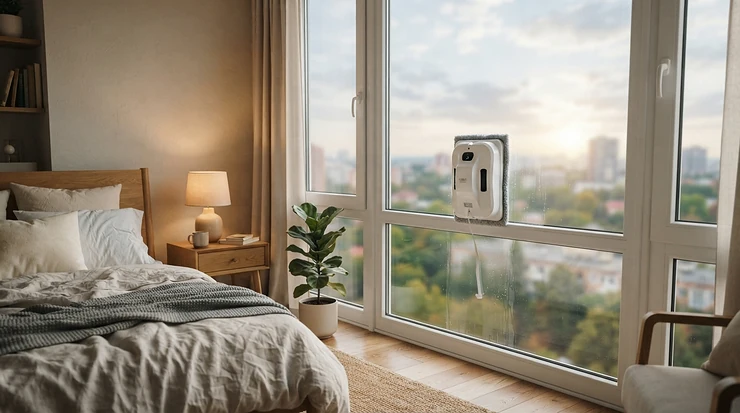
A robot window cleaner for high-rise flats is a compact, suction-gripping machine that crawls across glass on its own, spraying and wiping as it goes. A safety rope and backup battery stop it dropping if the power or the seal fails. Think of it as a cautious, tethered spider that does the squeegee work, so you don’t lean out of a window on the 14th floor.

That last point matters. Anyone living above the fifth floor knows the problem. The inside of the glass is fine, the outside looks like a bus shelter, and the only people who can reach it are rope-access crews on a service-charge timetable. Ladders are a non-starter at that height. That’s why a robot window cleaner for high-rise flats has gone from gimmick to a genuine household option.
Now the honest bit. Which? says in its guide to robot window cleaners that it hasn’t tested them itself, so there’s no neutral British lab benchmark to lean on. Everything below comes from manufacturer specifications, published hands-on reviews and aggregated owner feedback, and I flag it where the evidence is thin. I haven’t used any of these machines, and I won’t pretend otherwise.
You’ll get seven real models from budget to premium. You’ll also get the things listings skip: leasehold safety considerations, window ledge compatibility, what a remote monitoring app really does, and what a window robot for apartment high floors can and can’t achieve. Prices are ranges only, so check current price before buying.
Robot Window Cleaner for High-Rise Flats: Quick Comparison Table
Here’s the whole field at a glance, before the detail. Price ranges are indicative and based on research at the time of writing.
| Product | Safety backup (as specified) | Control | Price range | Best For |
|---|---|---|---|---|
| Ecovacs Winbot W3 Omni | 12-stage system, heavy anchor station, 30+ min hold | ECOVACS HOME app | £600-£800 | Wall-to-wall glass |
| Ecovacs Winbot W2 Pro Omni | 12-stage system, 5.2 kg station, 100 kg-rated cable | App and remote | £400-£550 | All-round high-floor use |
| Ecovacs Winbot W2S Omni | 8,000 Pa peak suction, ~30 min hold, rope | Check listing | £450-£600 | Tidier edges |
| Hobot S7 Pro | 4.5 m rope, ~20 min backup battery | Remote, plus app (see review) | £300-£350 | Frameless glass |
| Ecovacs Winbot Mini 2 | 3.3 m rope, 30 min hold | App | £250-£350 | Narrow panes |
| HUTT W8 | Rope, 650 mAh safety battery | Remote | £100-£200 | Budget first-timers |
| Hobot 2S | Rope, ~20 min backup battery | App | £150-£250 | Cheaper app control |
Looking at the comparison above, the Ecovacs Winbot W2 Pro Omni looks like the most balanced choice. It has a proper anchor station without the premium price of the Ecovacs Winbot W3 Omni. Buyers with a handful of small panes can skip the big stations entirely, since the Ecovacs Winbot Mini 2 covers tight glass at a lower cost. The HUTT W8 and Hobot 2S are the budget route, but they trade away the heavyweight safety hardware.
💬 Just one click — help others make better buying decisions too!😊
Top 7 Robot Window Cleaner for High-Rise Flats: Expert Analysis
Each pick below is ranked by suitability for upper-floor living, not by price. Specs are translated into what they mean when there’s a drop beneath you.
1. Ecovacs Winbot W3 Omni — built for floor-to-ceiling glass
The star is the station rather than the robot. It’s a roughly 10 kg base that generates over 800N of suction of its own and anchors a combined power-and-safety cable.
Ecovacs quotes up to 130 minutes on battery, a 12-stage protection system, WIN-SLAM 5.0 navigation and a contact-free pad wash called Vortex Wash. In practice, one charge should cover a full elevation of glazing, and self-washing pads mean you aren’t handling grubby cloths near a balcony edge.
Based on the spec comparison, the heavy anchor is the real safety story. If grip fails, the cable ties the robot to something far heavier than itself, and a carabiner line adds a second layer. It’s overkill for two bedroom windows but sensible for a wall of glass.
Gamereactor’s review found it handled large panes impressively, though not to a professional’s standard. It also argued Ecovacs still needs a smaller model for small jobs. I couldn’t find independent UK lab testing, so treat that as one voice.
Pros:
- ✅ Heavy anchor station adds a genuine safety layer
- ✅ Long battery run suits large glazing
- ✅ Self-washing pads reduce messy handling
Cons:
- ❌ Bulky station is awkward on small windows
- ❌ Premium pricing is hard to justify for few panes
Indicative price: £600-£800 range, so check current price. It’s the best fit when glass area is large and budget is flexible.
2. Ecovacs Winbot W2 Pro Omni — the balanced anchor-station all-rounder
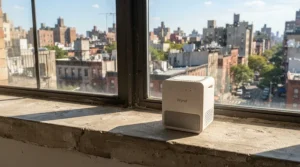
This is the “Omni” idea at a gentler size: a 5.2 kg station that doubles as control panel, charger and stabiliser.
The robot runs at 2,800 Pa while moving and can raise suction to 5,500 Pa in an emergency. Listings quote a 12-stage safety system, around 110 minutes of battery, seven cleaning modes and a composite cable rated to roughly 100 kg. One retailer lists a minimum window of about 30 × 40 cm and 3 mm glass, so check your panes.
On paper this suits a window robot for apartment high floors better than rope-only designs. The station and cable are one tidy line, with fewer loose cords to snag on balcony doors. The ECOVACS HOME app and remote give you two ways to pause quickly, which is a genuine remote monitoring app advantage when you’re cleaning panes you can’t comfortably reach.
On reviews, many roundup sites rank it as a best overall pick, but most are affiliate pages. I couldn’t verify a trustworthy independent aggregate, so I’d call its real-world record plausible rather than proven.
Pros:
- ✅ Station and single cable keep wiring tidy
- ✅ Emergency suction boost adds grip when needed
- ✅ App and remote offer flexible control
Cons:
- ❌ Station takes storage space in small flats
- ❌ Independent review evidence is thin
Indicative price: £400-£550 range. It’s a strong value verdict for most high-floor homes.
3. Ecovacs Winbot W2S Omni — 8,000 Pa grip with sharper edge work
The pitch is firm adhesion plus better edge scrubbing than its predecessor, from launch coverage by Notebookcheck.
That coverage cites 8,000 Pa of suction, sensors that detect movement and edges within roughly 0.2 seconds, and about 110 minutes of battery on a 4,500 mAh cell. It also reports that the robot should stay on the glass for around half an hour if the battery runs low. A safety rope is included, and Ecovacs offers optional cover for rare suction-failure damage.
Higher peak suction is reassuring, but it isn’t a direct comparison number, since brands quote moving and maximum figures differently. What the edge upgrade means is that you’ll see less of the grubby border that robots often leave around frames. That matters on tall windows you can’t easily touch up by hand.
On reviews, this is mostly launch-stage coverage with no long-term independent testing, so I can’t offer a reliable aggregated owner verdict. I’d wait for UK-specific feedback before treating it as a proven upgrade.
Pros:
- ✅ High peak suction for secure adhesion
- ✅ Quick edge detection response
- ✅ Safety rope and half-hour hold included
Cons:
- ❌ Limited independent testing so far
- ❌ Overlaps heavily with the cheaper Ecovacs Winbot W2 Pro Omni
Indicative price: mid-£400s to mid-£500s, so check current price. It’s worth it if tidy edges matter to you.
4. Hobot S7 Pro — frameless-edge sensors with a UPS backup
The headline feature is Hobot’s edge-leakage sensing, designed to stop the robot at frameless glass edges.
Hobot quotes 4,800 Pa of suction and a 4.5 m safety rope rated to 230 kgf. TechRadar lists two 80 ml tanks and a total cable length of about 6.4 m. A backup battery should keep it attached for around 20 minutes without power.
The most useful evidence comes from TechRadar’s hands-on review of the Hobot S7 Pro. The reviewer found it excellent on lightly soiled indoor glass and good at detecting frameless edges. Outdoor panes came out streaky, and it once fell off a window, caught by the rope. It also declined a very narrow 32 cm pane, so window ledge compatibility matters here.
Remote control needs line-of-sight pointing, and the reviewer noted app support sits in the Hobot Legee app rather than the main Hobot app.
Pros:
- ✅ Frameless edge detection confirmed in hands-on testing
- ✅ Long cable and rope give useful reach
- ✅ Good for maintenance cleans of big panes
Cons:
- ❌ Streaky on dirtier exterior glass
- ❌ Too large for narrow windows
Indicative price: £300-£350 range. It’s a good value verdict for frameless balconies, provided you use the rope every single time.
5. Ecovacs Winbot Mini 2 — pocket-sized for narrow panes
The standout is its size: 215 × 215 × 55 mm and about 1.3 kg, with corner brushes for edge cleaning within roughly 1 mm.
Suction is 3,400 Pa while moving and 8,000 Pa at maximum. The 3.3 m safety rope and a 3,000 mAh safety battery that holds it on glass for over 30 minutes are the practical safety numbers. It runs on mains power, so there’s no mid-clean battery fade, and the ECOVACS HOME app adds manual drive and spray control.
For flats with narrow tilt-and-turn windows, this sidesteps the size problem that stopped the Hobot S7 Pro on slim panes. That makes it a smart window robot for apartment high floors with small glazing. Its remote monitoring app control is Bluetooth-based per one retailer, so expect to stay close.
For reviews, an independent write-up of the original Mini praised stable operation and noted around three minutes per square metre in quick mode, with good results on dust and rain marks. I couldn’t verify equivalent coverage for Mini 2.
Pros:
- ✅ Slim size fits narrow panes
- ✅ Corner brushes tackle edges well
- ✅ Corded power avoids battery fade
Cons:
- ❌ Rope is shorter than larger rivals
- ❌ Not ideal for huge glass walls
Indicative price: £250-£350 range, so check current price. It’s a strong value verdict for small windows.
6. HUTT W8 — budget entry with a rope and backup cell
This is the entry ticket, with a dual water spray and a physical safety rope at a fraction of premium pricing.
Listings describe 3,800 Pa suction, automatic air-pressure compensation, a 650 mAh safety battery, a remote control and voice prompts. It weighs about 1.4 kg and cleans a roughly 24 cm width, and the listing mentions an 80 ml tank. I found no app mentioned, so control is by remote.
That makes it a sensible first purchase, but with a trade-off. You get core protection, a rope plus a backup cell, without the heavy station or the remote monitoring app of pricier models. Treat the rope as non-negotiable, because cheaper machines leave less margin for error.
For reviews, I could only verify a handful of retailer user comments, too few to call a trend. Independent testing seems limited, so expect fewer reliability data points than for the Ecovacs and Hobot models.
Pros:
- ✅ Low entry cost for trying the concept
- ✅ Includes rope and backup safety battery
- ✅ Light enough to handle comfortably
Cons:
- ❌ No app, remote only
- ❌ Limited independent review evidence
Indicative price: £100-£200 range. It’s a decent value verdict if you accept fewer safety layers.
7. Hobot 2S — older design with a 5 m cable and app control
This is the veteran, with a 24 × 24 cm cleaning cloth and two ultrasonic spray nozzles that mist water ahead of the pads.
Listings quote roughly 12 cm per second, about 2.4 minutes per square metre, and a backup battery that holds it on glass for about 20 minutes. It has a roughly 5 m power cable, a free app for Android and iOS, and a suggested minimum window of 40 × 40 cm. The manufacturer says to tie the safety rope to a fixed point indoors before starting.
Its remote monitoring app gives it an edge over remote-only budget rivals, and the three-monthly cleaning reminder is a nice touch. Against that, the safety margin is thinner than the anchor-station models, and the tank is small.
Consumer NZ trialled it in 2023 alongside two rivals, but the verdict sits behind a paywall, so I can’t summarise it. I found no other trustworthy aggregate.
Pros:
- ✅ App control at a lower price
- ✅ Long power cable for awkward sockets
- ✅ Small, light and easy to position
Cons:
- ❌ Backup hold time is shorter than premium rivals
- ❌ Older design, with a small 26 ml tank
Indicative price: £150-£250 range. The value verdict is fair for light, occasional use.
How to Set Up a Robot Window Cleaner for High-Rise Flats Safely: Your First 30 Days
This is where most of the real-world value sits, and where listings say least. The routine below is built from manufacturer instructions and reviewer experience, not from anything I’ve personally tested.
Day 1: Prepare before you place
Charge the backup battery, check the rope for fraying and wipe the pad surfaces. Dust and grit are the enemy of both suction seals and glass.
Step by step
- Choose an anchor. Use a solid fixed point inside the flat, such as a sturdy structural item. Never a loose chair, a radiator pipe you aren’t sure about, or a handle.
- Test indoors first. Run the robot on an inside pane to learn its sounds, speed and pause button.
- Attach the rope before switching on. The TechRadar reviewer admitted being lax with the rope until the robot fell once.
- Only deploy where you can reach safely. If placing it on the outside means leaning out, don’t.
- Stay present. These machines need you to move them pane to pane.
Weekly and monthly habits
Wash pads after each session, refill tanks with the recommended solution and keep nozzles clear. Hobot’s ultrasonic nozzles are described as sensitive, so avoid touching them. Within the first 30 days, the common errors are skipping the rope, running on wet panes in rain and ignoring battery checks.
Real-World Scenarios: Matching a Window Robot for Apartment High Floors to Your Flat
These are imagined buyer profiles, not case studies of real people. They show how the same budget and building type can lead to very different picks.
Scenario 1: The 22nd-floor, floor-to-ceiling new-build
Budget: £600-£800. Environment: large fixed panes and a balcony. Frequency: monthly.
The Ecovacs Winbot W3 Omni fits the glass area, and its anchor station suits panes you can only reach from a doorway. The Ecovacs Winbot W2 Pro Omni is the cheaper alternative if the budget stretches only so far.
Scenario 2: The 8th-floor one-bed with tilt-and-turn windows
Budget: £250-£350. Environment: narrow panes. Frequency: every few weeks.
The Ecovacs Winbot Mini 2 is purpose-built for tight glass, and its app gives manual control. Check window ledge compatibility against the minimum size in the manual.
Scenario 3: The 5th-floor flat with frameless glass partitions
Budget: £300-£350. Environment: frameless edges. Frequency: fortnightly maintenance.
The Hobot S7 Pro has the best-documented frameless edge sensing here. Expect lightly soiled glass to come up very well and accept streaks on dirty exterior panes.
How to Choose a Robot Window Cleaner for High-Rise Flats
A robot window cleaner for high-rise flats should be chosen on safety first, glass size second and price third. Work through these steps in order.
- Check your lease and managing agent first. Rules vary by building, so confirm what’s allowed before spending anything (see the leasehold safety considerations section).
- Measure your panes. Compare your smallest and largest panes with each model’s minimum size, a basic window ledge compatibility check.
- Confirm the frame type. Framed, frameless or thick-bead uPVC all affect edge detection.
- Prioritise physical safety layers. Look for a rope, a backup battery and, ideally, an anchor station.
- Decide whether you need app control. A remote monitoring app helps with pausing and manual driving, but remember these machines need you present.
- Budget for consumables. Pads and solution are recurring costs.
- Check support and warranty. Ecovacs and Hobot both offer UK support, so confirm terms.
Robot Window Cleaner Flat Safety Features: What Actually Keeps It on the Glass
Safety is not one feature but a stack of them, and manufacturers market the stack differently. Here’s how to read it.
The five layers
- Suction: Pascal figures aren’t directly comparable, because brands quote moving and peak values differently.
- Backup battery: this holds the robot on glass for roughly 20-30+ minutes if mains power fails.
- Tether: ropes are rated differently, such as 230 kgf on the Hobot S7 Pro and about 100 kg on the Ecovacs station cable.
- Edge sensors: they stop the robot sailing off an open edge.
- Anchor station: a heavy base on the cable end adds mass to the safety line.
HSE’s window-cleaning guidance is aimed at businesses, but its principle travels well: avoid working at height where reasonably practicable, for example by cleaning from inside. At home, that means choosing a robot you can place without leaning out.
| Product | Grip & anchor | Backup hold | Tether | Best For |
|---|---|---|---|---|
| Ecovacs Winbot W3 Omni | Heavy station, 800N+ | 30+ min | Combined cable plus carabiner line | Large glass walls |
| Ecovacs Winbot W2 Pro Omni | 2,800 Pa / 5,500 Pa emergency, 5.2 kg station | Auto return on low battery | Composite cable | All-round use |
| Ecovacs Winbot W2S Omni | 8,000 Pa | ~30 min | Safety rope | Edge-sensitive buyers |
| Hobot S7 Pro | 4,800 Pa | ~20 min | 4.5 m rope, 230 kgf | Frameless glass |
| Ecovacs Winbot Mini 2 | 3,400 Pa / 8,000 Pa max | 30 min | 3.3 m rope | Narrow panes |
| HUTT W8 | 3,800 Pa | 650 mAh cell | Rope | Budget buyers |
| Hobot 2S | Not verified | ~20 min | Rope | Budget app users |
Interpreting the table, only the Omni-style models add a heavy anchor on the line, which is the biggest structural safety difference. The Hobot S7 Pro has the most generous rope rating among the rope-only models, while the HUTT W8 and Hobot 2S rely on rope and backup battery alone. For higher floors, the extra layers are worth paying for.
Leasehold Safety Considerations: What to Check Before You Buy
I’m not a lawyer, and this isn’t legal advice. These leasehold safety considerations are practical prompts to raise with your managing agent or solicitor.
Who owns the window?
Lease wording differs. Published tribunal decisions on window repairs show disputes over whether windows sit within the flat or the building, so don’t assume. Lewisham Council’s leaseholder guidance is one example of a landlord requiring permission before windows are renewed or altered. A robot doesn’t alter a window, but it’s a sensible reference for how strictly some landlords treat exterior glazing.
Practical checks
- No fixings: don’t drill or fix anchors to anything you don’t own. Use an interior anchor point.
- House rules: some buildings restrict items attached to the exterior, so ask.
- Insurance: ask your insurer what cover applies if something fell. Ecovacs mentions optional cover for suction-failure damage, but terms vary.
- Neighbours below: drips and falling debris affect lower balconies, so avoid wet runs when others are outside.
The upshot is simple. Ask first, document the answer and keep it with your lease papers.
Window Ledge Compatibility: Frames, Edges and Awkward Glass
Window ledge compatibility is where plenty of purchases go wrong. A robot needs a smooth seal across its whole footprint, so anything that interrupts the glass matters.
Sizes and thickness
Retail listings suggest minimum panes of around 30 × 40 cm for the Ecovacs Winbot W2 Pro Omni and 40 × 40 cm for the Hobot 2S. TechRadar’s reviewer found the Hobot S7 Pro wouldn’t clean a pane about 32 cm wide. Always check the manual, not just the listing.
Frame types
- Framed windows: most robots detect the frame with bumpers.
- Frameless glass: look for dedicated sensors such as the edge-leakage feature on the Hobot S7 Pro.
- Raised beading or ridges: these can break the seal, so inspect your uPVC and sill details.
Other obstacles
Window film, frosted panels, tilt-and-turn handles, mullions and balcony railings all change what’s practical. Ecovacs’s own guidance says robots work best on large, flat, undecorated glass. If your windows are small and fiddly, the Ecovacs Winbot Mini 2 is the safer starting point.
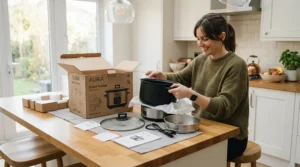
Remote Monitoring App: What It Does (and Doesn’t) Do
A remote monitoring app sounds like a drone feed. In reality it’s closer to a smart remote.
What you typically get
Start, pause, manual direction, spray controls, cleaning mode selection and status prompts. The Ecovacs Winbot Mini 2 adds four-direction manual control, and the Hobot 2S adds cleaning reminders and firmware updates. The Ecovacs Winbot W3 Omni adds a screen on the station plus the ECOVACS HOME app.
What it won’t do
It won’t let you leave the flat. One retailer lists the Ecovacs Winbot Mini 2 as Bluetooth-controlled, so you need to be nearby. Listings for the Ecovacs Winbot W2 Pro Omni warn not to leave it unattended, and TechRadar’s reviewer stressed that the Hobot S7 Pro can’t be left alone either.
Remote versus app
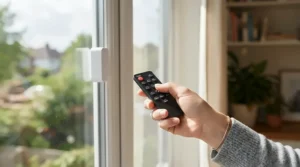
The HUTT W8 relies on a remote and voice prompts. The Hobot S7 Pro remote needs direct pointing, which the reviewer found fiddly. For awkward high panes, a remote monitoring app is more forgiving than a line-of-sight remote.
High-Rise Window Cleaning Robot Review: What the Evidence Really Says
Any honest high-rise window cleaning robot review has to start with what’s missing: independent British testing. Which? hasn’t tested these machines.
The evidence tiers
- Hands-on tests: TechRadar on the Hobot S7 Pro and Gamereactor on the Ecovacs Winbot W3 Omni.
- Trials behind paywalls: Consumer NZ’s 2023 trial included the Hobot 2S.
- Launch coverage: Notebookcheck on the Ecovacs Winbot W2S Omni.
- Affiliate roundups: many claim dramatic testing but are anonymous pages I couldn’t verify.
Common themes
Reviewers agree these robots suit maintenance cleaning rather than caked-on grime. They save effort more than time, and they need supervising. Ecovacs’s own UK guidance says they work best on large, flat glass and aren’t recommended in the rain. One high-rise window cleaning robot review that stood out for candour was TechRadar’s, because it admitted a fall. Treat any review that reports zero problems with scepticism.
Window Robot for Apartment High Floors: What to Expect in the Real World
A window robot for apartment high floors is a convenience tool, not a miracle worker. Setting expectations avoids disappointment.
Speed
Hobot advertises roughly 2 minutes 36 seconds per square metre for the Hobot S7 Pro, but TechRadar measured about 7.5 minutes for a 1.3 m² pane in a full run. The Ecovacs Winbot Mini 2‘s predecessor was reported at about three minutes per square metre in quick mode. Plan for slower than the brochure.
Wind and weather
TechRadar noted that a fine mist outdoors can blow away in a breeze. High floors are windier, so choose calm, dry days.
Cleaning quality
Light dust and rain marks come off well. Bird droppings and baked-on dirt are a manual job. Running a dry pass first, as Hobot suggests, can help.
Workload
You’ll still move the robot between panes. For a window robot for apartment high floors, that’s usually a 20-minute job per elevation rather than a full afternoon.
Robot Window Cleaner for High-Rise Flats vs Traditional Alternatives
How does a robot compare with other ways of cleaning high windows? The table gives the short answer.
| Option | Safety exposure | Cost pattern | Effort | Best For |
|---|---|---|---|---|
| Robot (e.g. Ecovacs Winbot W2 Pro Omni) | Low if tethered and used from inside | One-off outlay plus pads | Low, but supervised | Regular maintenance cleans |
| Professional service | Handled by trained staff | Repeating visits | Minimal | Heavy grime, tall façades |
| Ladder and squeegee | High at height | Cheap | High | Ground-floor windows only |
| Water-fed pole | Medium, reach-limited | Moderate | Moderate | Low-rise exterior glass |
Interpreting this, a robot wins where the main risk is you leaning out or using unsuitable access equipment. It loses to a professional on stubborn grime. A broad guide cites typical UK window cleaning at £25-£40 per hour, citing Checkatrade, though high-rise work is often priced differently.
As an illustration only, not a quote: if a visit cost £60-£100, a £300 robot could pay back in roughly three to five visits, before pads and solution.
Common Mistakes When Buying a Robot Window Cleaner for High-Rise Flats
Most regrets come from the same handful of errors.
Buying on suction alone
Pascal figures vary by how they’re measured. Safety layers matter more than one headline number.
Ignoring pane size and frame type
Window ledge compatibility is the most common cause of a returned robot. Measure first.
Skipping the rope
The rope is the backup to the backup. Even a reviewer who tested the Hobot S7 Pro extensively had one fall and was glad of it.
Assuming the lease doesn’t matter
Leasehold safety considerations apply even when you’re just using a gadget. Ask your managing agent.
Expecting unattended cleaning
Neither a robot window cleaner for high-rise flats nor its app replaces you. Stay present, and treat the robot window cleaner flat safety features as a safety net rather than permission.

FAQ
❓ Can a robot window cleaner for high-rise flats be used on the outside of a 10th-floor window?
❓ How much does a window robot for apartment high floors cost in the UK?
❓ Do these robots work on thick or double-glazed panes?
❓ Is a remote monitoring app necessary for a high-rise window cleaning robot?
❓ Do I need permission to use a robot window cleaner in a leasehold flat?
Conclusion
A robot window cleaner for high-rise flats won’t replace a professional deep clean, but it can take most of the nervous effort out of routine maintenance. The key is matching the machine to your glass and your building, not chasing the biggest suction number.
For large panes and premium budgets, the Ecovacs Winbot W3 Omni brings the strongest safety hardware. The Ecovacs Winbot W2 Pro Omni is the balanced all-rounder for most homes. The Ecovacs Winbot W2S Omni suits buyers who want tidier edges, and the Hobot S7 Pro is the frameless-glass specialist. For narrow windows the Ecovacs Winbot Mini 2 fits best, while the HUTT W8 and Hobot 2S keep costs down at the price of fewer safety layers.
Whichever you choose, tether it every time, stay close, and ask your managing agent first. The best robot window cleaner flat safety features only work if you use them.
Recommended for You
- Vertical Glass Cleaning Robot: 7 Best Picks For UK Homes (2026)
- Safest Robot Window Cleaner: 7 Proven Picks For UK Homes (2026)
- Robot Window Cleaner Under £200: 7 Best Picks For UK Homes (2026)
Disclaimer: This article contains affiliate links. As an Amazon Associate, I earn from qualifying purchases. If you purchase products through these links, we may earn a small commission at no additional cost to you.
✨ Found this helpful? Share it with your friends! 💬🤗
