In This Article
Emptying a robot vacuum’s bin is the domestic equivalent of wringing out a teabag. Fiddly, faintly grubby, and somehow needed after every single run. An auto-empty dust bin robot vacuum promises to end the ritual: it parks on a dock, the dock hoovers up the robot’s bin, and you ignore the whole business for weeks. Lovely idea. The catch? The dock is where the real decisions hide, and it’s where plenty of British buyers come unstuck.
Bag or bagless? Thirty days between empties, or seventy-five? A polite hum, or a noise like a leaf blower having a bad morning? Two robots with identical suction can be miles apart on the things that decide whether you still love the machine in year two: bag prices, allergy safety, dock size, and how loud it is at 8am on a Sunday.
So this guide goes deep on the dock. Seven real models, from bagless to bagged and budget to flagship, with plain-English analysis of what the specs mean in an actual home. Everything here draws on published specifications and aggregated findings from testers such as Expert Reviews, TechRadar, T3, Trusted Reviews, Vacuum Wars and Mumsnet, not invented hands-on anecdotes. Where reviewers disagree, I’ll say so. Where a claim can’t be verified, I’ll say that too.
What Is an Auto-Empty Dust Bin Robot Vacuum?
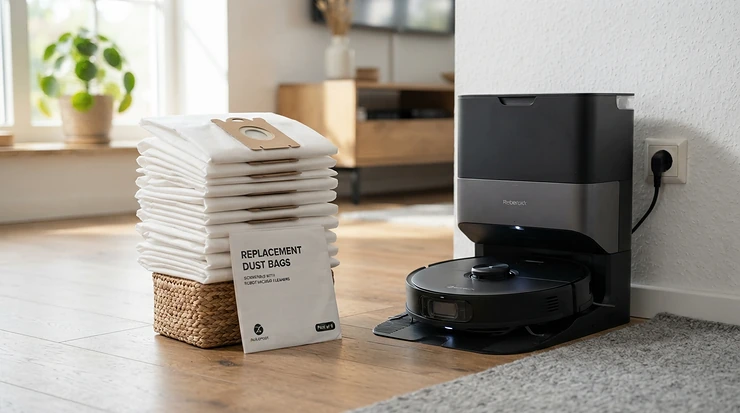
An auto-empty dust bin robot vacuum returns to a base station after cleaning and automatically suctions its small onboard bin into a much larger bag or container in the dock. That usually means weeks, not days, between manual emptying, depending on your home, your pets and whether the dock is bagged or bagless.
The feature is now a standard part of the wider robotic vacuum cleaner category, and premium docks go further, washing mop pads, refilling water tanks and drying everything with warm air.
Quick Comparison: 7 Auto-Empty Docks at a Glance
Here’s the whole field on one screen. Prices are ranges from research at the time of writing, so check current price before you buy.
| Product | Dock type | Dock interval (maker’s claim) | Price range | Best For |
|---|---|---|---|---|
| Ecovacs Deebot X11 OmniCyclone | Bagless cyclone | Around 60 days | £800-£1,200 | Big homes, zero bag costs |
| Shark PowerDetect | Bagless, HEPA | Up to 60 days | £700-£800 at launch | Hands-off mopping, no bags |
| Shark Matrix Plus | Bagless, 1.8L bin | Up to 60 days | Around £500 at launch | Small single-floor homes |
| iRobot Roomba Combo j9+ | Sealed bag | 60 days | Around £1,250 list | Pet homes, sealed disposal |
| Roborock Qrevo Curv 2 Pro | Sealed bag, 2.7L | Roughly 7+ weeks | Around £1,200 at launch | Carpet-heavy homes |
| Eufy X10 Pro Omni | Sealed bag, 2.5L | 30-60 days by household | Around £800 at launch | Mid-range mop-and-vac value |
| Lefant M2 Plus | Sealed bag, 2.2-2.5L | 40-75 days (claims vary) | Budget bracket | Tight budgets, light use |
Read the table as three tiers. The Shark Matrix Plus and Lefant M2 Plus are the budget entries, the Eufy X10 Pro Omni and Shark PowerDetect sit in the middle, and the Ecovacs Deebot X11 OmniCyclone, iRobot Roomba Combo j9+ and Roborock Qrevo Curv 2 Pro are the flagships. The robot vacuum dust bag vs bagless split cuts straight across all three tiers, which is why it gets its own section below.
💬 Just one click — help others make better buying decisions too!😊
Top 7 Auto-Empty Dust Bin Robot Vacuums: Expert Analysis
1. Ecovacs Deebot X11 OmniCyclone — bagless dock for big, busy homes
The headline isn’t the 19,500Pa figure. It’s the bagless OmniCyclone station, which Ecovacs says spares you roughly 25 dust bags over five years.
The suction is paired with 38 CFM of airflow, and airflow is what actually carries debris off carpet, so the pairing matters more than either number alone. PowerBoost charging restores around 6% of battery in the three minutes the mop spends washing, which helps in large floorplans where one charge won’t finish the job. The dock scrubs rollers with 75°C water and dries them with hot air, so the grubbiest chores are automated too. Because the station is cyclonic rather than bagged, you’ll empty a container and rinse filters occasionally instead of buying consumables.
Based on the spec comparison, this is the pick for large households where bag costs would quietly stack up. What the brochure won’t say, but T3 did: vacuuming performance is strong, mopping is merely average, and the AI extras add more to the price than to the results. Overall reviewer sentiment leans positive on cleaning power and the bagless dock, and lukewarm on mopping.
Pros:
- ✅ Bagless dock means no ongoing bag costs
- ✅ Fast PowerBoost charging suits large homes
- ✅ Strong vacuum performance and hair-resistant brush
Cons:
- ❌ Mopping only average according to T3
- ❌ AI features inflate the price
Roughly £800-£1,200 depending on promotions at the time of research. Worth it if you’ll lean on the bagless dock for years; harder to justify if mopping is your priority.
2. Shark PowerDetect — bagless dock that also washes the mop
Shark’s PowerDetect is what happens when a bagless dock gets a promotion: it still skips bags, but now it refills the robot’s water and washes and dries the mop pad too.
The NeverTouch Pro base stores up to 60 days of debris in a roughly two-litre tank and can keep mopping going for about 30 days between your interventions. Tech Advisor reports the base is built to trap up to 99.9% of dust and allergens, with an odour-neutralising cartridge on top. Translated: around six manual empties a year, not zero, plus a chunky dock (about 45cm tall and 48cm wide) to find a home for.
Buy the Pro base if hands-off mopping matters, because the cheaper NeverTouch base doesn’t self-clean its pads, according to TechRadar. The trade-off is finesse. Reviewers are genuinely split: Tom’s Guide praised the suction and easy app but noted loose debris on longer carpet, while Homes & Gardens found pet hair and edge cleaning weaker, and Trusted Reviews hit navigation hiccups and a basic app.
Pros:
- ✅ Bagless dock with claimed 60-day capacity
- ✅ Self-cleaning, self-refilling mop system on Pro base
- ✅ Odour cartridge and HEPA-style sealing
Cons:
- ❌ Mixed reviews on pet hair and edges
- ❌ Bulky, tall dock
List prices at launch sat around £700-£800 depending on the base; check current price. Fair value for hands-off mopping without bag bills, less so for long-pile carpets.
3. Shark Matrix Plus — cheapest route to a bagless dock
Shark’s first UK robot is the cheapest way into bagless docking, and it shows both the promise and the rough edges.
The dock holds debris in a 1.8-litre bin, much like a conventional vacuum’s, and T3 cites up to 60 days between empties. LiDAR maps the home within minutes, and runtime stretches to around 110 minutes. Crucially, the dock only empties: it doesn’t refill water or wash pads (Trusted Reviews), and the mop attachment has to be swapped in by hand (The Ambient).
On the specs, this suits smaller, single-floor properties with clearly defined carpet, which is what Expert Reviews concluded; add rugs and the robot can struggle. If you mop rarely, the manual swap is a shrug. If you mop weekly, it’ll grate. Reviewers disagree on the app: T3 rated it excellent, while Expert Reviews felt it lacks features found on rivals.
Pros:
- ✅ Bagless dock with no consumables
- ✅ Fast LiDAR mapping and neat cleaning lines
- ✅ Strong value for a LiDAR-plus-dock package
Cons:
- ❌ Dock doesn’t wash pads or refill water
- ❌ Manual mop-module swap
Launched at around £500; check current price. Verdict: the best-value bagless entry, if you can live with manual mopping.
4. iRobot Roomba Combo j9+ — sealed bag, retractable mop
If your priority is sealed, no-touch disposal, iRobot’s flagship still does it with a good deal of polish.
The Clean Base stores up to 60 days of debris in a bag and around 30 days of water. Two bags come in the box, and Expert Reviews noted iRobot’s replacements cost roughly £7-£10 each, with cheaper third-party options available. The mop lifts fully onto the robot’s body, so carpets stay dry, and PrecisionVision cameras handle obstacles without a LiDAR turret, which also means no live map in the app.
Analytically, this is for pet homes that want sealed disposal and low drama. It’s less compelling if you want a mop-washing dock, because the base doesn’t rinse pads; you’ll machine-wash them. Expert Reviews called it iRobot’s best mopping Roomba yet, while TechRadar liked the convenience but found the emptying slightly loud and the price steep.
Pros:
- ✅ Sealed bag disposal, minimal dust contact
- ✅ Retractable mop protects carpets
- ✅ Strong obstacle avoidance
Cons:
- ❌ Base doesn’t wash mop pads
- ❌ Ongoing bag cost and high list price
List price around £1,250, and around £950 for the non-mop version according to TechRadar; check current price. Worth it for the sealed system and obstacle skills, not for value.
5. Roborock Qrevo Curv 2 Pro — 25,000Pa and a roomy 2.7L bag
Roborock’s 2026 flagship gives its bag a generous 2.7 litres and pairs it with 25,000Pa of suction.
That figure sits well above the 8,000-15,000Pa most UK mid-rangers manage, according to Trusted Reviews. The AdaptiLift chassis raises the body over carpets up to 3cm thick, which is why carpet-heavy homes are the sweet spot. The onboard bin is tiny (the Qrevo family’s runs around 325ml), so the dock earns its keep after every run, and it washes and dries mop pads too.
TechRadar found emptying noisy but thorough, even when packed with dog hair, though it disliked the deep, narrow bag chamber, where the bag can bend at the inlet. Roborock rates a bag at roughly seven weeks across the Qrevo range; other testers reported two to three months. Overall, TechRadar called it exceptionally capable, with excellent suction and a highly self-sufficient dock.
Pros:
- ✅ Class-leading suction and carpet lifting
- ✅ Large 2.7L dust bag
- ✅ Fully automated dock with hot-water mop washing
Cons:
- ❌ Emptying cycle is noisy
- ❌ Premium price and awkward bag chamber
Launched in the UK at around £1,200 via Amazon UK; check current price. Excellent for carpet-heavy homes, pricey for hard floors alone.
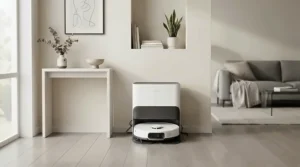
6. Eufy X10 Pro Omni — bagged dock with honest household-adjusted intervals
The best-known middle path: a bagged Omni dock whose maker publishes refreshingly candid intervals.
eufy rates its 2.5L antibacterial bag at around 60 days for a three-person home without pets, 45 with one pet and 30 with two, which makes budgeting bags easy. Suction is 8,000Pa, mid-tier by 2026 standards, though a 2026 roundup of RTINGS testing says the figure is accurate. Normal modes run around 57-58dB, but that roundup reports about 76dB at maximum on carpet. The app lets you set the emptying interval, and Bas on Tech notes it skips emptying after very short runs.
Practically, it suits mixed homes wanting mop-and-vacuum automation without flagship prices, but not deep pile. The dock washes pads with cold water, dries them with warm air, and needs roughly 85cm of overhead clearance. Mumsnet’s tester found it brilliant on carpets and cat hair but was irked by the hum while charging; Rapid Reviews UK also called it a little loud.
Pros:
- ✅ Pet-adjusted bag intervals published
- ✅ Good carpet and cat-hair pickup
- ✅ App-adjustable emptying schedule
Cons:
- ❌ Cold-water mop wash
- ❌ Tall robot, bulky dock
Launched at around £800 and often discounted since; check current price. A sensible mid-range buy if you can accommodate the dock.
7. Lefant M2 Plus — budget bagged dock with conflicting claims
A budget dock that punches above its price on paper, and contradicts itself on the box.
You get 6,000Pa suction, dToF laser mapping, a 300ml water tank and up to 140 minutes of runtime, which Amazon UK says covers 140m². The dock takes a sealed bag, but sources disagree on size and interval: Amazon UK markets 75 days, the manual points to a 2.2L bag and up to 40 days, and a US listing mentions 2.5L bags. That’s an eyebrow-raiser worth resolving before you buy.
For a small flat with light dust, 40 days is plenty; with a shedding dog, plan on the low end. Sealed bags give allergic households bagged-dock hygiene at budget prices. I couldn’t find a full test from a major UK publication, so treat performance claims as manufacturer claims until independent data appears. Third-party bag multipacks are widely sold, but check fit first.
Pros:
- ✅ Budget-friendly self-emptying dock
- ✅ Mapping and app control included
- ✅ Sealed bag disposal
Cons:
- ❌ Conflicting capacity claims
- ❌ Limited independent testing
The budget bracket, and the cheapest of the seven at the time of research; check current price. A decent starter, provided you verify the specs.
Auto-Empty Bin Capacity Comparison: What Litres and “Days” Really Mean
An auto-empty bin capacity comparison is trickier than it looks, because bags and bins don’t measure the same way, and “days” is a marketing unit, not an engineering one. A bag compresses debris as suction packs it in; a bagless bin holds it loose. So 2.7 litres of bag and 1.8 litres of bin aren’t a like-for-like contest. And every “up to 60 days” assumes a tidy household: modest hair, few muddy paws.
| Product | Dock container | Onboard bin | Maker’s interval |
|---|---|---|---|
| Ecovacs Deebot X11 OmniCyclone | Bagless cyclone | Not confirmed | Around 60 days |
| Shark PowerDetect | Bagless, about 2L | Not confirmed | Up to 60 days |
| Shark Matrix Plus | Bagless, 1.8L | Not confirmed | Up to 60 days |
| iRobot Roomba Combo j9+ | Sealed bag | Not confirmed | 60 days |
| Roborock Qrevo Curv 2 Pro | Sealed bag, 2.7L | Roughly 325ml (family) | Roughly 7+ weeks |
| Eufy X10 Pro Omni | Sealed bag, 2.5L | 330ml | 30-60 days |
| Lefant M2 Plus | Sealed bag, 2.2-2.5L | 250ml | 40-75 days |
The takeaway: Eufy X10 Pro Omni is the only model here that adjusts its claim for pets, and the Lefant M2 Plus spread of 40-75 days suggests you should plan on the low end. The small onboard bins (roughly 250-330ml) explain why docks exist at all. For any auto-empty bin capacity comparison, halve the claimed interval if you own a heavy shedder.
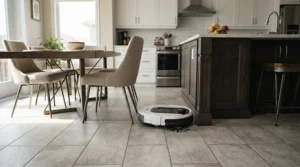
Robot Vacuum Dust Bag vs Bagless: The Honest Head-to-Head
The robot vacuum dust bag vs bagless debate boils down to three currencies: money, mess and maintenance.
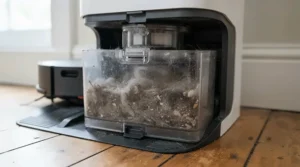
A bagged dock seals dust away. You pay per bag, but you rarely touch what’s inside. A bagless dock costs nothing to run beyond filter care, but every few weeks you’ll be dumping a bin of fine dust into a rubbish bag. Expert Reviews, testing the Shark Matrix Plus, wondered aloud why other stations still demand bags, while The Ambient noted the few extra filters you’ll clean as the price of that freedom. Brand claims cloud things too: Eureka argues all-in-one docks need sealed systems, yet the Ecovacs Deebot X11 OmniCyclone and Shark PowerDetect both wash mops and empty bagless.
| Factor | Bagged dock | Bagless dock |
|---|---|---|
| Ongoing cost | Roughly £7-£10 per bag | Filter care only |
| Emptying | Seal and bin, minimal dust | Dump the bin; mask advisable |
| Maintenance | Bag swap plus filter check | Filter washing, bin wipe |
| Waste | Disposable bags | None |
| Best For | iRobot Roomba Combo j9+, Roborock Qrevo Curv 2 Pro, Eufy X10 Pro Omni, Lefant M2 Plus | Ecovacs Deebot X11 OmniCyclone, Shark PowerDetect, Shark Matrix Plus |
If you’d rather spend money than touch dust, go bagged. If you’d rather spend ten minutes a month washing filters than buy consumables, go bagless. Neither is objectively “better”; they suit different temperaments.
Replacement Bag Cost: The Five-Year Maths
Replacement bag cost is the quiet line item that changes the maths of a “cheap” dock. Expert Reviews noted iRobot’s bags cost roughly £7-£10 each, and Ecovacs says its bagless design saves around 25 bags over five years, or five a year. Here’s my own arithmetic across three household types, using that £7-£10 range.
| Scenario | Bags per year | Five-year cost |
|---|---|---|
| Light use, 60-day interval | 6 | £210-£300 |
| One pet, 45-day interval | 8 | £280-£400 |
| Two pets, 30-day interval | 12 | £420-£600 |
Those figures are illustrative, not quotes, but they show why a pet household pays roughly double. Cheaper third-party bags exist, though a PCMag test of a third-party bag on a Roborock model found a poorly fitting mount stopped auto-emptying working properly. A saving isn’t a saving if the dock fails.
Bagless docks trade that replacement bag cost for filter care, so the true comparison is £200-£600 over five years against a few minutes a month of washing. For a bagged iRobot Roomba Combo j9+ or Roborock Qrevo Curv 2 Pro, budget the bags as part of the purchase, not an afterthought.
Auto-Empty Bin Noise Level Review: What the Reports Actually Say
Every auto-empty bin noise level review says the same thing: the cleaning is polite, and the emptying is the tantrum. PCMag describes a burst lasting roughly 15 to 30 seconds, about as loud as an old-school upright. Prospect, citing HSE-style comparisons, puts a typical vacuum cleaner around 70dB(A) and normal conversation at about 60dB(A). And because HSE notes that every 3dB increase doubles the noise, the gap between the Eufy X10 Pro Omni‘s roughly 58dB normal modes and the roughly 76dB reported at maximum on carpet is anything but subtle.
Model by model: TechRadar found the Roborock Qrevo Curv 2 Pro‘s emptying noisy, and the iRobot Roomba Combo j9+ a little loud despite iRobot calling it its quietest dock yet. Mumsnet’s tester disliked the Eufy X10 Pro Omni‘s hum while charging. I couldn’t find independent decibel readings for the bagless docks, so don’t assume they’re quieter; the motor doing the sucking is similar either way.
The practical fix is scheduling. Use do-not-disturb hours, set longer emptying intervals, and, on the Eufy X10 Pro Omni, let the app skip emptying after short runs. Any auto-empty bin noise level review should end with the same advice: run it while you’re out.
Suction Retention: Does a Fuller Dock Weaken Your Robot?
Suction retention is the worry that a filling bag or bin will choke performance mid-clean. With a docked system, the answer is mostly reassuring. The robot’s own bin is emptied after every run, so what the robot experiences on the floor is largely independent of how full the dock is.
What does erode suction retention is everything around the bin: clogged filters, hair wrapped round the brush, and a dock so full it can’t empty the robot properly. TechRadar noted occasional bag clogging across Roborock reviews, and Ecovacs advises keeping bins clear to protect performance. Which?, testing conventional vacuums, found that some bagged models lose no suction as they fill while some bagless ones do lose it, so don’t take either camp’s marketing at face value.
Practical rules for good suction retention: wash or replace filters on schedule (Lefant’s manual suggests every three to six months), clear brush hair weekly, and change bags when the app alerts you rather than stretching them. The Eufy X10 Pro Omni‘s station comb, which brushes hair off the roller during emptying, helps here, though owners still report clearing some weekly.
Bagged vs Bagless Systems: Allergies, Hygiene and Common Sense
The bagged vs bagless systems question matters most if anyone in your home has allergies. Which? found in its tests of conventional vacuums, including ones with “hygienic” emptying, that bagged models were better at preventing dust escaping when emptied. Allergy UK advises high-filtration cleaners and, for bagless models, emptying into a bag outdoors while wearing a mask and gloves.
Two caveats. Those tests weren’t on docks, so treat the finding as directional. And a dock changes the maths: you handle dust perhaps six times a year rather than daily, so even a bagless dock exposes you far less than emptying a robot’s onboard bin. Shark says its bagless bases trap up to 99.9% of dust, but that’s a manufacturer claim.
My reading: for a household with significant allergies, bagged systems such as the iRobot Roomba Combo j9+, Roborock Qrevo Curv 2 Pro or Eufy X10 Pro Omni are the cautious choice. For everyone else, the bagged vs bagless systems decision is really about cost and tolerance for fiddly chores. Either way, a robot with a dock beats a robot without one for allergy-prone homes, because you stop emptying dust by hand every few days.
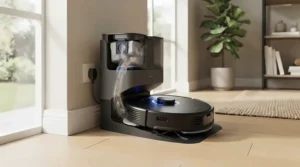
How to Choose an Auto-Empty Dust Bin Robot Vacuum
Choosing an auto-empty dust bin robot vacuum comes down to seven questions, best answered in this order.
- Bag or bagless? Decide whether you’d rather pay £7-£10 per bag or wash filters and dump a bin. Allergies tip you towards bags.
- Read the interval for your household. Halve any “up to” figure if you have pets; run your own auto-empty bin capacity comparison rather than trusting headlines.
- Check the noise plan. Choose a model whose app lets you set emptying schedules and do-not-disturb hours.
- Measure the dock. Some, like the Eufy X10 Pro Omni, want about 85cm overhead and half a metre either side.
- Match suction to floors. Carpets favour lift-and-boost designs like the Roborock Qrevo Curv 2 Pro; hard floors don’t need flagship Pa.
- Confirm bag availability and fit. Buy genuine or proven-compatible bags, and factor in replacement bag cost from day one.
- Test the app. Reviewers disagree on several, so read recent feedback.
Features That Actually Matter (And Those That Don’t)
What matters: dock capacity in real days, suction retention through easy filter care, obstacle avoidance for cables and pet mess, and clearance. The Eufy X10 Pro Omni‘s roughly 11cm height reportedly stopped it reaching under 100mm kickboards, a reminder to measure your furniture before falling in love with a spec sheet. Mop washing matters if you have lots of hard floor; on carpet, retractable mops such as the iRobot Roomba Combo j9+‘s do more good.
What doesn’t: headline Pa figures, which aren’t comparable between brands (RTINGS-based testing suggests Eufy X10 Pro Omni‘s 8,000Pa is honest, yet mid-tier). AI voice agents and gimmicks, which T3 felt added more to the Ecovacs Deebot X11 OmniCyclone‘s price than its performance. And “90-day” bag claims, which assume a light-shedding household.
Think of the dock as a car’s boot and the suction as its top speed. You’ll use the boot every day; you’ll rarely reach top speed.
Practical Guide: Your First 30 Days and a Maintenance Schedule
Week one. Place the dock on hard flooring beside a socket, with clear space around it. Avoid enclosed cupboards, because Eufy warns that drying-cycle moisture can be a problem. Run a mapping pass, set no-go zones, and pick up loose cables, the kryptonite of every robot. Then set do-not-disturb hours and an emptying interval.
Weekly. Clear tangled hair from the brush and wipe the sensors and charging contacts with a dry cloth. Five minutes prevents most stuck-robot dramas.
Monthly. Wash or tap out filters, wipe the bagless bin if you have one, and check the bag-full alert. Don’t ignore it; bag clogging is a real failure mode.
Every 30-75 days. Swap the bag when the app or dock asks. Replace filters every three to six months, per Lefant’s manual.
End of life. Batteries make robot vacuums small electricals: they shouldn’t go in general waste. Electrical Safety First explains that retailers must offer take-back when you buy a replacement, and councils run recycling routes.
Common first-month mistakes: stretching bags too long, blocking the dock’s approach path, and running max suction at night.
Real-World Scenarios: Three Homes, Three Docks
Scenario 1: A one-bed flat, hard floors, no pets, budget around £500, cleaning three times a week. Dust builds slowly, so a bagless dock’s 60-day claim is realistic. The Shark Matrix Plus fits: LiDAR mapping, no bag costs, and mopping done by hand only occasionally. If you’d rather pay less upfront, the Lefant M2 Plus is the budget alternative, though its capacity claims need checking.
Scenario 2: A family home with two dogs, mixed carpet and hard floors, budget £1,000+, daily runs. Hair fills docks fast, so expect a 30-day cycle and roughly £420-£600 in bags over five years. The Roborock Qrevo Curv 2 Pro‘s 2.7L bag and carpet lift suit this, as does the iRobot Roomba Combo j9+ for sealed disposal. If you’d rather avoid bag bills, the Ecovacs Deebot X11 OmniCyclone is the bagless alternative.
Scenario 3: A large, open-plan, mostly hard-floor home with a busy household. You want minimal intervention and lots of range. The Shark PowerDetect‘s self-cleaning mop and bagless base, or the Ecovacs Deebot X11 OmniCyclone‘s fast charging and bagless design, keep upkeep low. Choose by whether you value mopping (Shark) or raw vacuum performance (Ecovacs).
✨ Don’t Miss These Exclusive Deals!
🔍 Take your hands-free floor care to the next level with these carefully selected auto-empty robot vacuums. Click on any highlighted item to check current pricing and availability. These docks will help you create the spotless, low-effort home your family will love!
Common Mistakes When Buying an Auto-Empty Robot Vacuum
- Buying on suction alone. Pa figures aren’t comparable across brands; dock capacity and noise shape daily life more.
- Ignoring the dock footprint. A large dock in a small hallway becomes furniture you resent.
- Trusting “up to” days. Halve them with pets, and remember the Lefant M2 Plus‘s own listings disagree.
- Skipping the noise plan. Emptying is loud; schedule it or regret it.
- Buying the wrong bags. A poor-fitting third-party bag can stop emptying working, so check compatibility.
- Forgetting marks and plugs. Look for UKCA or CE marking and a UK plug from a reputable seller.
The best purchase is the one whose annoyances you’ve already priced in.
FAQ
❓ Are auto-empty robot vacuums worth it compared with emptying the bin yourself?
❓ Where should I put the dock of an auto-empty dust bin robot vacuum?
❓ Do I need a mop-washing dock, or is a self-empty-only dock enough?
❓ Is a budget auto-empty robot vacuum good enough?
❓ Is a bagless dock better for pet hair?
Conclusion
The best auto-empty dust bin robot vacuum isn’t the one with the biggest suction number; it’s the one whose dock fits your home, your wallet and your tolerance for dust. Do the auto-empty bin capacity comparison honestly for your household, run the replacement bag cost maths over five years, and decide whether you’re a robot vacuum dust bag vs bagless person before you look at anything else.
If you want zero consumables and big-home performance, the Ecovacs Deebot X11 OmniCyclone and Shark PowerDetect lead the bagless pack, with the Shark Matrix Plus as the budget route. If sealed disposal matters, the iRobot Roomba Combo j9+, Roborock Qrevo Curv 2 Pro and Eufy X10 Pro Omni are the bagged front-runners, and the Lefant M2 Plus is a low-cost starter once you’ve verified its specs. Keep the bagged vs bagless systems trade-off in mind if allergies are involved, remember every auto-empty bin noise level review says to schedule emptying for when you’re out, and protect suction retention with regular filter care.
Pick the dock, then the robot. The floors will thank you, and so will your Sunday mornings.
Recommended for You
- Self-Emptying Robot Vacuum: 7 Best Affordable Picks (2026)
- Self-Emptying Robot Vacuum Base: 7 Best UK Picks (2026)
- Robot Vacuum Mop Combo vs Separate Mop: 7 Best Picks UK 2026
Disclaimer: This article contains affiliate links. As an Amazon Associate, I earn from qualifying purchases. If you purchase products through these links, we may earn a small commission at no additional cost to you.
✨ Found this helpful? Share it with your friends! 💬🤗
