
In This Article
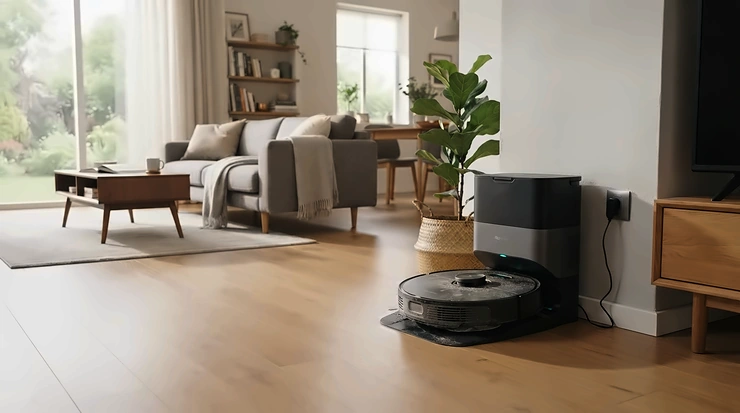
The self-emptying base vs manual emptying robot vacuum question comes down to who handles the dirt. A self-emptying base sucks the robot’s small onboard bin into a larger bag or canister in the dock, usually leaving weeks between jobs. A manual robot needs its bin emptied by hand every few runs, or sooner if you have a dog.
Robotic vacuum cleaners have been around for over two decades, yet the dock is where the real arguments start. A manual robot is a neat, low-slung disc that tucks under the sofa. A docked one is a small appliance tower that wants a permanent place on your skirting board. One looks like a gadget. The other looks like a gadget with a utility bill.
So the question isn’t whether self-emptying robots are clever. They are. The question is whether the extra cash, the bag subscription and the extra footprint buy you something you’ll feel. For some homes the answer is a loud yes. For others, a self-emptying base vs manual emptying robot vacuum comparison ends with “keep the money, empty the bin.”
What follows is a spec-led, review-informed breakdown of seven real models, the true cost of ownership, and a framework for deciding. Think of it as the conversation you’d have with a friend who’s read far too many spec sheets, so you don’t have to.
Quick Comparison: 7 Self-Emptying Robot Vacuums at a Glance
Prices below are indicative brackets at the time of research and move with promotions, so check current price before buying.
| Model | Emptying style | Dock capacity (claimed) | Price range | Best For |
|---|---|---|---|---|
| Roomba Combo j5+ | Bagged Clean Base | Around 60 days | £400-£600 | Carpet-heavy homes |
| Shark RV2820VEUK | Bagless base | Up to 60 days | £400-£500 | Bag-averse pet owners |
| Shark RV2620WAUK | Bagless base | Up to 60 days | £400-£500 | 2-in-1 sweep and mop on a budget |
| eufy Omni C20 | Bagged all-in-one station | Up to 60 days | £300-£450 | Low furniture, mopping |
| eufy X10 Pro Omni | Bagged all-in-one station | Around 2 months | Around £600 | Cluttered family homes |
| Roborock Q Revo | Bagged multifunction dock | Up to 7 weeks | £450-£700 | Hard-floor homes |
| Roborock Qrevo Curv | Bagged multifunction dock | Up to 7 weeks | £800-£1,200 | Premium, design-conscious buyers |
Looking at the table, the interval between bag changes barely varies, so the dock’s capacity is rarely what separates these models. The real divides are bagged versus bagless, how much mopping the station handles, and how tall the robot stands. Budget buyers should note that the Shark RV2820VEUK and Shark RV2620WAUK avoid bag costs entirely, while the Roborock Qrevo Curv is paying for a premium dock and flagship suction.
💬 Just one click — help others make better buying decisions too!😊
Top 7 Robot Vacuums for the Self-Emptying Base vs Manual Emptying Robot Vacuum Decision
Every model here has a self-emptying dock. Where relevant, I flag how a manual-emptying alternative from the same brand changes the maths. Review notes below are aggregated from published reviews I could find. Where I couldn’t verify an independent review pool, I say so rather than invent one.
1. Roomba Combo j5+ — cheap bags, proven dock design
The standout here is running cost. iRobot’s bagged Clean Base has some of the more affordable consumables in the category.
The Clean Base holds a bag that iRobot says lasts around 60 days. TechRadar’s j5+ review notes that this is a vacuum-and-mop combo, but you swap parts between jobs rather than running both at once as the pricier Roomba Combo j7+ can. In practice, treat it as a vacuum that can mop, not a true two-in-one.
Reviewers broadly agree on the pattern. Tom’s Guide rated its carpet pickup highly against rivals costing more, but found pet hair on hardwood harder going. TechRadar reported that fine dust gave it trouble while larger debris was handled well, and that upkeep was minimal over time.
Pros:
- ✅ Strong carpet performance for its price bracket
- ✅ Affordable replacement bags in packs of three
- ✅ Low day-to-day maintenance reported
Cons:
- ❌ Mop module needs swapping, not simultaneous
- ❌ Pet hair on hard floors reportedly tricky
Price range: roughly £400-£600, depending on deals. Verdict: good value if your home is mostly carpet and you want cheap consumables.
2. Shark RV2820VEUK — bagless base with 60-day capacity
The standout is that there are no bags to buy. The base takes the robot’s 0.6-litre bin into a 2-litre bagless canister, which Shark says holds up to 60 days of dirt.
It uses 360° LiDAR mapping, and the base carries an Anti-Allergen Complete Seal that Shark claims traps 99.9% of dust inside. An Anti-Odour cartridge is included, with extras sold separately. According to listings, the robot weighs 3.7 kg and the base 6.7 kg, and Shark’s two-year guarantee applies if you register within 28 days.
This suits households that dread the bag subscription and don’t mind a chunkier base. I couldn’t verify a large pool of independent UK owner reviews. Most of what’s published online echoes manufacturer claims, so treat the “60 days” as a best-case figure.
Pros:
- ✅ No dust bags to buy or store
- ✅ LiDAR mapping for methodical coverage
- ✅ Two-year guarantee on registration
Cons:
- ❌ Odour cartridges are a hidden consumable
- ❌ Base is a bulky addition to a hallway
Price range: in the £400-£500 bracket. Verdict: strong value for bag-averse buyers.
3. Shark RV2620WAUK — 2-in-1 sonic mop, bagless base
Its standout is combining sweeping and sonic mopping with a bagless dock, all in the same price bracket as vacuum-only rivals.
Shark lists up to 110 minutes of run time, Recharge and Resume, and a grid-pattern cleaning route. The sonic mop scrubs a hard floor 100 times a minute. The bagless base claims up to 60 days of dirt capacity.
On paper, this is the straightforward choice for a hard-floor home with pets. The listings don’t describe automatic mop-pad washing, so assume you’ll rinse the pad yourself. That is a real difference from the all-in-one stations from eufy and Roborock below. I couldn’t verify independent review volume, so I’m drawing on the spec sheet here.
Pros:
- ✅ Sweep and mop from one robot
- ✅ Bagless base avoids bag costs
- ✅ Recharge-and-resume handles bigger homes
Cons:
- ❌ Mop pad care appears to stay manual
- ❌ Base still takes up wall space
Price range: £400-£500. Verdict: good value for hard floors if you accept manual mop upkeep.
4. eufy Omni C20 — slim robot, 3.1-litre dust bag
The standout is the 3.35-inch (about 8.5 cm) body, which can reach under desks and beds where taller, LiDAR-turret robots stall.
The station empties into a 3.1-litre bag for up to 60 days, washes and dries the mop, and refills the water. It offers 7,000 Pa suction and a Pro-Detangle Comb for hair. It also lifts the mop on carpet and stores up to three floor maps.
One reviewer, who disclosed receiving a sample, felt mopping was the star while vacuuming was good rather than best-in-class. They also noted less hair tangling after self-emptying. In my reading, this is the all-in-one dock for people who care about mopping and low furniture more than raw carpet suction.
Pros:
- ✅ Ultra-slim body reaches under low furniture
- ✅ Full wash, dry and refill station
- ✅ Large bag stretches between changes
Cons:
- ❌ Vacuuming reportedly not flagship-level
- ❌ Bags add an annual running cost
Price range: roughly £300-£450. Verdict: strong value for its feature count.
5. eufy X10 Pro Omni — hot-air drying and obstacle recognition
The standout is a more thoughtful brain. AI.See obstacle avoidance recognises over 100 object types, including cables, shoes and toys, which matters in a family home.
Suction is 8,000 Pa, the station bag holds 2.5 litres and eufy suggests changing it roughly every two months, and the mop pads are dried with 45°C air. That hot-air drying is useful because damp pads left in a dock are how smells begin.
One comparison guide points out the trade-off. Its LiDAR turret makes the robot taller, so it cannot reach some spaces under furniture that the slimmer eufy Omni C20 can. Measure your sofa gap first.
Pros:
- ✅ Strong obstacle recognition for cluttered rooms
- ✅ Hot-air mop drying limits odours
- ✅ Two-month bag interval
Cons:
- ❌ Taller body misses some low furniture
- ❌ Recurring bag costs
Price range: around £600. Verdict: good value if you have a cluttered, busy household.
6. Roborock Q Revo — seven-week bagged dock
The standout is endurance. The 2.7-litre bag is rated for up to seven weeks, so you may deal with it roughly eight times a year.
Suction is 5,500 Pa, and the multifunction dock empties, refills water and washes the mop pads. Dock dimensions are roughly 34 x 49 x 56 cm, per one review database, so this is not a discreet unit. Bob Vila’s review concluded that the premium over a basic robot is justified by cleaning power and the dock, and noted six bags cost about $32 in the US.
Reviewers describe hard floors as its happy place. If you have deep-pile carpets or heavy pet hair, look higher up the Roborock range.
Pros:
- ✅ Seven-week bag interval
- ✅ Full dock handles mopping chores
- ✅ Hard-floor performance praised
Cons:
- ❌ Dock is large for small flats
- ❌ Modest suction on thick carpet
Price range: roughly £450-£700, depending on deals. Verdict: solid value for hard-floor households.
7. Roborock Qrevo Curv — premium dock, flagship suction
The standout is polish. The curved white dock hides its bag behind a cabinet panel and, with 18,500 Pa suction, the robot can cope with carpet and fine dust.
The dock is a 17.7-inch cube weighing around 19.6 lb (about 8.9 kg), per BGR’s spec list, and handles hot-water mop washing and air-drying. Best Buy Canada’s reviewer was an easy convert. However, one long-term review flagged a design flaw: the bag is slightly too big for the dock cavity and never fills completely. It also reported docking trouble when the dock sits on carpet, and suggests the newer Qrevo Edge fixes the bag issue.
The honest read: this is the aspirational pick, and the Curv only makes sense if it’s discounted or you want the best.
Pros:
- ✅ Flagship 18,500 Pa suction
- ✅ Attractive dock hides the bag
- ✅ Hot-water mop washing and drying
Cons:
- ❌ Bag fit reportedly wastes capacity
- ❌ Docking issues reported on carpet
Price range: premium, roughly £800-£1,200. Verdict: worth it only if you value design and power.
Top 7 Summary Table
| Model | Bagged or bagless | Dock claim | Mop station | Best For |
|---|---|---|---|---|
| Roomba Combo j5+ | Bagged | About 60 days | Swap parts | Carpet and low bag costs |
| Shark RV2820VEUK | Bagless | Up to 60 days | No | Vacuum-only, no bags |
| Shark RV2620WAUK | Bagless | Up to 60 days | Sonic mop | Budget 2-in-1 |
| eufy Omni C20 | Bagged | Up to 60 days | Wash and dry | Low furniture |
| eufy X10 Pro Omni | Bagged | About 2 months | Hot-air dry | Cluttered homes |
| Roborock Q Revo | Bagged | Up to 7 weeks | Wash and dry | Hard floors |
| Roborock Qrevo Curv | Bagged | Up to 7 weeks | Hot-water wash | Premium buyers |
The bagless Shark pair are the cheapest to run, while eufy and Roborock offer fuller mop automation. If you only want dust handled, paying for a washing station is paying for features you won’t use.
Is a Self-Emptying Robot Vacuum Worth It? The Honest Verdict
Whether a self-emptying robot vacuum is worth it depends on how often you’d otherwise empty the bin. Tom’s Guide describes self-emptying bases as a premium feature that can hold 45 to 60 days of dust, but also expensive and tall, protruding into the room when docked.
| Factor | Self-emptying base | Manual emptying | Best For |
|---|---|---|---|
| Upfront cost | Higher, often by around £150-£250 | Lower | Tight budgets: manual |
| Weekly effort | Bag swap every 6-9 weeks | Bin every 1-3 runs | Busy homes: Shark RV2820VEUK |
| Dust exposure | Contained in bags or sealed bases | Cloud when tipping the bin | Allergy-prone homes: eufy X10 Pro Omni |
| Footprint | Bulky dock | Compact charging pad | Small flats: manual |
| Noise | Short, loud emptying burst | Silent | Light sleepers: manual |
The pattern is clear: a self-emptying base buys consistency, not cleaner floors. Daily-schedule households with pets, kids or forgetful owners get most from it. If you run your robot twice a week in a flat, a manual unit probably wins.
Manual vs Auto-Empty Robot Vacuum Cost: The Real Three-Year Maths
Manual vs auto-empty robot vacuum cost is easy to compare once you add up the dock premium and the consumables. As an illustration, launch-era UK pricing for the Roomba Combo j7 was £799 without the base and £999.99 with it, a gap of around £200. TechRadar put the i3 at £449.99 without a station.
Add bags, and the three-year picture looks roughly like this (illustrative arithmetic, not a quote):
| Option | Dock premium | Bags or cartridges (3 years) | Total extra | Best For |
|---|---|---|---|---|
| Manual emptying | £0 | £0 | £0 | Light users |
| Bagged, e.g. Roomba Combo j5+ | £150-£250 | £75-£150 | £225-£400 | Carpet homes |
| Bagless, e.g. Shark RV2820VEUK | £150-£250 | Cartridges only | £150-£250+ | Bag-averse buyers |
Here’s the sobering bit. If you’d empty a manual bin three times a week, that’s about 468 emptyings over three years. At £225-£400 extra, you’re paying roughly 48p-85p per avoided emptying, each of which takes a couple of minutes. The saving isn’t time so much as reliability, because a robot with a full bin quietly stops cleaning properly. Whether that’s worth it is personal, but at least now you can see the price.
Self-Emptying Base Pros and Cons: What Reviewers Keep Saying
The self-emptying base pros and cons list is surprisingly consistent across independent reviews.
The upsides:
- Hands-off cleaning: the robot starts every run with an empty bin.
- Less contact with dust, particularly with sealed bags.
- Heavier, more stable docks that robots can climb onto reliably, as Tom’s Guide notes.
- Fewer reminders, since indicator lights and app alerts tell you when a bag is full.
The downsides:
- Higher purchase price.
- Bulk: tall docks that stick out from the wall.
- Emptying is loud. TechRadar’s i3+ review flagged the noise as a drawback.
- Consumable bags, plus filters and odour cartridges on some models.
A wise reading is that these are all trade-offs rather than defects. If your home is tiny, tall docks are a big deal. If it’s large, they’re a rounding error. Pets and allergy-prone households tend to value the sealed dust containment most.
Ongoing Bag Costs: What You’ll Actually Spend Each Year
Ongoing bag costs are modest, but they are never zero. TechRadar’s i3+ review put iRobot’s dust bags at £21.95 for a pack of three, with each bag rated for around 60 days. That’s about £7 per bag, or roughly £40-£45 a year.
Roborock’s bags look similar. A six-pack was listed at around $32 in the US, with a bag rated at about seven weeks, which suggests roughly £25-£35 a year. eufy suggests changing the X10 Pro Omni’s bag roughly every two months, so expect a broadly similar bracket.
Three things inflate the bill. First, filters and mop pads on combo models. Second, a busy pet home that fills bags faster than the headline claim. Third, brand lock-in: third-party bags exist and cost less, but check fit before buying, since a poorly sealing bag defeats the point.
Bagless bases like the Shark RV2820VEUK avoid bag spend, though odour cartridges are sold separately. The real question isn’t “bags or no bags” but “which consumable do I mind buying?”
Convenience Trade-Off: Hands-Off Cleaning vs Hidden Chores
The convenience trade-off is subtle. A self-emptying base removes the most frequent chore, but it adds new, rarer ones.
With a manual robot you empty the bin every few runs, wipe the filter and go. With a dock you swap a bag every six to nine weeks, wash the dock tray on combo models and occasionally clear a clogged intake. Fewer jobs, but bigger and less obvious ones, which is exactly when people forget.
There’s also a psychological effect. Manual robots demand attention, so you notice problems early. Docked robots disappear into the background until something jams. That’s why app alerts matter.
The honest conclusion is that convenience scales with frequency. Run the robot daily and the dock pays for itself in sanity. Run it weekly and manual emptying is barely a chore. For most busy households, the convenience trade-off tips towards the dock, but only if you’ll actually respond when the app pings you.
Dock Size vs Storage: Will It Fit, and How Much Dirt Can It Hold?
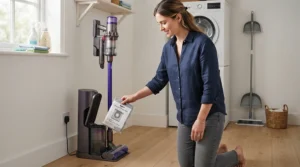
Dock size vs storage is really two questions: how much floor space does the dock claim, and how many weeks of dirt does it swallow?
On footprint, listings give the Shark RV2820VEUK dimensions of around 35 x 34 x 46 cm, with a 6.7 kg base. Roborock’s Q Revo dock is around 34 x 49 x 56 cm, and the Qrevo Curv dock is roughly a 45 cm cube at about 8.9 kg. Combo docks with water tanks are bigger still.
On storage, claims cluster around 45-60 days. Real life is shorter in homes with pets, long hair or heavy carpet shedding. Treat the headline number as a ceiling.
Placement matters as much as size. Docks need clear space beside and in front for the robot to approach. One long-term review reported docking problems when the Curv dock sat on carpet, so a hard-floor spot is safer. And remember the robot’s own height: the eufy Omni C20 is about 8.5 cm tall, while taller LiDAR models may not clear low furniture. Measure twice, buy once.
How to Choose Between a Self-Emptying Base vs Manual Emptying Robot Vacuum
Here is a decision framework in seven steps.
- Count your weekly runs. Three or more runs a week favours a dock. Fewer, and manual wins.
- Check your pets and hair. Heavy shedding fills bins fast, so a dock saves real effort.
- Measure the dock spot. You need a clear, ideally hard-floor wall space for the dock and the robot’s approach.
- Measure your furniture gaps. Low sofas favour slim robots like the eufy Omni C20.
- Pick your consumable. Bags are cheap but recurring. Bagless bases avoid bags but may need cartridges.
- Decide on mopping. Only pay for a washing dock if you will genuinely use it.
- Set a total budget. Include three years of bags, not just the sticker price.
If your answers split evenly, remember the sensible rule: a better robot with a basic dock beats a worse robot with a fancy one.
Real-World Scenarios: Which Setup Fits Which Home?
Scenario 1: The two-dog family in a three-bed semi. Cleaning runs daily, hair is relentless and carpets cover the stairs landing. A bagged dock like the Roomba Combo j5+ keeps dust sealed and costs little to run. Budget: around £500.
Scenario 2: The one-bed flat with hard floors. The robot runs twice a week and storage is tight. A manual robot saves money and wall space. If you want mopping too, the Shark RV2620WAUK keeps things simple. Budget: under £500.
Scenario 3: The busy household with toys everywhere. Obstacles, mess and a crowded hallway call for the eufy X10 Pro Omni, where obstacle recognition and a two-month bag interval reduce babysitting. Budget: around £600.
The pattern is simple. High frequency plus mess equals dock. Low frequency plus space pressure equals manual.
Practical Usage Guide: Setup, Maintenance and Mistakes to Avoid
Setup. Place the dock on a hard floor against a wall, leaving clear space either side and in front. Keep it away from cables and dark rugs that confuse sensors. Run a first mapping pass with the doors open.
Weekly. Check the robot’s brush for hair and clean the dock contacts. Wash the filter if your model calls for it. iRobot’s i3+ materials, for instance, mention weekly filter cleaning.
Monthly. Inspect the dock intake for clogs, empty the clean-water tank, and wipe the mop tray on combo models.
Every 6-9 weeks. Replace the bag, or empty the canister on bagless models.
Common mistakes in the first 30 days:
- Ignoring the full-bag alert.
- Leaving mop pads damp in a closed dock.
- Placing the dock beside a dark rug that confuses sensors.
- Buying unverified bags that don’t seal.
- Forgetting to register the warranty. Shark’s guarantee, for example, requires registration within 28 days.
FAQ
❓ Can I add a self-emptying base to a robot vacuum I already own?
❓ Are third-party bags safe for a self-emptying dock?
❓ How noisy is the self-emptying cycle?
❓ Does a self-emptying base help with allergies?
❓ Is a bagless self-emptying base cheaper to run?
Conclusion
The self-emptying base vs manual emptying robot vacuum decision isn’t about technology. It’s about frequency, space and temperament. A dock turns a robot from a gadget you tend into a service you forget, and for pet owners, families and daily-schedule households that’s worth paying for. For occasional cleaners in small flats, a manual robot is cheaper, smaller and simpler.
If you go docked, remember the arithmetic: a typical premium of £150-£250 plus roughly £25-£50 a year in bags, which comes to well under a pound per avoided emptying. Pick bagless like the Shark RV2820VEUK if bags annoy you, bagged like the Roomba Combo j5+ for carpets, and an all-in-one like the eufy X10 Pro Omni or Roborock Q Revo if you want mopping handled too. If you’re truly torn, buy the better robot and settle for the simpler dock.
✨ Ready to make your floors someone else’s job?
🔍 Click through to check current prices and availability on the picks above, and choose the setup that matches your home. 🧹
Recommended for You
- Quietest Self-Emptying Robot Vacuum Base: 7 Best UK Picks (2026)
- Self-Emptying Robot Vacuum Base For Large Homes: 7 Best Buys (2026)
- Robot Vacuum Base For Pet Hair: 7 Best Hassle-Free Picks (2026)
Disclaimer: This article contains affiliate links. As an Amazon Associate, I earn from qualifying purchases. If you purchase products through these links, we may earn a small commission at no additional cost to you.
✨ Found this helpful? Share it with your friends! 💬🤗
